QUESTION IMAGE
Question
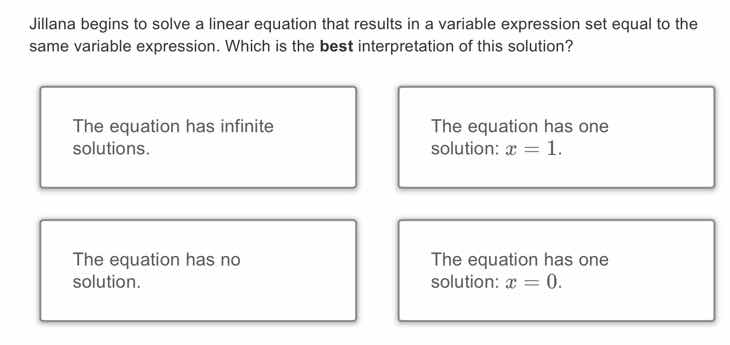
jillana begins to solve a linear equation that results in a variable expression set equal to the same variable expression. which is the best interpretation of this solution?
the equation has infinite solutions.
the equation has one solution: ( x = 1 ).
the equation has no solution.
the equation has one solution: ( x = 0 ).
In linear equations, if we end up with a statement like \( a x + b = a x + b \) (a variable expression equal to the same variable expression), this is an identity. Identities are true for all values of the variable, meaning there are infinite solutions. For example, \( 2x + 3 = 2x + 3 \) is true for any \( x \), so it has infinitely many solutions. The other options are incorrect: "no solution" occurs when we get a false statement (like \( 0 = 5 \)), and a single solution (like \( x = 1 \) or \( x = 0 \)) occurs when we can solve for a unique \( x \), which isn't the case here.

Snap & solve any problem in the app
Get step-by-step solutions on Sovi AI
Photo-based solutions with guided steps
Explore more problems and detailed explanations
The equation has infinite solutions.