QUESTION IMAGE
Question
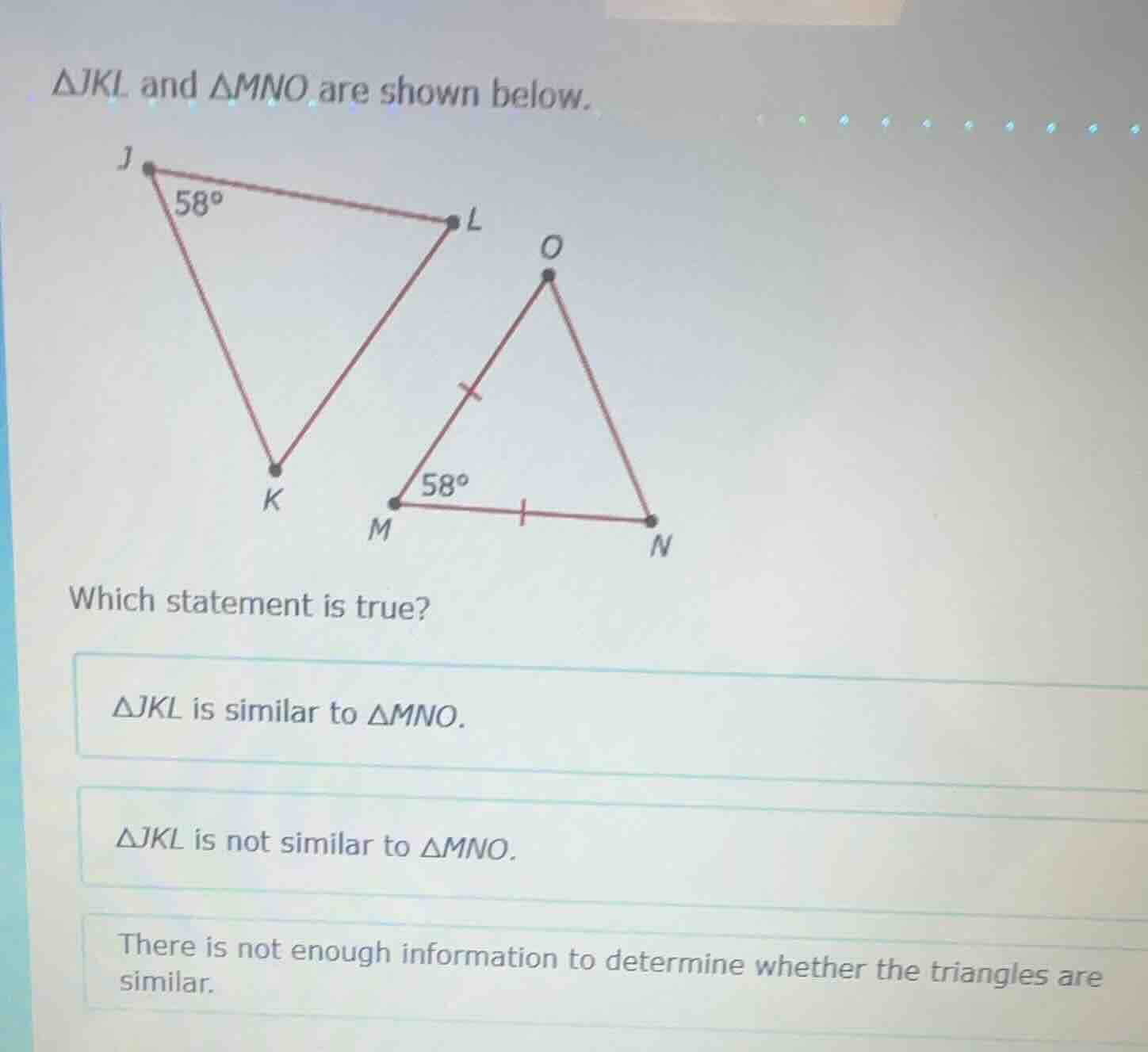
△jkl and △mno are shown below.
which statement is true?
△jkl is similar to △mno.
△jkl is not similar to △mno.
there is not enough information to determine whether the triangles are similar.
Step1: Analyze triangle \( \triangle MNO \)
In \( \triangle MNO \), two sides are marked as equal (isosceles triangle), so the base angles are equal. Let \( \angle M = 58^\circ \), then \( \angle N=\angle M = 58^\circ \) (isosceles triangle property: angles opposite equal sides are equal). Then \( \angle O=180^\circ - 58^\circ - 58^\circ=64^\circ \) (angle sum of triangle is \( 180^\circ \)).
Step2: Analyze triangle \( \triangle JKL \)
We know \( \angle J = 58^\circ \), but we don't know the other angles or side relationships. For similarity, we need AA (Angle - Angle) criterion (if two angles of one triangle are equal to two angles of another triangle, they are similar). In \( \triangle JKL \), we only know one angle (\( 58^\circ \)), and in \( \triangle MNO \), we have angles \( 58^\circ, 58^\circ, 64^\circ \). We don't have enough information to confirm two angles are equal between the triangles. Wait, no—wait, the first triangle \( \triangle JKL \): is it isosceles? The diagram doesn't show equal sides. Wait, maybe I made a mistake. Wait, the problem: let's re - check. The second triangle \( \triangle MNO \) has two equal sides (marked), so it's isosceles with \( \angle M=\angle N = 58^\circ \). The first triangle \( \triangle JKL \) has \( \angle J = 58^\circ \), but we don't know if it's isosceles or not. Wait, no—wait, maybe the key is: do we have enough info? Wait, no, wait. Wait, the statement "There is not enough information to determine whether the triangles are similar." Wait, no, wait. Wait, maybe I messed up. Wait, let's think again. For triangle similarity, AA requires two angles. In \( \triangle MNO \), angles are \( 58^\circ, 58^\circ, 64^\circ \). In \( \triangle JKL \), we know \( \angle J = 58^\circ \), but we don't know the other angles. So we can't say that two angles are equal. So we don't have enough information to determine similarity. Wait, but wait, maybe the first triangle is also isosceles? The diagram of \( \triangle JKL \) doesn't have equal side marks. So we can't assume that. So the correct statement is "There is not enough information to determine whether the triangles are similar." Wait, no, wait—wait, the options:
- \( \triangle JKL \) is similar to \( \triangle MNO \): To be similar, we need AA. We know \( \angle J = 58^\circ \), and in \( \triangle MNO \), \( \angle M=\angle N = 58^\circ \). But we don't know if \( \angle K \) or \( \angle L \) is equal to another angle in \( \triangle MNO \).
- \( \triangle JKL \) is not similar to \( \triangle MNO \): We can't be sure of that either, because we don't know all angles of \( \triangle JKL \).
- There is not enough information to determine whether the triangles are similar: This is correct because we only know one angle of \( \triangle JKL \) and the angles of \( \triangle MNO \), but we don't have enough angle - angle correspondence to confirm similarity or non - similarity.
Wait, no, wait a second. Wait, maybe I made a mistake. Let's re - examine the diagram. The first triangle \( \triangle JKL \): sides \( JK \) and \( KL \) – no, the diagram: \( J \) connected to \( L \) and \( K \), \( K \) connected to \( L \). The second triangle \( M \) connected to \( O \) and \( N \), \( O \) connected to \( N \), with \( MN \) and \( MO \) equal (marked). So \( \triangle MNO \) is isosceles with \( MN = MO \), so \( \angle N=\angle O \)? Wait, no! Wait, in a triangle, equal sides are opposite equal angles. If \( MN = MO \), then the angles opposite them are \( \angle O \) and \( \angle N \) respectively. So \( \angle O=\angle N \). Wait, I…

Snap & solve any problem in the app
Get step-by-step solutions on Sovi AI
Photo-based solutions with guided steps
Explore more problems and detailed explanations
There is not enough information to determine whether the triangles are similar.