QUESTION IMAGE
Question
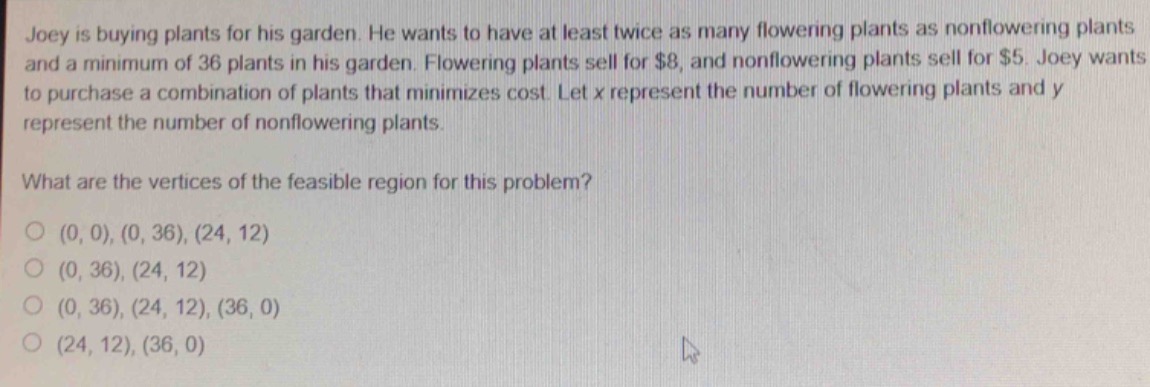
joey is buying plants for his garden. he wants to have at least twice as many flowering plants as nonflowering plants and a minimum of 36 plants in his garden. flowering plants sell for $8, and nonflowering plants sell for $5. joey wants to purchase a combination of plants that minimizes cost. let x represent the number of flowering plants and y represent the number of nonflowering plants. what are the vertices of the feasible region for this problem? ○ (0, 0), (0, 36), (24, 12) ○ (0, 36), (24, 12) ○ (0, 36), (24, 12), (36, 0) ○ (24, 12), (36, 0)
Step1: Define constraints
First, translate the problem into inequalities:
- At least twice as many flowering plants: $x \geq 2y$
- Minimum 36 total plants: $x + y \geq 36$
- Non-negative plant counts: $x \geq 0$, $y \geq 0$
Step2: Find intersection of $x=2y$ and $x+y=36$
Substitute $x=2y$ into $x+y=36$:
$$2y + y = 36$$
$$3y = 36 \implies y=12$$
Then $x=2(12)=24$. This gives the point $(24, 12)$.
Step3: Find intercepts of $x+y=36$
- When $y=0$: $x=36$, so point $(36, 0)$
- When $x=0$: $y=36$, so point $(0, 36)$
Step4: Eliminate invalid points
The point $(0,0)$ violates $x+y \geq 36$, so it is not in the feasible region.

Snap & solve any problem in the app
Get step-by-step solutions on Sovi AI
Photo-based solutions with guided steps
Explore more problems and detailed explanations
(0, 36), (24, 12), (36, 0)