QUESTION IMAGE
Question
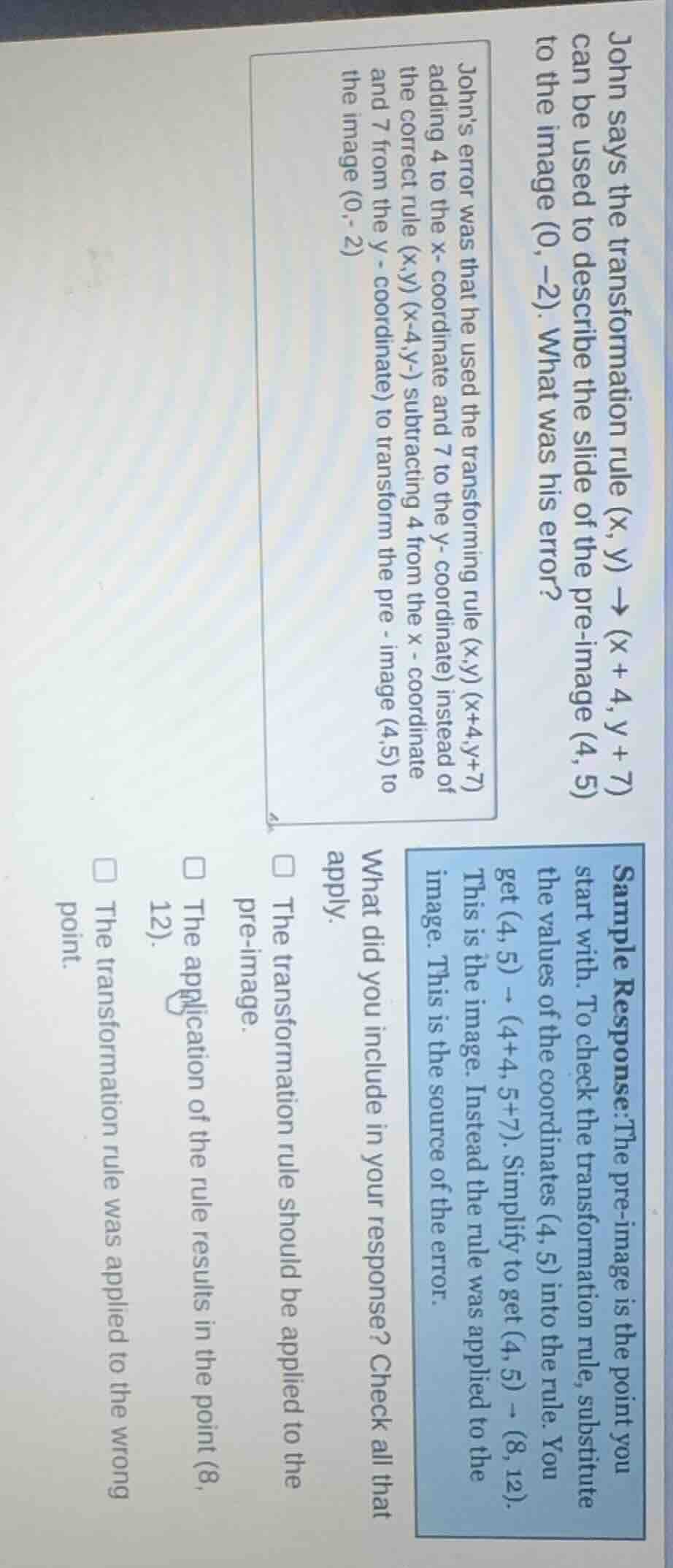
john says the transformation rule (x, y) → (x + 4, y + 7) can be used to describe the slide of the pre - image (4, 5) to the image (0, −2). what was his error?
johns error was that he used the transforming rule (x,y)→(x + 4,y + 7) adding 4 to the x - coordinate and 7 to the y - coordinate) instead of the correct rule (x,y)→(x - 4,y - 7) subtracting 4 from the x - coordinate and 7 from the y - coordinate) to transform the pre - image (4,5) to the image (0, - 2)
sample response:the pre - image is the point you start with. to check the transformation rule, substitute the values of the coordinates (4,5) into the rule. you get (4,5) → (4 + 4,5 + 7). simplify to get (4,5) → (8, 12). this is the image. instead the rule was applied to the image. this is the source of the error.
what did you include in your response? check all that apply.
□ the transformation rule should be applied to the pre - image.
□ the application of the rule results in the point (8, 12).
□ the transformation rule was applied to the wrong point.
For the first part (John's error):
Step1: Identify pre - image and rule
The pre - image is \((4,5)\) and the transformation rule John used is \((x,y)\to(x + 4,y + 7)\), but the image is \((0,-2)\). Let's assume the correct rule should be \((x,y)\to(x - a,y - b)\) or a misapplication of addition/subtraction.
Step2: Analyze the x - coordinate
For the x - coordinate: \(4+a = 0\) (if it was a subtraction error) or \(4 - a=0\). Solving \(4 - a = 0\) gives \(a = 4\). For the y - coordinate: \(5 + b=-2\) or \(5 - b=-2\). Solving \(5 - b=-2\) gives \(b = 7\). So John used addition (\(x + 4,y + 7\)) instead of subtraction (\(x-4,y - 7\)) to get from \((4,5)\) to \((0,-2)\).
- "The transformation rule was applied to the wrong point": This is correct because John should have applied the rule to the pre - image \((4,5)\) but his result shows he applied it incorrectly (or to a different point conceptually).
- "The application of the rule results in the point \((8,12)\)": When we apply \((x + 4,y + 7)\) to \((4,5)\), we get \(x=4 + 4=8\) and \(y = 5+7 = 12\), so this is a key part of showing the error (he got \((0,-2)\) instead of \((8,12)\)).
- "The transformation rule should be applied to the pre - image": This is correct as the rule is for transforming the pre - image to the image, so we need to apply it to the pre - image \((4,5)\).

Snap & solve any problem in the app
Get step-by-step solutions on Sovi AI
Photo-based solutions with guided steps
Explore more problems and detailed explanations
John used the transformation rule \((x,y)\to(x + 4,y + 7)\) (adding 4 to the x - coordinate and 7 to the y - coordinate) instead of the correct rule \((x,y)\to(x - 4,y - 7)\) (subtracting 4 from the x - coordinate and 7 from the y - coordinate) to transform the pre - image \((4,5)\) to the image \((0,-2)\).