QUESTION IMAGE
Question
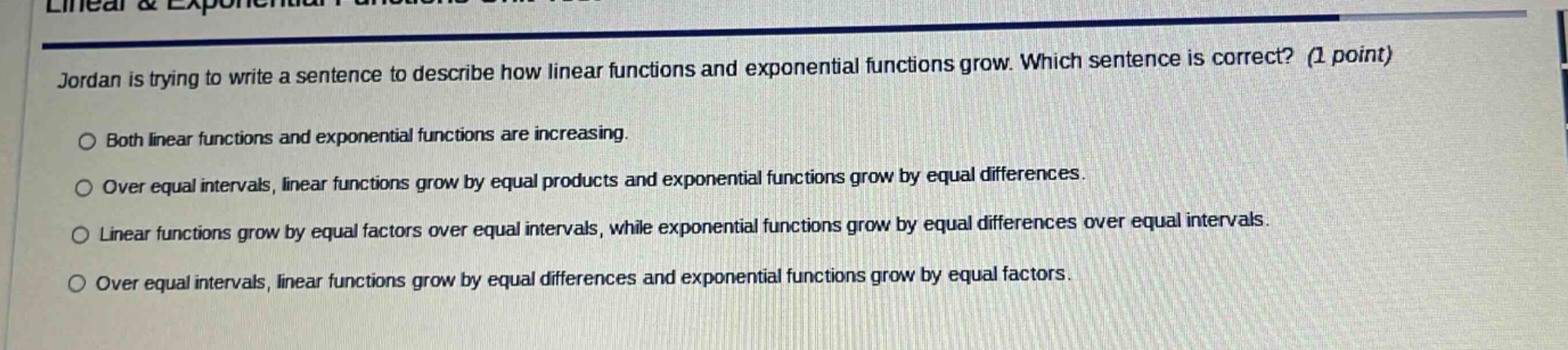
jordan is trying to write a sentence to describe how linear functions and exponential functions grow. which sentence is correct? (1 point)
both linear functions and exponential functions are increasing.
over equal intervals, linear functions grow by equal products and exponential functions grow by equal differences.
linear functions grow by equal factors over equal intervals, while exponential functions grow by equal differences over equal intervals.
over equal intervals, linear functions grow by equal differences and exponential functions grow by equal factors.
- Analyze the first option: Linear functions can be decreasing (e.g., \( y = -2x + 3 \)) and exponential functions can be decreasing (e.g., \( y = 0.5^x \)), so this is incorrect.
- Analyze the second option: Linear functions grow by equal differences (not products) over equal intervals, and exponential functions grow by equal factors (not differences), so this is incorrect.
- Analyze the third option: Linear functions grow by equal differences (not factors) over equal intervals, and exponential functions grow by equal factors (not differences), so this is incorrect.
- Analyze the fourth option: By definition, a linear function \( y = mx + b \) has a constant rate of change \( m \), so over equal intervals \( \Delta x \), the change in \( y \) ( \( \Delta y = m\Delta x \)) is constant (equal differences). An exponential function \( y = a(b)^x \) has a constant ratio between consecutive \( y \)-values over equal \( x \)-intervals (equal factors, since \( \frac{y(x + 1)}{y(x)}=b \)). So this option is correct.

Snap & solve any problem in the app
Get step-by-step solutions on Sovi AI
Photo-based solutions with guided steps
Explore more problems and detailed explanations
D. Over equal intervals, linear functions grow by equal differences and exponential functions grow by equal factors.