QUESTION IMAGE
Question
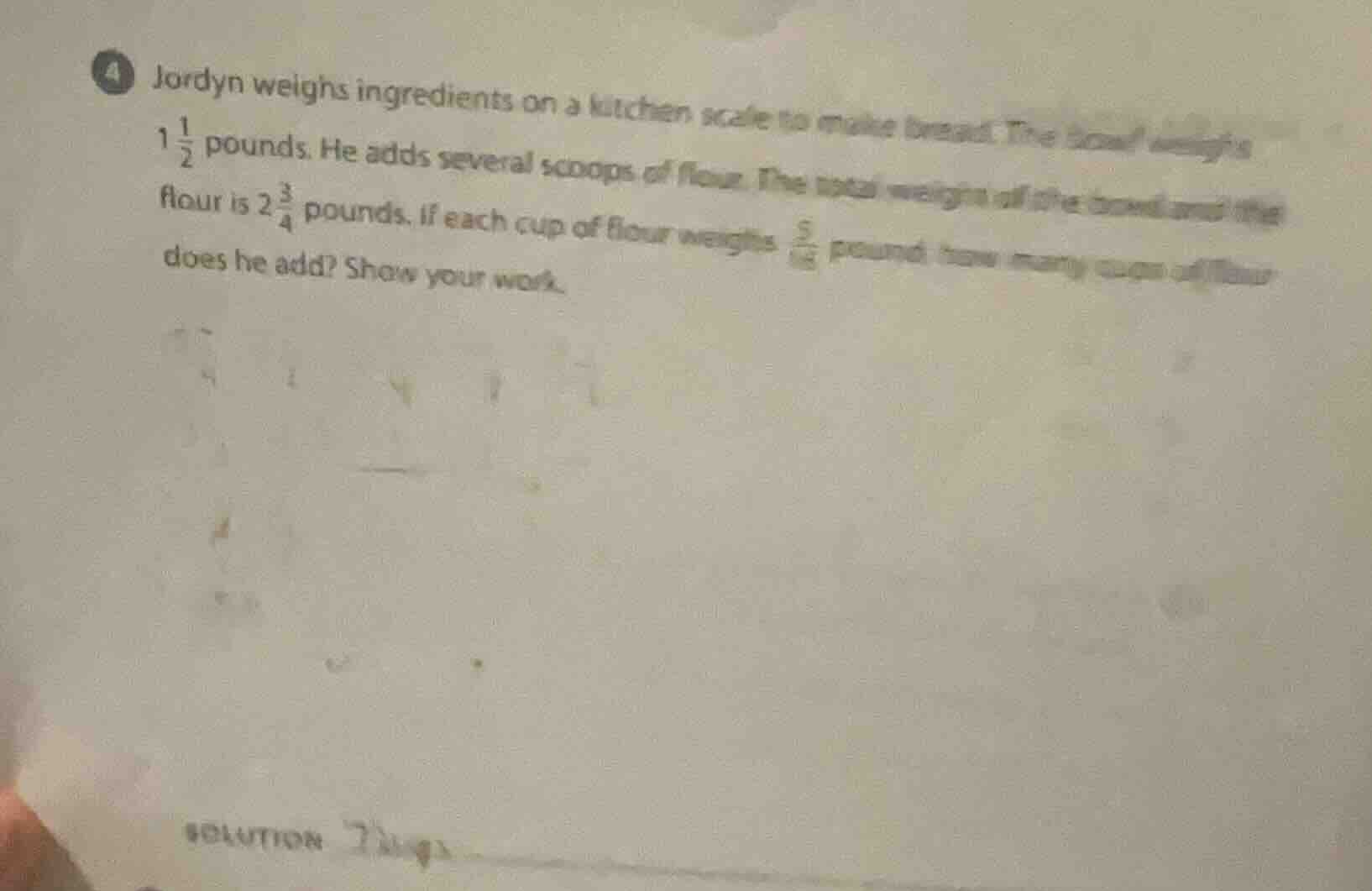
jordyn weighs ingredients on a kitchen scale to make bread. the bowl weighs $1\frac{1}{2}$ pounds. he adds several scoops of flour. the total weight of the bowl and the flour is $2\frac{3}{4}$ pounds. if each cup of flour weighs $\frac{5}{16}$ pound, how many cups of flour does he add? show your work.
Step1: Find the weight of flour added
First, we need to find the weight of the flour alone. The total weight of the bowl and flour is \(2\frac{3}{4}\) pounds, and the bowl weighs \(1\frac{1}{2}\) pounds. So we subtract the weight of the bowl from the total weight:
\(2\frac{3}{4}-1\frac{1}{2}\)
Convert mixed numbers to improper fractions: \(2\frac{3}{4}=\frac{11}{4}\), \(1\frac{1}{2}=\frac{3}{2}=\frac{6}{4}\)
Then \(\frac{11}{4}-\frac{6}{4}=\frac{5}{4}\) pounds. This is the weight of the flour.
Step2: Calculate the number of cups of flour
Each cup of flour weighs \(\frac{5}{16}\) pound. To find the number of cups, we divide the total weight of flour by the weight per cup:
\(\frac{5}{4}\div\frac{5}{16}\)
Dividing by a fraction is multiplying by its reciprocal: \(\frac{5}{4}\times\frac{16}{5}\)
Simplify: The 5s cancel out, and \(\frac{16}{4} = 4\). Wait, that seems wrong. Wait, no, let's recalculate. Wait, \(\frac{5}{4}\div\frac{5}{16}=\frac{5}{4}\times\frac{16}{5}=\frac{5\times16}{4\times5}=\frac{16}{4}=4\)? Wait, no, wait the total weight of flour: wait, \(2\frac{3}{4}-1\frac{1}{2}\): \(2\frac{3}{4}\) is \(2.75\), \(1\frac{1}{2}\) is \(1.5\), so \(2.75 - 1.5 = 1.25\) pounds, which is \(\frac{5}{4}\) pounds (since \(1.25=\frac{5}{4}\)). Then each cup is \(\frac{5}{16}\) pounds. So number of cups is \(\frac{5}{4}\div\frac{5}{16}=\frac{5}{4}\times\frac{16}{5}=\frac{16}{4}=4\)? Wait, but let's check again. Wait, maybe I made a mistake in the total weight. Wait, the problem says "the total weight of the bowl and the flour is \(2\frac{3}{4}\) pounds", and the bowl is \(1\frac{1}{2}\) pounds. So flour weight is \(2\frac{3}{4}-1\frac{1}{2}\). Let's do it as decimals: \(2.75 - 1.5 = 1.25\) pounds. Each cup is \(\frac{5}{16}\) pounds, which is \(0.3125\) pounds. Then \(1.25\div0.3125 = 4\). Wait, but that seems low. Wait, maybe I misread the problem. Wait, the problem says "each cup of flour weighs \(\frac{5}{16}\) pound"? Wait, \(\frac{5}{16}\) is about 0.3125 pounds per cup. Then 1.25 pounds of flour would be 1.25 / 0.3125 = 4 cups. Wait, but let's check the fractions again. \(\frac{5}{4}\) divided by \(\frac{5}{16}\): \(\frac{5}{4}\times\frac{16}{5}\). The 5s cancel, 16 divided by 4 is 4. So yes, 4 cups. Wait, but maybe the problem had a typo? Wait, no, let's check the original problem again. Wait, the total weight of the bowl and flour is \(2\frac{3}{4}\) pounds, bowl is \(1\frac{1}{2}\) pounds, so flour is \(2\frac{3}{4}-1\frac{1}{2}=1\frac{1}{4}\) pounds, which is \(\frac{5}{4}\) pounds. Each cup is \(\frac{5}{16}\) pounds. So \(\frac{5}{4}\div\frac{5}{16}=\frac{5}{4}\times\frac{16}{5}=4\). So the number of cups is 4. Wait, but maybe I made a mistake in subtraction. Let's check: \(2\frac{3}{4}\) is \(2 + \frac{3}{4}\), \(1\frac{1}{2}\) is \(1 + \frac{2}{4}\). So subtracting: \(2 - 1 = 1\), \(\frac{3}{4}-\frac{2}{4}=\frac{1}{4}\), so total is \(1\frac{1}{4}\) pounds, which is \(\frac{5}{4}\) pounds. Correct. Then dividing by \(\frac{5}{16}\): \(\frac{5}{4}\times\frac{16}{5}=4\). So the answer is 4.

Snap & solve any problem in the app
Get step-by-step solutions on Sovi AI
Photo-based solutions with guided steps
Explore more problems and detailed explanations
4