QUESTION IMAGE
Question
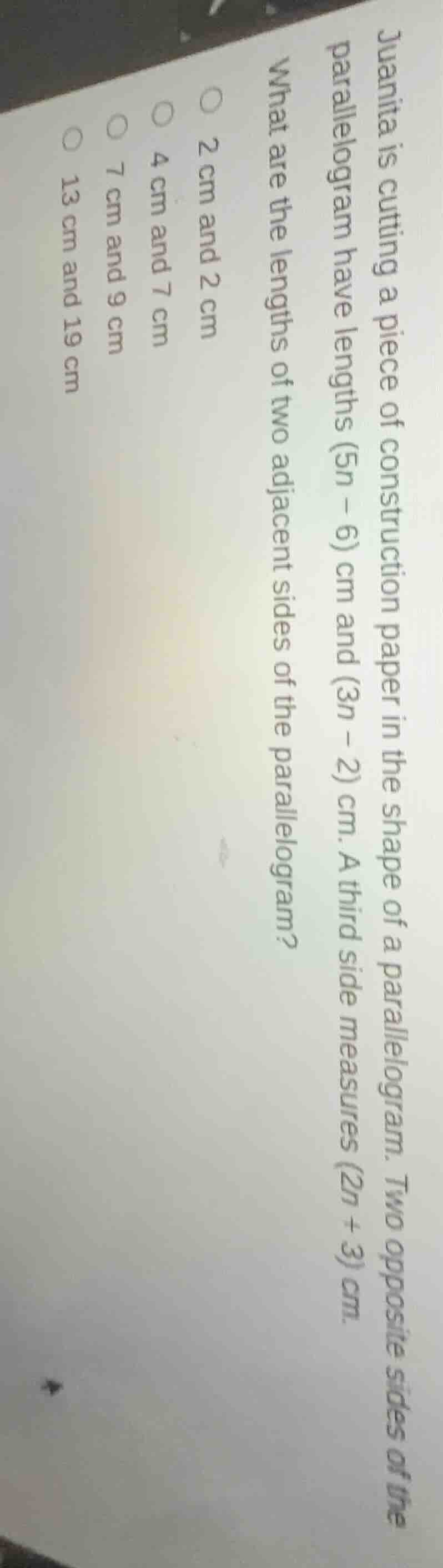
juanita is cutting a piece of construction paper in the shape of a parallelogram. two opposite sides of the parallelogram have lengths (5n - 6) cm and (3n - 2) cm. a third side measures (2n + 3) cm. what are the lengths of two adjacent sides of the parallelogram? 2 cm and 2 cm 4 cm and 7 cm 7 cm and 9 cm 13 cm and 19 cm
Step1: Recall parallelogram property
In a parallelogram, opposite sides are equal. So we have two pairs of equal sides. Let's assume the sides are \(5n - 6\), \(3n - 2\), and \(2n + 3\). Since opposite sides are equal, we can set \(5n - 6 = 2n + 3\) (assuming these are opposite sides) or \(3n - 2 = 2n + 3\). Let's try \(3n - 2 = 2n + 3\) first.
Step2: Solve for n (first equation)
\(3n - 2 = 2n + 3\)
Subtract \(2n\) from both sides: \(3n - 2n - 2 = 2n - 2n + 3\)
Simplify: \(n - 2 = 3\)
Add 2 to both sides: \(n = 3 + 2 = 5\). Wait, but let's check with the other equation. Now try \(5n - 6 = 2n + 3\)
Step3: Solve for n (second equation)
\(5n - 6 = 2n + 3\)
Subtract \(2n\) from both sides: \(5n - 2n - 6 = 2n - 2n + 3\)
Simplify: \(3n - 6 = 3\)
Add 6 to both sides: \(3n = 3 + 6 = 9\)
Divide by 3: \(n = \frac{9}{3} = 3\)
Step4: Calculate side lengths
Now, substitute \(n = 3\) into the expressions:
- \(5n - 6 = 5(3) - 6 = 15 - 6 = 9\)
- \(3n - 2 = 3(3) - 2 = 9 - 2 = 7\)
- \(2n + 3 = 2(3) + 3 = 6 + 3 = 9\) (Wait, no, maybe I mixed up. Wait, the problem says two opposite sides are \(5n - 6\) and \(3n - 2\) is another, and \(2n + 3\) is the third. Wait, no, in a parallelogram, there are two pairs of equal sides. So let's correct. Let's say the sides are \(5n - 6\), \(3n - 2\), \(5n - 6\), \(3n - 2\) (since opposite sides are equal). But the problem mentions a third side \(2n + 3\), which must be equal to one of the other sides. So either \(5n - 6 = 2n + 3\) or \(3n - 2 = 2n + 3\). We saw \(n = 3\) from \(5n - 6 = 2n + 3\) gives \(5(3)-6 = 9\), \(2(3)+3 = 9\), so those are equal. Then the other side is \(3n - 2 = 3(3)-2 = 7\). So the sides are 9, 7, 9, 7? Wait, but the options are 2 and 2, 4 and 7, 7 and 9, 13 and 19. Wait, maybe I made a mistake. Let's try \(3n - 2 = 2n + 3\) gives \(n = 5\). Then \(5n - 6 = 5(5)-6 = 19\), \(3n - 2 = 13\), \(2n + 3 = 13\). Then sides are 19,13,19,13. But that's an option (13 and 19). Wait, but the problem says "two opposite sides of the parallelogram have lengths \((5n - 6)\) cm and \((3n - 2)\) cm. A third side measures \((2n + 3)\) cm." Wait, no, in a parallelogram, there are four sides: two pairs of equal sides. So if two opposite sides are \(5n - 6\) and \(3n - 2\), that can't be, because opposite sides must be equal. So actually, the two opposite sides are \(5n - 6\) and \(2n + 3\) (since they are equal), and the other two opposite sides are \(3n - 2\) and \(2n + 3\)? No, that's not right. Wait, correct property: In a parallelogram, opposite sides are congruent. So we have two pairs: let's say side 1 = side 3, side 2 = side 4. So if the sides are \(5n - 6\), \(3n - 2\), \(5n - 6\), \(3n - 2\), but there's a third side \(2n + 3\), which must be equal to either \(5n - 6\) or \(3n - 2\). So case 1: \(5n - 6 = 2n + 3\)
\(5n - 2n = 3 + 6\)
\(3n = 9\)
\(n = 3\)
Then \(5n - 6 = 9\), \(3n - 2 = 7\), \(2n + 3 = 9\). So the sides are 9,7,9,7. So adjacent sides are 7 and 9. Case 2: \(3n - 2 = 2n + 3\)
\(n = 5\)
Then \(5n - 6 = 19\), \(3n - 2 = 13\), \(2n + 3 = 13\). So sides are 19,13,19,13. Adjacent sides 13 and 19. Now check the options. The options are 2 and 2, 4 and 7, 7 and 9, 13 and 19. So both 7 and 9 (when n=3) and 13 and 19 (when n=5) are options. Wait, but let's check if the side lengths are positive. For n=3: \(5n -6 = 9\) (positive), \(3n -2 =7\) (positive), \(2n +3 =9\) (positive). For n=5: \(5n -6 =19\), \(3n -2 =13\), \(2n +3 =13\) (all positive). But the problem says "cutting a piece of construction paper", so maybe smaller lengths. Wait, maybe I misread the problem. Wait, the problem say…

Snap & solve any problem in the app
Get step-by-step solutions on Sovi AI
Photo-based solutions with guided steps
Explore more problems and detailed explanations
4 cm and 7 cm (Option B)