QUESTION IMAGE
Question
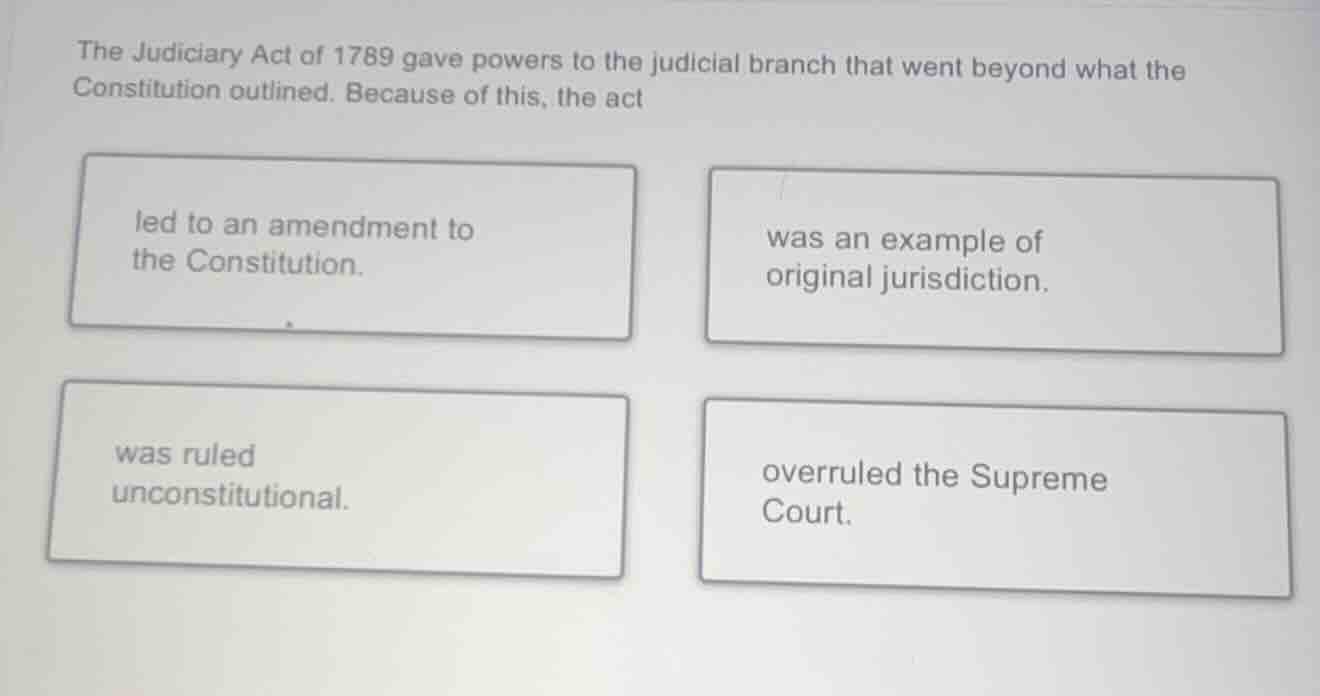
the judiciary act of 1789 gave powers to the judicial branch that went beyond what the constitution outlined. because of this, the act
led to an amendment to
the constitution.
was an example of
original jurisdiction.
was ruled
unconstitutional.
overruled the supreme
court.
Brief Explanations
- Analyze each option:
- Option 1: The Judiciary Act of 1789 didn't lead to a constitutional amendment directly due to its over - reaching powers in this context.
- Option 2: Original jurisdiction refers to the court's authority to hear a case first, which is not related to the act's over - reaching powers.
- Option 3: The Judiciary Act of 1789 (specifically parts of it, like the Judiciary Act of 1801 was related, but in general, when a law gives powers beyond the Constitution, it can be ruled unconstitutional. The principle of judicial review allows the courts to declare laws unconstitutional if they conflict with the Constitution. The Judiciary Act of 1789's parts that were beyond the Constitution's outline could be ruled unconstitutional.
- Option 4: An act cannot overrule the Supreme Court; rather, the Supreme Court can rule on the constitutionality of an act.

Snap & solve any problem in the app
Get step-by-step solutions on Sovi AI
Photo-based solutions with guided steps
Explore more problems and detailed explanations
was ruled unconstitutional.