QUESTION IMAGE
Question
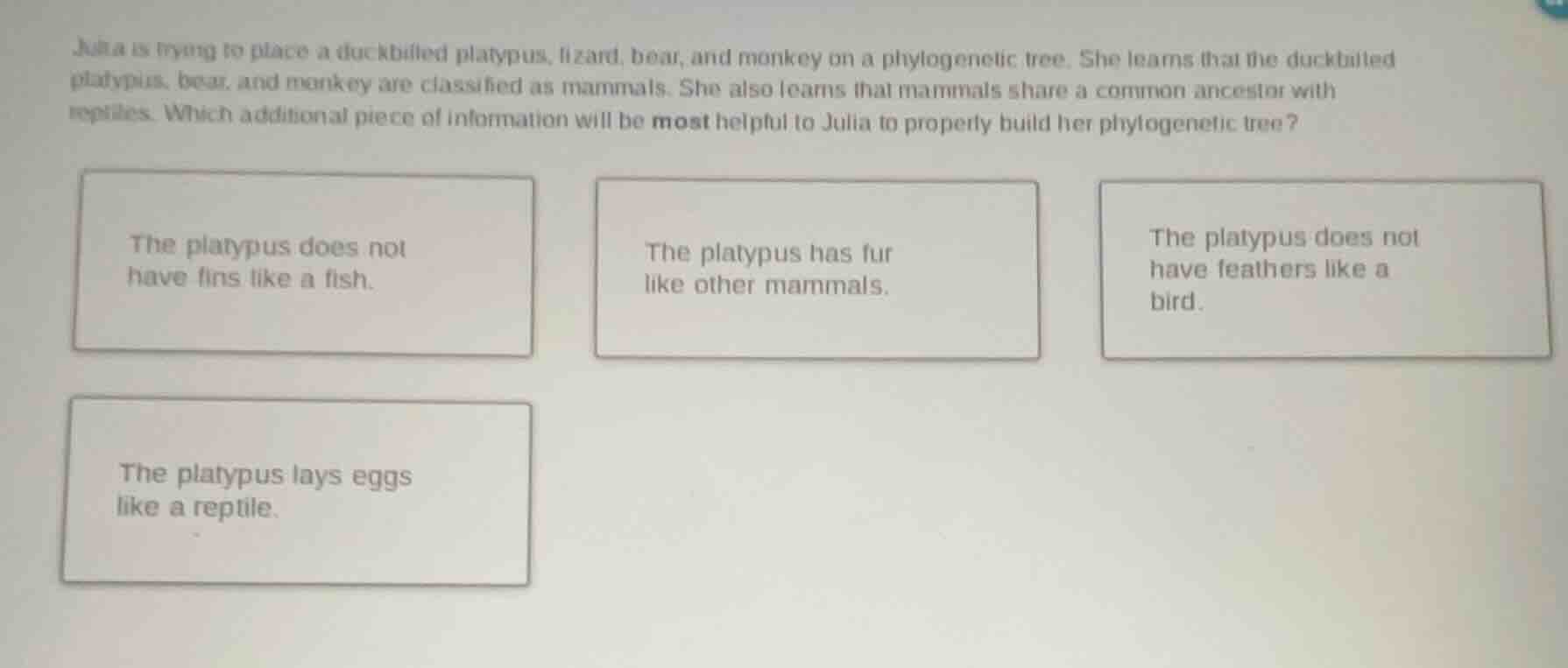
julia is trying to place a duckbilled platypus, lizard, bear, and monkey on a phylogenetic tree. she learns that the duckbilled platypus, bear, and monkey are classified as mammals. she also learns that mammals share a common ancestor with reptiles. which additional piece of information will be most helpful to julia to properly build her phylogenetic tree? the platypus does not have fins like a fish. the platypus has fur like other mammals. the platypus does not have feathers like a bird. the platypus lays eggs like a reptile.
To build a phylogenetic tree, we need information about shared characteristics (homologies) that reflect evolutionary relationships. The duck - billed platypus is a mammal, but mammals share a common ancestor with reptiles. The fact that the platypus lays eggs like a reptile is a key shared characteristic (a plesiomorphy or a trait that links mammals to their reptilian ancestors).
- The option “The platypus does not have fins like a fish” is not relevant as fins are not a trait related to the reptile - mammal evolutionary link.
- “The platypus has fur like other mammals” is a derived trait of mammals and does not help in showing the connection to reptiles.
- “The platypus does not have feathers like a bird” is also not relevant as feathers are a bird - specific trait and not related to the reptile - mammal relationship.
So, the information that the platypus lays eggs like a reptile is the most helpful as it shows a shared trait between mammals (platypus) and reptiles, which is crucial for constructing the phylogenetic tree based on evolutionary relationships.

Snap & solve any problem in the app
Get step-by-step solutions on Sovi AI
Photo-based solutions with guided steps
Explore more problems and detailed explanations
The platypus lays eggs like a reptile.