QUESTION IMAGE
Question
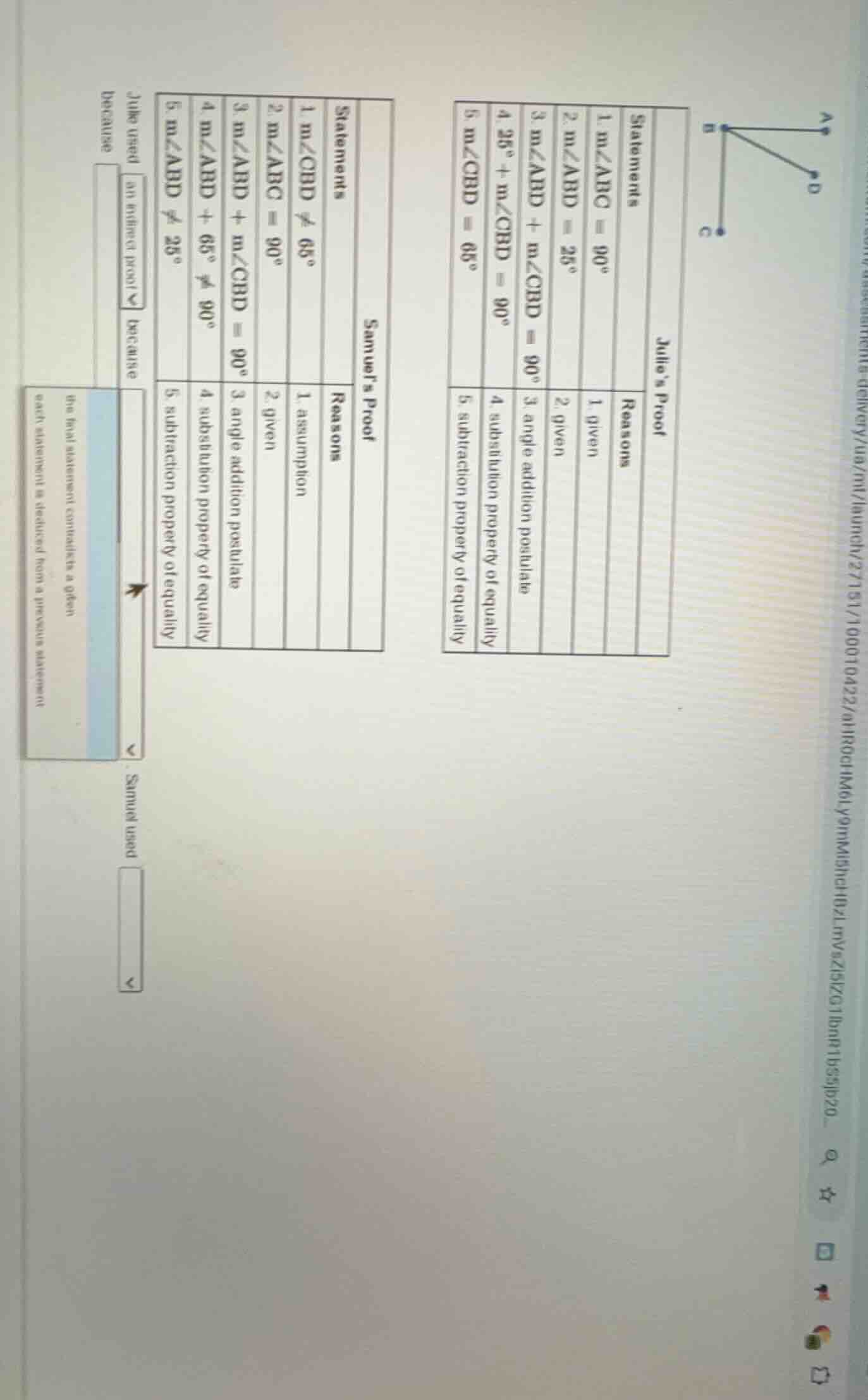
julie’s proof statements 1. ( mangle abc = 90^circ ) 2. ( mangle abd = 25^circ ) 3. ( mangle abd + mangle cbd = 90^circ ) 4. ( 25^circ + mangle cbd = 90^circ ) 5. ( mangle cbd = 65^circ ) reasons 1. given 2. given 3. angle addition postulate 4. substitution property of equality 5. subtraction property of equality samuel’s proof statements 1. ( mangle cbd
eq 65^circ ) 2. ( mangle abc = 90^circ ) 3. ( mangle abd + mangle cbd = 90^circ ) 4. ( mangle abd + 65^circ
eq 90^circ ) 5. ( mangle abd
eq 25^circ ) reasons 1. assumption 2. given 3. angle addition postulate 4. substitution property of equality 5. subtraction property of equality julie used an indirect proof because the final statement contradicts a given statement. samuel used
To determine the proof method Samuel used, we analyze his proof structure:
- Step 1 (Assumption): Samuel starts by assuming \( m\angle CBD
eq 65^\circ \) (the opposite of what he wants to prove).
- Step 2 (Given): He uses the given \( m\angle ABC = 90^\circ \).
- Step 3 (Angle Addition Postulate): Applies \( m\angle ABD + m\angle CBD = 90^\circ \) (from the angle addition postulate, as \( \angle ABC \) is composed of \( \angle ABD \) and \( \angle CBD \)).
- Step 4 (Substitution): Substitutes \( m\angle ABD = 25^\circ \) (implied or given) into the equation, leading to \( 25^\circ + m\angle CBD = 90^\circ \).
- Step 5 (Subtraction Property): Solves for \( m\angle CBD \), finding \( m\angle CBD = 65^\circ \), which contradicts his initial assumption (\( m\angle CBD
eq 65^\circ \)).
This process—assuming the opposite of the conclusion, deriving a contradiction, and thus proving the original statement—is the indirect proof (proof by contradiction) method.
Samuel’s proof assumes the opposite of the desired conclusion (\( m\angle CBD
eq 65^\circ \)), then derives a contradiction (showing \( m\angle CBD = 65^\circ \) instead), which is the structure of an indirect proof (proof by contradiction).

Snap & solve any problem in the app
Get step-by-step solutions on Sovi AI
Photo-based solutions with guided steps
Explore more problems and detailed explanations
Samuel used an indirect proof (proof by contradiction) because he assumed the opposite of the conclusion, derived a contradiction, and thus proved the original statement.