QUESTION IMAGE
Question
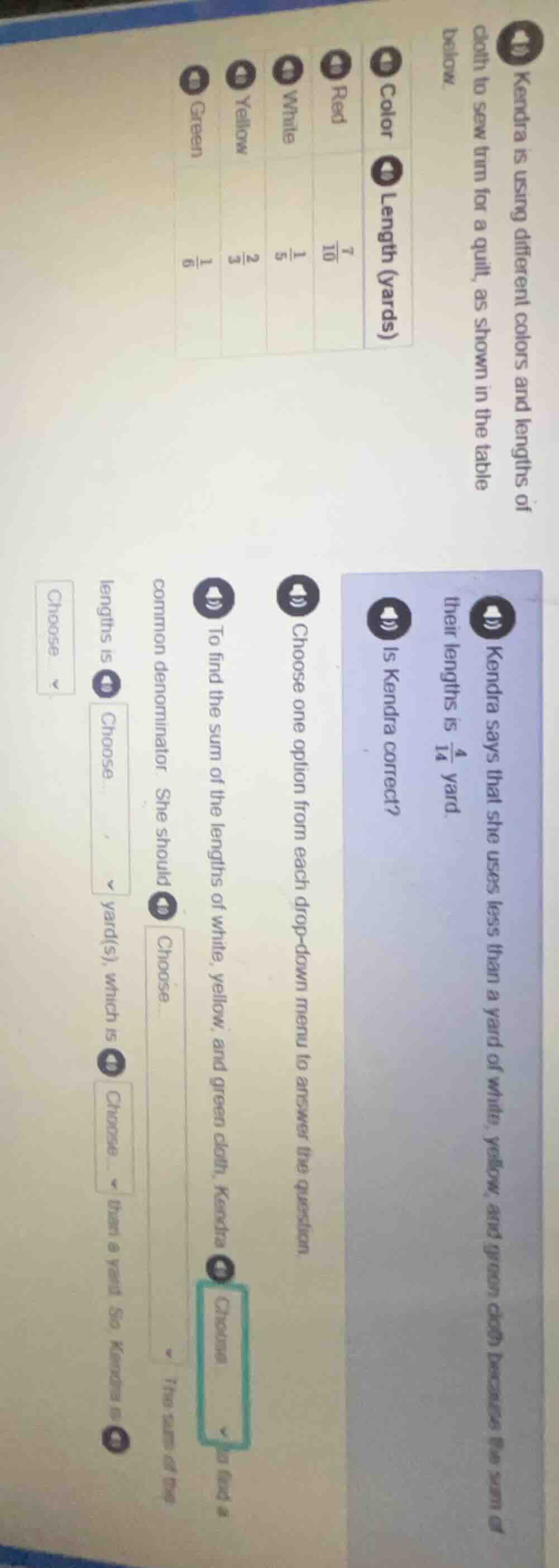
kendra is using different colors and lengths of cloth to sew trim for a quilt, as shown in the table below.
| color | length (yards) |
|---|---|
| white | $\frac{1}{5}$ |
| yellow | $\frac{2}{3}$ |
| green | $\frac{1}{6}$ |
kendra says that she uses less than a yard of white, yellow, and green cloth because the sum of their lengths is $\frac{4}{14}$ yard.
is kendra correct?
to find the sum of the lengths of white, yellow, and green cloth, kendra to find a common denominator. she should the sum of the lengths is yard(s), which is than a yard. so kendra is
To solve the problem of finding the sum of the lengths of white, yellow, and green cloth (lengths: $\frac{1}{5}$, $\frac{2}{3}$, $\frac{1}{6}$ yards) and checking Kendra's claim, we follow these steps:
Step 1: Find a common denominator
The denominators are 5, 3, and 6. The least common multiple (LCM) of 5, 3, and 6 is 30. So, the common denominator is 30.
Step 2: Convert each fraction to have denominator 30
- For white cloth ($\frac{1}{5}$):
Multiply numerator and denominator by 6:
$\frac{1 \times 6}{5 \times 6} = \frac{6}{30}$
- For yellow cloth ($\frac{2}{3}$):
Multiply numerator and denominator by 10:
$\frac{2 \times 10}{3 \times 10} = \frac{20}{30}$
- For green cloth ($\frac{1}{6}$):
Multiply numerator and denominator by 5:
$\frac{1 \times 5}{6 \times 5} = \frac{5}{30}$
Step 3: Sum the converted fractions
Add the numerators:
$\frac{6}{30} + \frac{20}{30} + \frac{5}{30} = \frac{6 + 20 + 5}{30} = \frac{31}{30}$
Step 4: Compare the sum to Kendra’s claim
Kendra claims the sum is $\frac{4}{14}$ (simplified: $\frac{2}{7} \approx 0.2857$ yards). Our calculated sum is $\frac{31}{30} \approx 1.033$ yards, which is greater than 1 yard.
For the dropdowns:
- To find the sum, Kendra should find a common denominator (30) to add the fractions.
- The sum of the lengths is $\frac{31}{30}$ yards, which is greater than 1 yard.
Final Answer for Kendra’s claim:
Kendra is not correct because the sum of the lengths ($\frac{31}{30}$ yards) is greater than 1 yard, not less than 1 yard.

Snap & solve any problem in the app
Get step-by-step solutions on Sovi AI
Photo-based solutions with guided steps
Explore more problems and detailed explanations
To solve the problem of finding the sum of the lengths of white, yellow, and green cloth (lengths: $\frac{1}{5}$, $\frac{2}{3}$, $\frac{1}{6}$ yards) and checking Kendra's claim, we follow these steps:
Step 1: Find a common denominator
The denominators are 5, 3, and 6. The least common multiple (LCM) of 5, 3, and 6 is 30. So, the common denominator is 30.
Step 2: Convert each fraction to have denominator 30
- For white cloth ($\frac{1}{5}$):
Multiply numerator and denominator by 6:
$\frac{1 \times 6}{5 \times 6} = \frac{6}{30}$
- For yellow cloth ($\frac{2}{3}$):
Multiply numerator and denominator by 10:
$\frac{2 \times 10}{3 \times 10} = \frac{20}{30}$
- For green cloth ($\frac{1}{6}$):
Multiply numerator and denominator by 5:
$\frac{1 \times 5}{6 \times 5} = \frac{5}{30}$
Step 3: Sum the converted fractions
Add the numerators:
$\frac{6}{30} + \frac{20}{30} + \frac{5}{30} = \frac{6 + 20 + 5}{30} = \frac{31}{30}$
Step 4: Compare the sum to Kendra’s claim
Kendra claims the sum is $\frac{4}{14}$ (simplified: $\frac{2}{7} \approx 0.2857$ yards). Our calculated sum is $\frac{31}{30} \approx 1.033$ yards, which is greater than 1 yard.
For the dropdowns:
- To find the sum, Kendra should find a common denominator (30) to add the fractions.
- The sum of the lengths is $\frac{31}{30}$ yards, which is greater than 1 yard.
Final Answer for Kendra’s claim:
Kendra is not correct because the sum of the lengths ($\frac{31}{30}$ yards) is greater than 1 yard, not less than 1 yard.