QUESTION IMAGE
Question
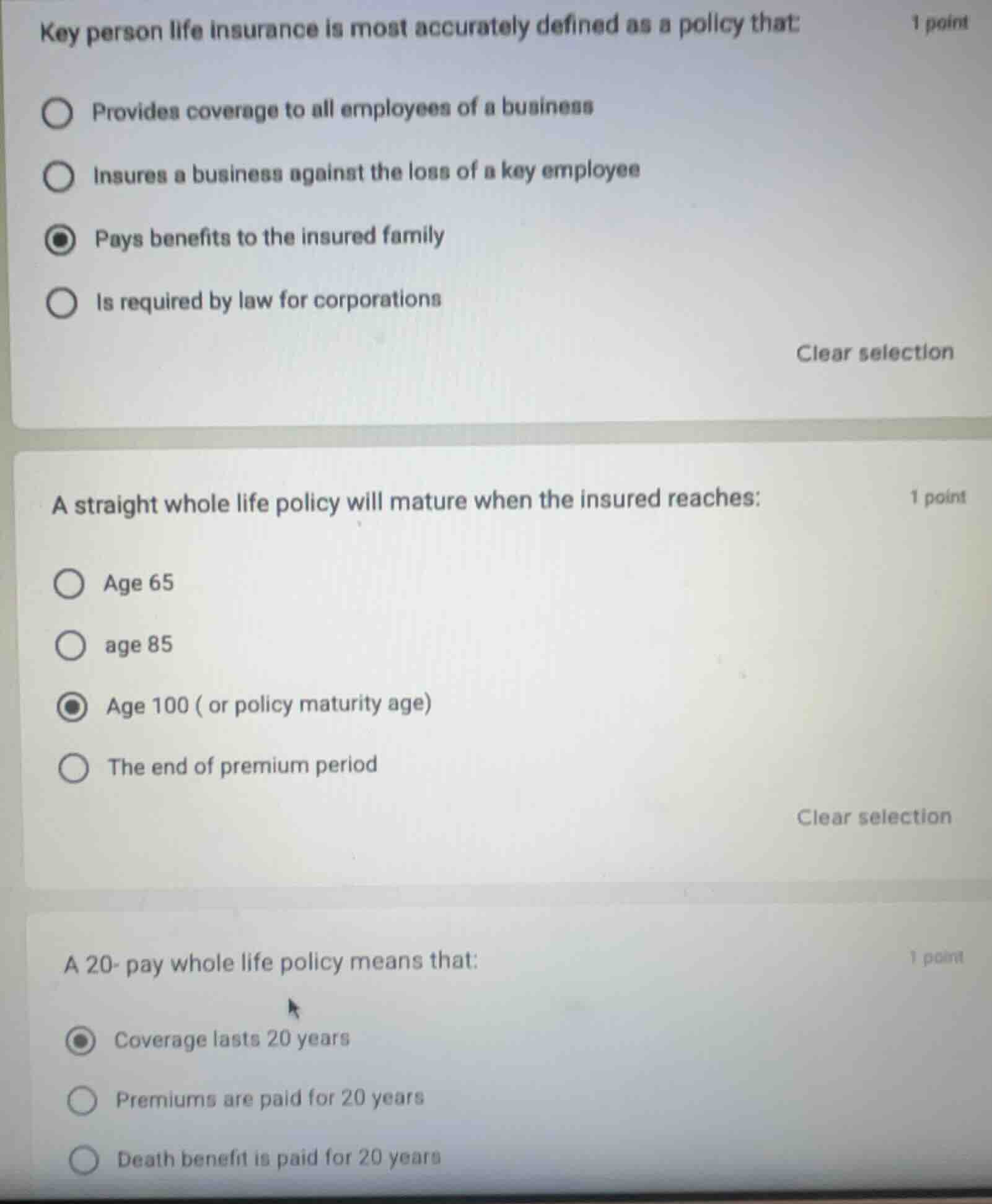
key person life insurance is most accurately defined as a policy that:
provides coverage to all employees of a business
insures a business against the loss of a key employee
pays benefits to the insured family
is required by law for corporations
a straight whole life policy will mature when the insured reaches:
age 65
age 85
age 100 ( or policy maturity age)
the end of premium period
a 20 - pay whole life policy means that:
coverage lasts 20 years
premiums are paid for 20 years
death benefit is paid for 20 years
Brief Explanations
- For key person life insurance: This policy protects the business from financial harm if a critical employee passes away, as that employee's skills/role is vital to operations. The other options are incorrect: it does not cover all employees, benefits go to the business not the family, and it is not legally required.
- For straight whole life policies: These policies are designed to mature when the insured reaches age 100 (or the contract's specified maturity age), at which point the policy's cash value equals the death benefit. Retirement ages like 65/85 or the end of premium payments are not the maturity trigger.
- For 20-pay whole life policies: The "20-pay" term refers to the premium payment period, meaning all required premiums are paid over 20 years, while coverage remains for the insured's entire life. The other options misinterpret the term, as coverage is lifelong, not 20 years, and the death benefit is a lump sum (not paid over 20 years).

Snap & solve any problem in the app
Get step-by-step solutions on Sovi AI
Photo-based solutions with guided steps
Explore more problems and detailed explanations
- Insures a business against the loss of a key employee
- Age 100 ( or policy maturity age)
- Premiums are paid for 20 years