QUESTION IMAGE
Question
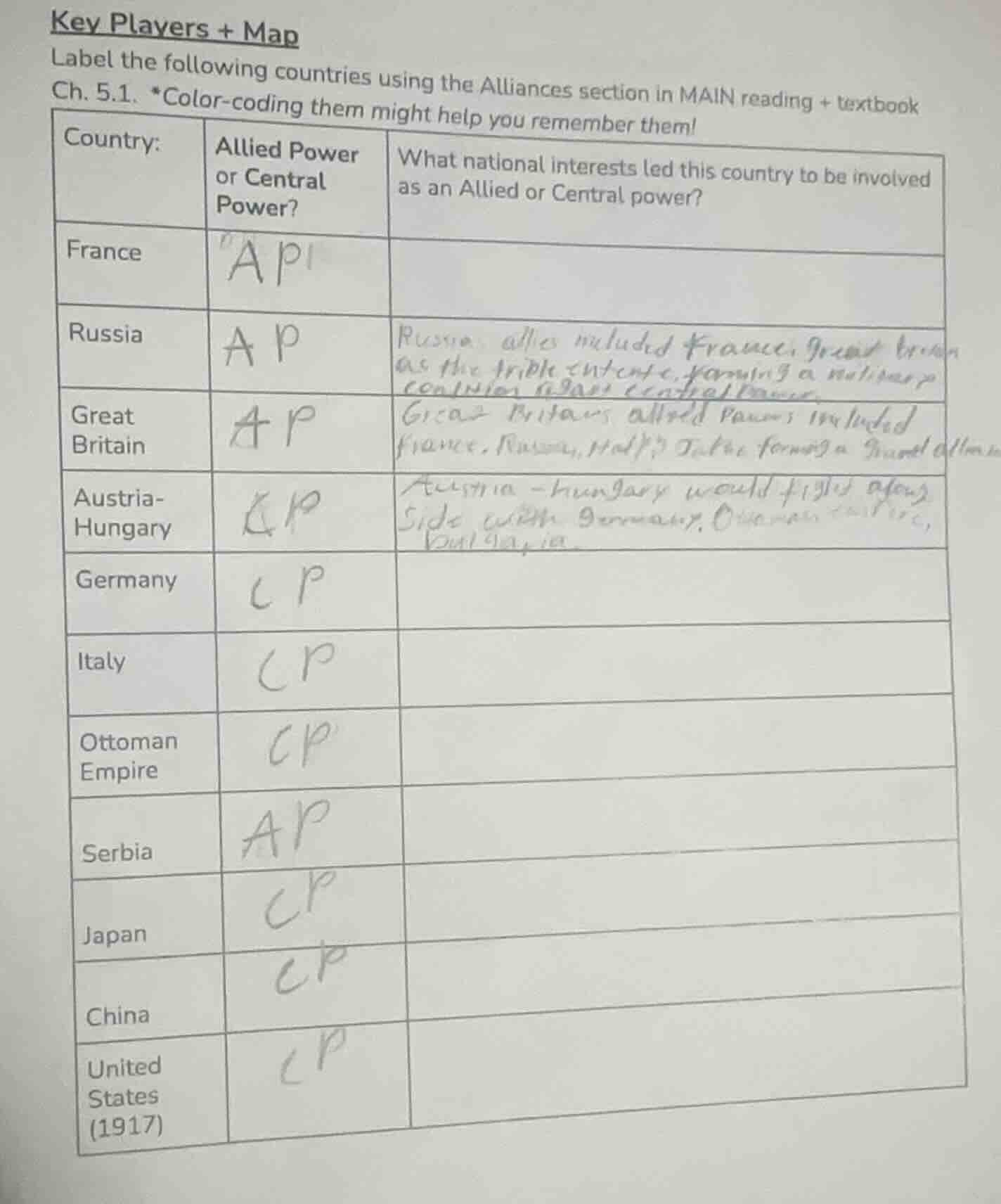
key players + map
label the following countries using the alliances section in main reading + textbook
ch. 5.1. *color - coding them might help you remember them!
| country: | allied power or central power? | what national interests led this country to be involved as an allied or central power? |
|---|---|---|
| russia | ap | russia, allies included france, great britain as the triple entente, forming a multipower coalition against central powers. |
| great britain | ap | great britains allied powers included france, russia, italy, etc. forming a broad alliance |
| austria - hungary | cp | austria - hungary would fight on the side with germany, ottoman empire, bulgaria. |
| germany | cp | |
| italy | cp | |
| ottoman empire | cp | |
| serbia | ap | |
| japan | cp | |
| china | cp | |
| united states (1917) | cp |
Response
To answer this, we analyze each country's WWI alliance and national interests:
France
- Allied Power (AP)
- National Interest: France sought to regain Alsace - Lorraine (lost to Germany in 1871) and protect against German aggression. It was part of the Triple Entente (with Russia, Great Britain) to counter Central Powers.
Germany
- Central Power (CP)
- National Interest: Germany aimed to expand its empire, assert dominance in Europe, and support its ally Austria - Hungary. It led the Central Powers (Triple Alliance with Austria - Hungary, initially Italy) to challenge Allied influence.
Italy
- Initially Central Power (CP) (part of Triple Alliance), but later switched to Allied Power (AP).
- National Interest (as CP initially): Italy joined the Triple Alliance for territorial gains (e.g., in the Balkans) and security. Later, it switched to Allies for better territorial promises (e.g., Treaty of London) and to oppose Central Powers’ dominance.
Ottoman Empire
- Central Power (CP)
- National Interest: The Ottoman Empire wanted to regain lost territories, protect its remaining empire from Allied expansion, and support its ally Germany (for military/financial aid).
Japan
- Allied Power (AP) (not CP).
- National Interest: Japan joined Allies to seize German colonies in Asia (e.g., Tsingtao) and expand its Pacific influence, aligning with Allied goals to defeat Germany.
China
- Allied Power (AP) (not CP).
- National Interest: China joined Allies to gain international support, end foreign (including German) imperial influence, and secure a seat at the post - war table (though outcomes were mixed).
United States (1917)
- Allied Power (AP) (not CP).
- National Interest: The US joined to protect trade with Allies, oppose German unrestricted submarine warfare, and promote democratic ideals, aligning with Allied efforts against Central Powers.
Serbia
- Allied Power (AP)
- National Interest: Serbia sought to defend its sovereignty (after Austria - Hungary’s ultimatum) and expand South Slavic influence. It was supported by Russia (Slavic ally), joining the Allied cause.
Corrections to Initial Mistakes (Japan, China, US, Italy):
- Japan: AP (fought with Allies to take German Pacific/Asian colonies).
- China: AP (joined Allies to end foreign domination, support Allied war effort).
- US (1917): AP (entered to support Allies, oppose German aggression).
- Italy: Initially CP, later AP (switched for territorial gains with Allies).
Final Table (Corrected):
| Country | Allied Power (AP) or Central Power (CP)? | What national interests led involvement? |
|---|---|---|
| Russia | AP | Protect Slavic allies (Serbia), expand influence, part of Triple Entente. |
| Great Britain | AP | Defend empire, support allies, counter German naval/territorial expansion (Triple Entente). |
| Austria - Hungary | CP | Defend empire, support German ally, punish Serbia (after assassination), expand Balkan… |

Snap & solve any problem in the app
Get step-by-step solutions on Sovi AI
Photo-based solutions with guided steps
Explore more problems and detailed explanations
To answer this, we analyze each country's WWI alliance and national interests:
France
- Allied Power (AP)
- National Interest: France sought to regain Alsace - Lorraine (lost to Germany in 1871) and protect against German aggression. It was part of the Triple Entente (with Russia, Great Britain) to counter Central Powers.
Germany
- Central Power (CP)
- National Interest: Germany aimed to expand its empire, assert dominance in Europe, and support its ally Austria - Hungary. It led the Central Powers (Triple Alliance with Austria - Hungary, initially Italy) to challenge Allied influence.
Italy
- Initially Central Power (CP) (part of Triple Alliance), but later switched to Allied Power (AP).
- National Interest (as CP initially): Italy joined the Triple Alliance for territorial gains (e.g., in the Balkans) and security. Later, it switched to Allies for better territorial promises (e.g., Treaty of London) and to oppose Central Powers’ dominance.
Ottoman Empire
- Central Power (CP)
- National Interest: The Ottoman Empire wanted to regain lost territories, protect its remaining empire from Allied expansion, and support its ally Germany (for military/financial aid).
Japan
- Allied Power (AP) (not CP).
- National Interest: Japan joined Allies to seize German colonies in Asia (e.g., Tsingtao) and expand its Pacific influence, aligning with Allied goals to defeat Germany.
China
- Allied Power (AP) (not CP).
- National Interest: China joined Allies to gain international support, end foreign (including German) imperial influence, and secure a seat at the post - war table (though outcomes were mixed).
United States (1917)
- Allied Power (AP) (not CP).
- National Interest: The US joined to protect trade with Allies, oppose German unrestricted submarine warfare, and promote democratic ideals, aligning with Allied efforts against Central Powers.
Serbia
- Allied Power (AP)
- National Interest: Serbia sought to defend its sovereignty (after Austria - Hungary’s ultimatum) and expand South Slavic influence. It was supported by Russia (Slavic ally), joining the Allied cause.
Corrections to Initial Mistakes (Japan, China, US, Italy):
- Japan: AP (fought with Allies to take German Pacific/Asian colonies).
- China: AP (joined Allies to end foreign domination, support Allied war effort).
- US (1917): AP (entered to support Allies, oppose German aggression).
- Italy: Initially CP, later AP (switched for territorial gains with Allies).
Final Table (Corrected):
| Country | Allied Power (AP) or Central Power (CP)? | What national interests led involvement? |
|---|---|---|
| Russia | AP | Protect Slavic allies (Serbia), expand influence, part of Triple Entente. |
| Great Britain | AP | Defend empire, support allies, counter German naval/territorial expansion (Triple Entente). |
| Austria - Hungary | CP | Defend empire, support German ally, punish Serbia (after assassination), expand Balkan influence. |
| Germany | CP | Expand empire, assert dominance, support Austria - Hungary (Triple Alliance). |
| Italy | Initially CP, later AP | Initially: territorial gains (Triple Alliance); later: better Allied territorial promises (Treaty of London). |
| Ottoman Empire | CP | Regain lost territories, protect empire, support Germany. |
| Serbia | AP | Defend sovereignty, expand South Slavic influence, supported by Russia. |
| Japan | AP | Seize German Asian colonies, expand Pacific influence, support Allies. |
| China | AP | End foreign imperial influence, gain international support, oppose German presence. |
| United States (1917) | AP | Protect Allied trade, oppose German submarine warfare, promote democracy. |
(Note: Initial handwritten labels for Japan, China, US, Italy were incorrect; corrected based on WWI history.)