QUESTION IMAGE
Question
key terms
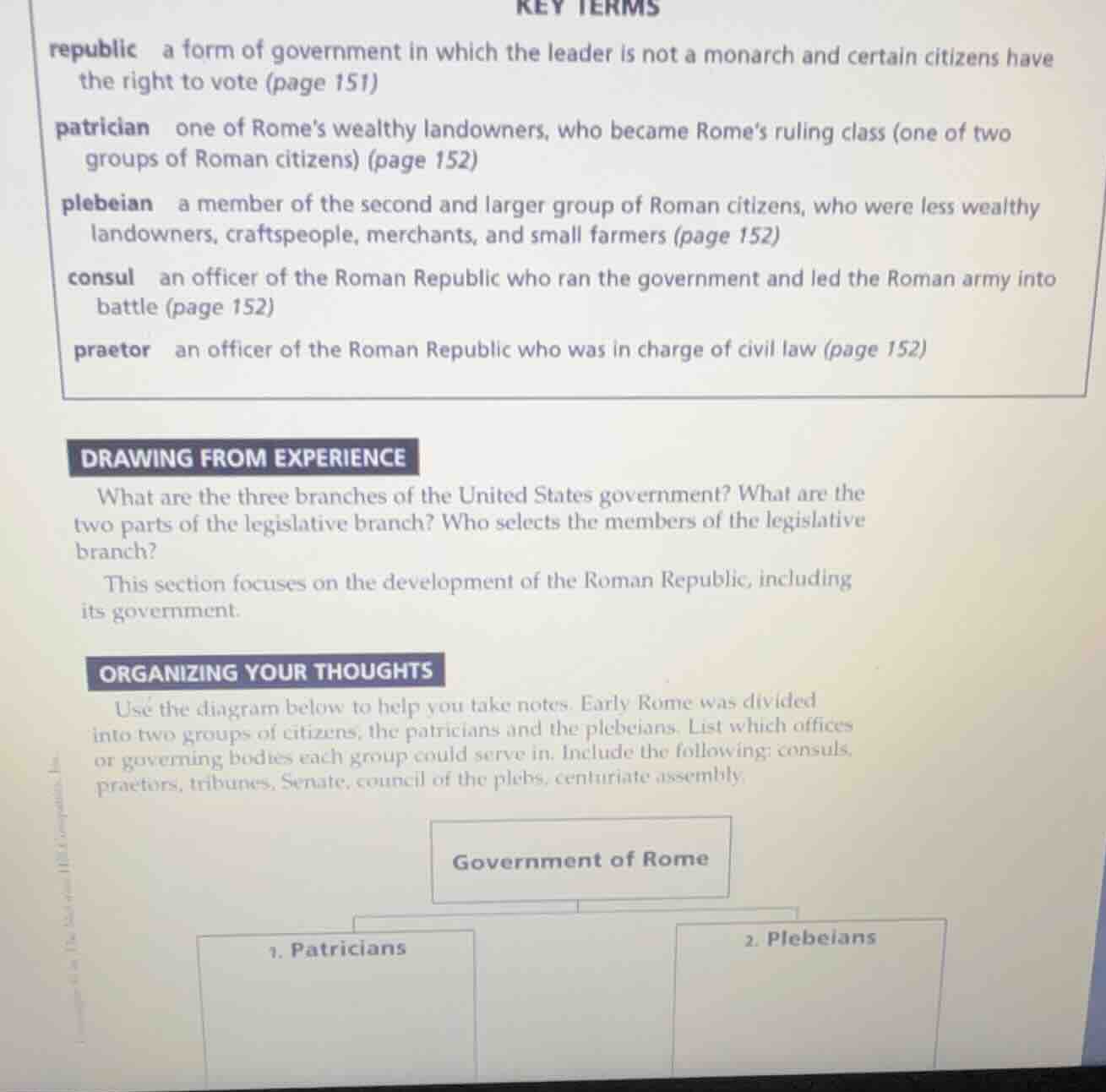
republic a form of government in which the leader is not a monarch and certain citizens have the right to vote (page 151)
patrician one of rome’s wealthy landowners, who became rome’s ruling class (one of two groups of roman citizens) (page 152)
plebeian a member of the second and larger group of roman citizens, who were less wealthy landowners, craftspeople, merchants, and small farmers (page 152)
consul an officer of the roman republic who ran the government and led the roman army into battle (page 152)
praetor an officer of the roman republic who was in charge of civil law (page 152)
drawing from experience
what are the three branches of the united states government? what are the two parts of the legislative branch? who selects the members of the legislative branch?
this section focuses on the development of the roman republic, including its government.
organizing your thoughts
use the diagram below to help you take notes. early rome was divided into two groups of citizens, the patricians and the plebeians. list which offices or governing bodies each group could serve in. include the following: consuls, praetors, tribunes, senate, council of the plebs, centuriate assembly.
government of rome
- patricians
- plebeians
First, address the U.S. government questions: The U.S. government's three branches are defined by separation of powers. The legislative branch's structure and member selection are set by U.S. constitutional rules. For Roman Republic roles: Patricians were the ruling class with access to the highest traditional offices, while Plebeians had their own representative bodies and specific offices they could hold.
- For U.S. government questions:
- The three branches are established to create checks and balances.
- The legislative branch is bicameral as defined in the U.S. Constitution.
- Member selection follows electoral rules for each chamber.
- For Roman Republic government roles:
- Patricians held the elite, traditional governing offices and controlled the primary senatorial body.
- Plebeians had offices and assemblies created to represent their interests, separate from patrician-controlled institutions.

Snap & solve any problem in the app
Get step-by-step solutions on Sovi AI
Photo-based solutions with guided steps
Explore more problems and detailed explanations
U.S. Government Questions:
- The three branches of the United States government are the Legislative Branch, Executive Branch, and Judicial Branch.
- The two parts of the legislative branch are the Senate and the House of Representatives.
- Members of the House of Representatives are elected by eligible voters in their respective congressional districts; members of the Senate are elected by eligible voters in their entire state.
Roman Republic Government Roles:
- Patricians: Consuls, Praetors, Senate, Centuriate Assembly
- Plebeians: Tribunes, Council of the Plebs