QUESTION IMAGE
Question
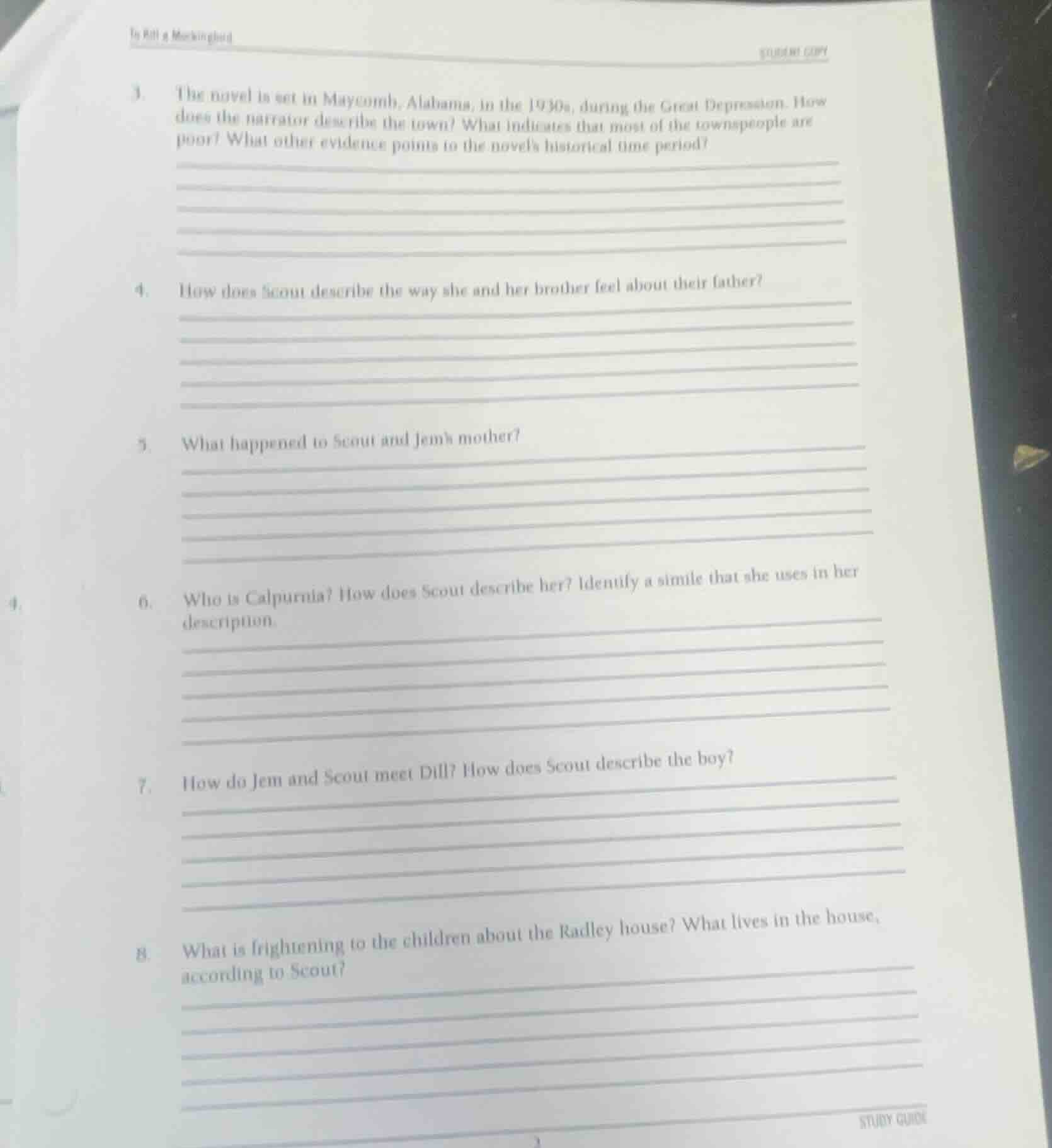
to kill a mockingbird student copy 3. the novel is set in maycomb, alabama, in the 1930s, during the great depression. how does the narrator describe the town? what indicates that most of the townspeople are poor? what other evidence points to the novels historical time period? 4. how does scout describe the way she and her brother feel about their father? 5. what happened to scout and jems mother? 6. who is calpurnia? how does scout describe her? identify a simile that she uses in her description. 7. how do jem and scout meet dill? how does scout describe the boy? 8. what is frightening to the children about the radley house? what lives in the house, according to scout? study guide
For Question 3:
Scout describes Maycomb as a slow, hot, small Southern town where everyone knows each other's business. Evidence of poverty includes families like the Ewells living off relief, people bartering goods instead of using cash, and the lack of modern conveniences. Historical context is shown by references to the Great Depression, segregation, and the prevalence of old-fashioned Southern social norms.
For Question 4:
Scout says she and Jem respect Atticus, but initially find him "boring" compared to other fathers—he is older, doesn't hunt or play sports, and works as a lawyer. They come to admire him deeply later, but early on, they see him as quiet and unremarkable in a small-town, active father sense.
For Question 5:
Scout and Jem's mother died from a heart attack when Scout was two years old. Jem has faint memories of her, but Scout has no real memories of her at all.
For Question 6:
Calpurnia is the Finch family's Black cook and housekeeper, who also acts as a maternal figure to Scout and Jem. Scout describes her as strict, firm, and a good disciplinarian. She uses the simile: "Calpurnia was something else again. She was all angles and bones; she was nearsighted; she squinted; her hand was wide as a bed slat and twice as hard."
For Question 7:
Jem and Scout meet Dill (Charles Baker Harris) when he comes to stay with his aunt, Miss Rachel Haverford, who lives next door to the Finches every summer. Scout describes Dill as a small, smart, imaginative boy with white hair, blue eyes, and a talent for storytelling and making up games.
For Question 8:
The children are frightened by the Radley house because of the local rumors and myths about Boo Radley, a reclusive man who is said to never leave the house. According to Scout, the house is dark, overgrown, and looks haunted; the children believe Boo Radley is a monster-like figure who lurks inside, eats raw animals, and wanders at night.

Snap & solve any problem in the app
Get step-by-step solutions on Sovi AI
Photo-based solutions with guided steps
Explore more problems and detailed explanations
- Scout calls Maycomb a slow, small, close-knit town. Poverty signs: bartering, Ewells on relief, lack of modern goods. Historical clues: Great Depression references, segregation, old Southern norms.
- Initially, they find Atticus boring (older, no "fun" dad activities) but respect his quiet integrity.
- She died of a heart attack when Scout was 2; Jem has faint memories, Scout has none.
- Calpurnia is the Finches' cook/maternal figure. Scout calls her strict, angular; simile: "her hand was wide as a bed slat and twice as hard."
- They meet Dill when he visits his aunt next door each summer. Scout describes him as small, imaginative, white-haired, a skilled storyteller.
- The house is spooky, overgrown, tied to Boo Radley myths. Scout says Boo (a reclusive, rumored monster-like man) lives there, who is said to be violent and strange.