QUESTION IMAGE
Question
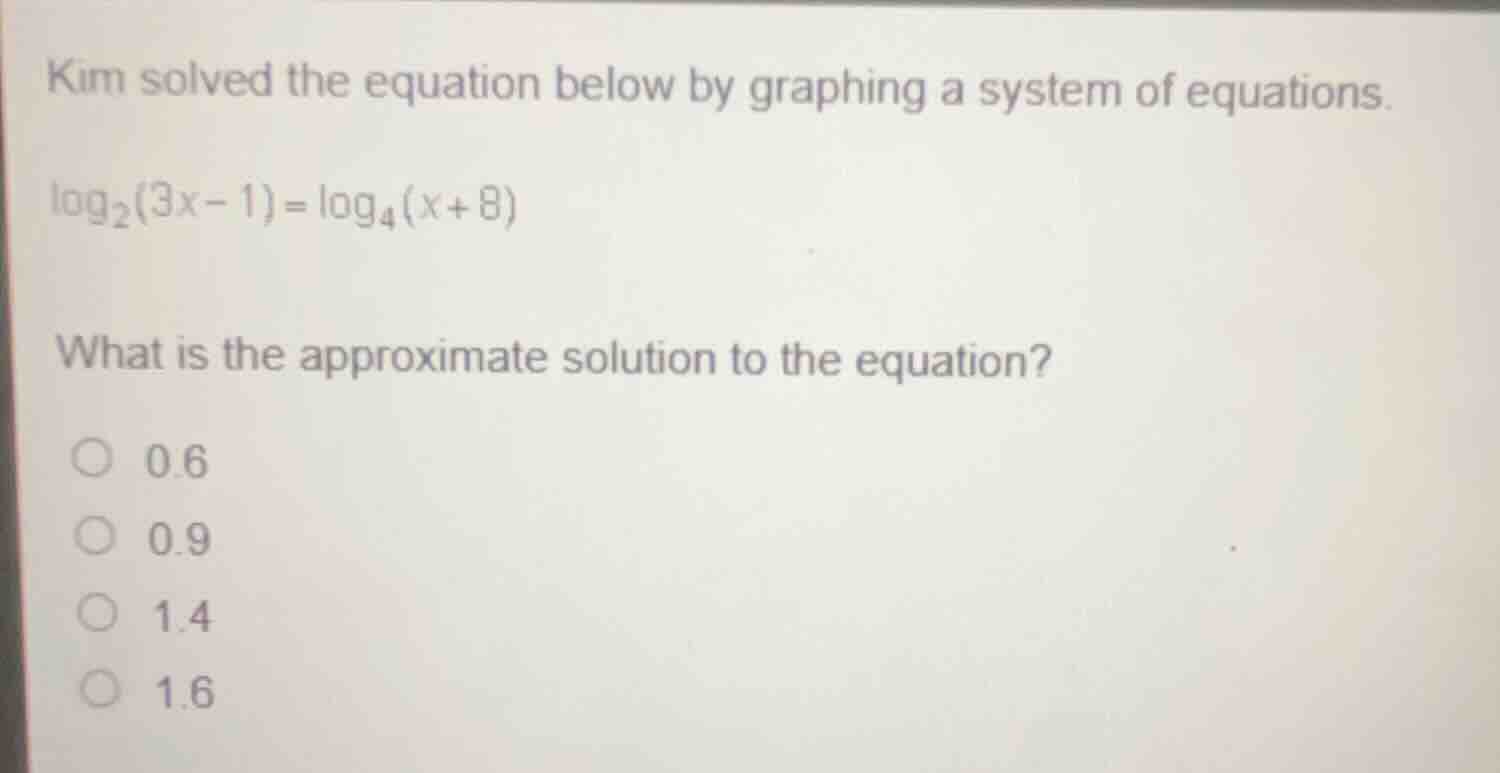
kim solved the equation below by graphing a system of equations.\\(\log_{2}(3x - 1)=\log_{4}(x + 8)\\)\
what is the approximate solution to the equation?\
\\(\bigcirc\\) 0.6\
\\(\bigcirc\\) 0.9\
\\(\bigcirc\\) 1.4\
\\(\bigcirc\\) 1.6
Step1: Rewrite the equations
We can rewrite the equation \(\log_{2}(3x - 1)=\log_{4}(x + 8)\) as a system of equations: \(y = \log_{2}(3x - 1)\) and \(y=\log_{4}(x + 8)\). We can also use the change - of - base formula or logarithmic properties to solve it algebraically and then check with the given options.
First, recall that \(\log_{a^n}b=\frac{1}{n}\log_{a}b\). So \(\log_{4}(x + 8)=\log_{2^2}(x + 8)=\frac{1}{2}\log_{2}(x + 8)=\log_{2}\sqrt{x + 8}\)
The original equation \(\log_{2}(3x - 1)=\log_{2}\sqrt{x + 8}\) (since if \(\log_{a}m=\log_{a}n\), then \(m = n\) for \(a>0,a
eq1,m>0,n>0\))
So we have the equation \(3x-1=\sqrt{x + 8}\)
Step2: Test the given options
- For \(x = 0.6\):
Left - hand side of \(3x - 1\): \(3\times0.6-1=1.8 - 1=0.8\)
Right - hand side: \(\sqrt{0.6 + 8}=\sqrt{8.6}\approx2.93\)
Since \(0.8
eq2.93\), \(x = 0.6\) is not a solution.
- For \(x = 0.9\):
Left - hand side: \(3\times0.9-1 = 2.7-1=1.7\)
Right - hand side: \(\sqrt{0.9 + 8}=\sqrt{8.9}\approx2.98\)
Since \(1.7
eq2.98\), \(x = 0.9\) is not a solution.
- For \(x = 1.4\):
Left - hand side: \(3\times1.4-1=4.2 - 1 = 3.2\)
Right - hand side: \(\sqrt{1.4+8}=\sqrt{9.4}\approx3.07\)
The two sides are relatively close.
- For \(x = 1.6\):
Left - hand side: \(3\times1.6-1=4.8 - 1=3.8\)
Right - hand side: \(\sqrt{1.6 + 8}=\sqrt{9.6}\approx3.1\)
Since \(3.8
eq3.1\)
We can also solve the equation \(3x - 1=\sqrt{x + 8}\) by squaring both sides (note that we have to check for extraneous solutions later):
\((3x - 1)^2=x + 8\)
\(9x^{2}-6x + 1=x + 8\)
\(9x^{2}-7x - 7 = 0\)
Using the quadratic formula \(x=\frac{-b\pm\sqrt{b^{2}-4ac}}{2a}\) for the quadratic equation \(ax^{2}+bx + c = 0\), here \(a = 9\), \(b=-7\), \(c=-7\)
\(x=\frac{7\pm\sqrt{(-7)^{2}-4\times9\times(-7)}}{2\times9}=\frac{7\pm\sqrt{49 + 252}}{18}=\frac{7\pm\sqrt{301}}{18}\)
\(\sqrt{301}\approx17.35\)
\(x=\frac{7 + 17.35}{18}\approx\frac{24.35}{18}\approx1.35\approx1.4\) (we discard the negative root since \(3x-1>0\) and \(x + 8>0\) for the domain of the logarithmic functions)

Snap & solve any problem in the app
Get step-by-step solutions on Sovi AI
Photo-based solutions with guided steps
Explore more problems and detailed explanations
1.4 (the option corresponding to 1.4, e.g., if the options are A. 0.6, B. 0.9, C. 1.4, D. 1.6, then the answer is C. 1.4)