QUESTION IMAGE
Question
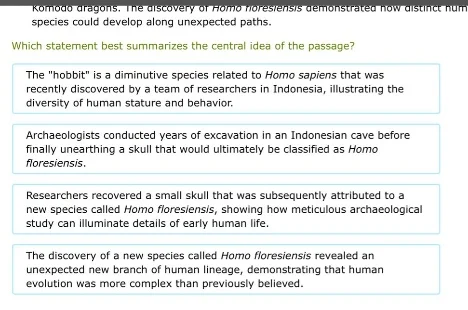
komodo dragons. the discovery of homo floresiensis demonstrated how distinct num species could develop along unexpected paths. which statement best summarizes the central idea of the passage? \the hobbit is a diminutive species related to homo sapiens that was recently discovered by a team of researchers in indonesia, illustrating the diversity of human stature and behavior. archaeologists conducted years of excavation in an indonesian cave before finally unearthing a skull that would ultimately be classified as homo floresiensis. researchers recovered a small skull that was subsequently attributed to a new species called homo floresiensis, showing how meticulous archaeological study can illuminate details of early human life. the discovery of a new species called homo floresiensis revealed an unexpected new branch of human lineage, demonstrating that human evolution was more complex than previously believed.\
To summarize the central idea, we analyze each option:
- First option focuses on "hobbit" being related to Homo sapiens and human diversity in stature/behavior, but the key from the passage (about distinct human species and unexpected evolution) isn't fully captured.
- Second option is about the excavation process, not the central idea of what the discovery means for human evolution.
- Third option emphasizes meticulous archaeological study, but the main point is about the discovery's impact on understanding human evolution.
- Fourth option: The discovery of Homo floresiensis (a new human species branch) showed human evolution had unexpected paths, matching the passage's central idea about how distinct human species could have unexpected origins/evolution paths.

Snap & solve any problem in the app
Get step-by-step solutions on Sovi AI
Photo-based solutions with guided steps
Explore more problems and detailed explanations
The discovery of Homo floresiensis revealed an unexpected new branch of human lineage, demonstrating that human evolution was more complex than previously believed.