QUESTION IMAGE
Question
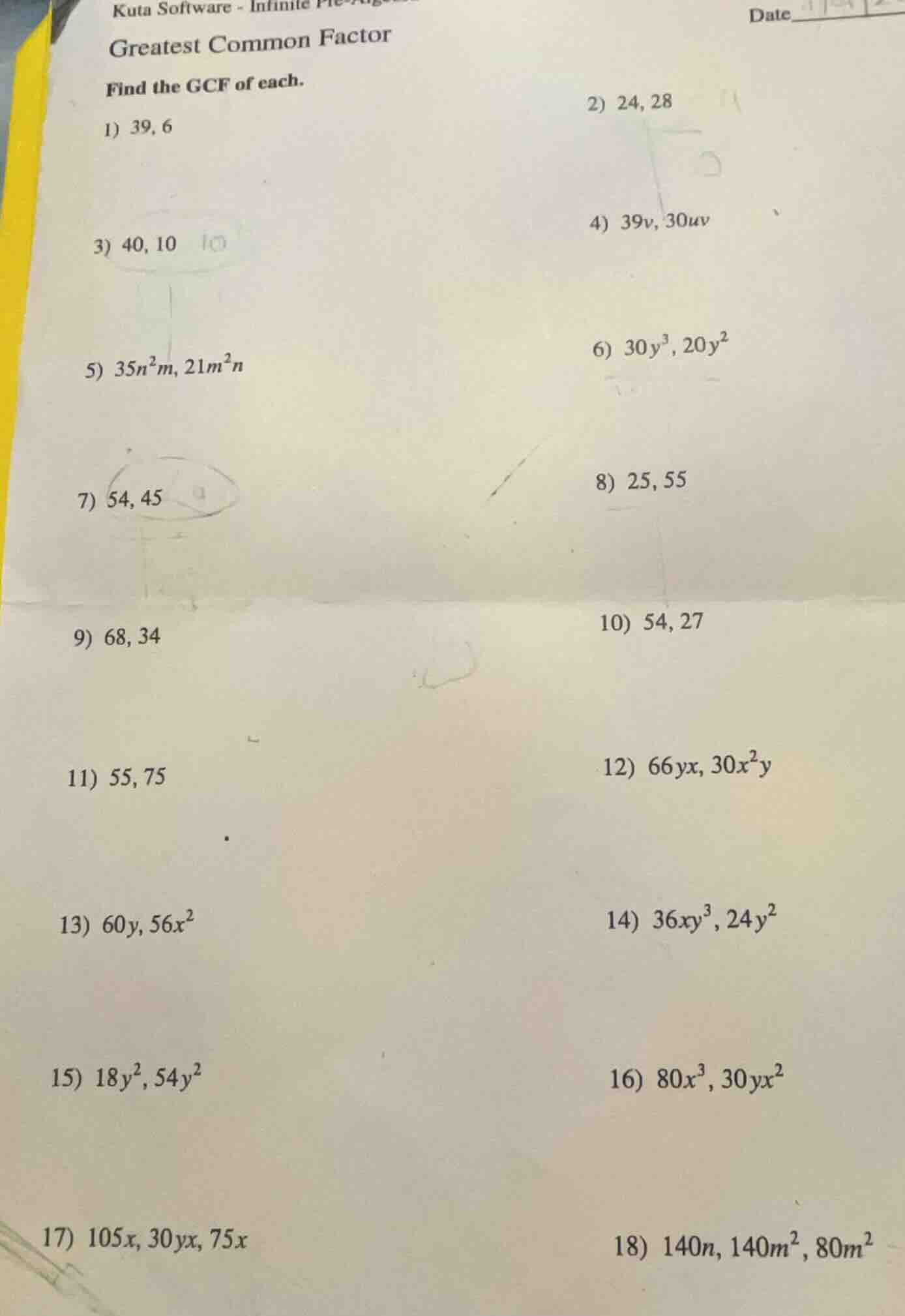
kuta software - infinite pre-algebra
greatest common factor
find the gcf of each.
- 39, 6
- 24, 28
- 40, 10
- 39v, 30uv
- 35n²m, 21m²n
- 30y³, 20y²
- 54, 45
- 25, 55
- 68, 34
- 54, 27
- 55, 75
- 66yx, 30x²y
- 60y, 56x²
- 36xy³, 24y²
- 18y², 54y²
- 80x³, 30yx²
- 105x, 30yx, 75x
- 140n, 140m², 80m²
Let's solve these GCF problems one by one. We'll use the method of prime factorization or listing factors to find the greatest common factor.
Problem 1: Find the GCF of 39 and 6
Step 1: List the factors of 39
The factors of 39 are \(1, 3, 13, 39\) (since \(1\times39 = 39\) and \(3\times13 = 39\)).
Step 2: List the factors of 6
The factors of 6 are \(1, 2, 3, 6\) (since \(1\times6 = 6\) and \(2\times3 = 6\)).
Step 3: Identify the common factors
The common factors of 39 and 6 are \(1, 3\).
Step 4: Find the greatest common factor
The greatest among the common factors is \(3\).
Problem 2: Find the GCF of 24 and 28
Step 1: List the factors of 24
The factors of 24 are \(1, 2, 3, 4, 6, 8, 12, 24\) (since \(1\times24 = 24\), \(2\times12 = 24\), \(3\times8 = 24\), \(4\times6 = 24\)).
Step 2: List the factors of 28
The factors of 28 are \(1, 2, 4, 7, 14, 28\) (since \(1\times28 = 28\), \(2\times14 = 28\), \(4\times7 = 28\)).
Step 3: Identify the common factors
The common factors of 24 and 28 are \(1, 2, 4\).
Step 4: Find the greatest common factor
The greatest among the common factors is \(4\).
Problem 3: Find the GCF of 40 and 10
Step 1: List the factors of 40
The factors of 40 are \(1, 2, 4, 5, 8, 10, 20, 40\) (since \(1\times40 = 40\), \(2\times20 = 40\), \(4\times10 = 40\), \(5\times8 = 40\)).
Step 2: List the factors of 10
The factors of 10 are \(1, 2, 5, 10\) (since \(1\times10 = 10\), \(2\times5 = 10\)).
Step 3: Identify the common factors
The common factors of 40 and 10 are \(1, 2, 5, 10\).
Step 4: Find the greatest common factor
The greatest among the common factors is \(10\).
Problem 4: Find the GCF of \(39v\) and \(30uv\)
Step 1: Factor the coefficients and variables separately
- For the coefficients: Factor 39 and 30.
- The factors of 39 are \(1, 3, 13, 39\).
- The factors of 30 are \(1, 2, 3, 5, 6, 10, 15, 30\).
- The common factor of 39 and 30 is \(3\).
- For the variables: Look at the variables in each term. The first term has \(v\) and the second term has \(u\) and \(v\). The common variable factor is \(v\) (since \(u\) is only in the second term).
Step 2: Combine the common factors
Multiply the common coefficient factor and the common variable factor: \(3\times v = 3v\).
Problem 5: Find the GCF of \(35n^{2}m\) and \(21m^{2}n\)
Step 1: Factor the coefficients and variables separately
- For the coefficients: Factor 35 and 21.
- The factors of 35 are \(1, 5, 7, 35\).
- The factors of 21 are \(1, 3, 7, 21\).
- The common factor of 35 and 21 is \(7\).
- For the variables:
- For \(n\): The first term has \(n^{2}\) and the second term has \(n\). The common factor is \(n\) (the lowest power).
- For \(m\): The first term has \(m\) and the second term has \(m^{2}\). The common factor is \(m\) (the lowest power).
Step 2: Combine the common factors
Multiply the common coefficient factor and the common variable factors: \(7\times n\times m = 7mn\).
Problem 6: Find the GCF of \(30y^{3}\) and \(20y^{2}\)
Step 1: Factor the coefficients and variables separately
- For the coefficients: Factor 30 and 20.
- The factors of 30 are \(1, 2, 3, 5, 6, 10, 15, 30\).
- The factors of 20 are \(1, 2, 4, 5, 10, 20\).
- The common factor of 30 and 20 is \(10\).
- For the variable \(y\): The first term has \(y^{3}\) and the second term has \(y^{2}\). The common factor is \(y^{2}\) (the lowest power).
Step 2: Combine the common factors
Multiply the common coefficient factor and the common variable factor: \(10\times y^{2} = 10y^{2}\).
Problem 7: Find…

Snap & solve any problem in the app
Get step-by-step solutions on Sovi AI
Photo-based solutions with guided steps
Explore more problems and detailed explanations
Let's solve these GCF problems one by one. We'll use the method of prime factorization or listing factors to find the greatest common factor.
Problem 1: Find the GCF of 39 and 6
Step 1: List the factors of 39
The factors of 39 are \(1, 3, 13, 39\) (since \(1\times39 = 39\) and \(3\times13 = 39\)).
Step 2: List the factors of 6
The factors of 6 are \(1, 2, 3, 6\) (since \(1\times6 = 6\) and \(2\times3 = 6\)).
Step 3: Identify the common factors
The common factors of 39 and 6 are \(1, 3\).
Step 4: Find the greatest common factor
The greatest among the common factors is \(3\).
Problem 2: Find the GCF of 24 and 28
Step 1: List the factors of 24
The factors of 24 are \(1, 2, 3, 4, 6, 8, 12, 24\) (since \(1\times24 = 24\), \(2\times12 = 24\), \(3\times8 = 24\), \(4\times6 = 24\)).
Step 2: List the factors of 28
The factors of 28 are \(1, 2, 4, 7, 14, 28\) (since \(1\times28 = 28\), \(2\times14 = 28\), \(4\times7 = 28\)).
Step 3: Identify the common factors
The common factors of 24 and 28 are \(1, 2, 4\).
Step 4: Find the greatest common factor
The greatest among the common factors is \(4\).
Problem 3: Find the GCF of 40 and 10
Step 1: List the factors of 40
The factors of 40 are \(1, 2, 4, 5, 8, 10, 20, 40\) (since \(1\times40 = 40\), \(2\times20 = 40\), \(4\times10 = 40\), \(5\times8 = 40\)).
Step 2: List the factors of 10
The factors of 10 are \(1, 2, 5, 10\) (since \(1\times10 = 10\), \(2\times5 = 10\)).
Step 3: Identify the common factors
The common factors of 40 and 10 are \(1, 2, 5, 10\).
Step 4: Find the greatest common factor
The greatest among the common factors is \(10\).
Problem 4: Find the GCF of \(39v\) and \(30uv\)
Step 1: Factor the coefficients and variables separately
- For the coefficients: Factor 39 and 30.
- The factors of 39 are \(1, 3, 13, 39\).
- The factors of 30 are \(1, 2, 3, 5, 6, 10, 15, 30\).
- The common factor of 39 and 30 is \(3\).
- For the variables: Look at the variables in each term. The first term has \(v\) and the second term has \(u\) and \(v\). The common variable factor is \(v\) (since \(u\) is only in the second term).
Step 2: Combine the common factors
Multiply the common coefficient factor and the common variable factor: \(3\times v = 3v\).
Problem 5: Find the GCF of \(35n^{2}m\) and \(21m^{2}n\)
Step 1: Factor the coefficients and variables separately
- For the coefficients: Factor 35 and 21.
- The factors of 35 are \(1, 5, 7, 35\).
- The factors of 21 are \(1, 3, 7, 21\).
- The common factor of 35 and 21 is \(7\).
- For the variables:
- For \(n\): The first term has \(n^{2}\) and the second term has \(n\). The common factor is \(n\) (the lowest power).
- For \(m\): The first term has \(m\) and the second term has \(m^{2}\). The common factor is \(m\) (the lowest power).
Step 2: Combine the common factors
Multiply the common coefficient factor and the common variable factors: \(7\times n\times m = 7mn\).
Problem 6: Find the GCF of \(30y^{3}\) and \(20y^{2}\)
Step 1: Factor the coefficients and variables separately
- For the coefficients: Factor 30 and 20.
- The factors of 30 are \(1, 2, 3, 5, 6, 10, 15, 30\).
- The factors of 20 are \(1, 2, 4, 5, 10, 20\).
- The common factor of 30 and 20 is \(10\).
- For the variable \(y\): The first term has \(y^{3}\) and the second term has \(y^{2}\). The common factor is \(y^{2}\) (the lowest power).
Step 2: Combine the common factors
Multiply the common coefficient factor and the common variable factor: \(10\times y^{2} = 10y^{2}\).
Problem 7: Find the GCF of 54 and 45
Step 1: List the factors of 54
The factors of 54 are \(1, 2, 3, 6, 9, 18, 27, 54\) (since \(1\times54 = 54\), \(2\times27 = 54\), \(3\times18 = 54\), \(6\times9 = 54\)).
Step 2: List the factors of 45
The factors of 45 are \(1, 3, 5, 9, 15, 45\) (since \(1\times45 = 45\), \(3\times15 = 45\), \(5\times9 = 45\)).
Step 3: Identify the common factors
The common factors of 54 and 45 are \(1, 3, 9\).
Step 4: Find the greatest common factor
The greatest among the common factors is \(9\).
Problem 8: Find the GCF of 25 and 55
Step 1: List the factors of 25
The factors of 25 are \(1, 5, 25\) (since \(1\times25 = 25\), \(5\times5 = 25\)).
Step 2: List the factors of 55
The factors of 55 are \(1, 5, 11, 55\) (since \(1\times55 = 55\), \(5\times11 = 55\)).
Step 3: Identify the common factors
The common factors of 25 and 55 are \(1, 5\).
Step 4: Find the greatest common factor
The greatest among the common factors is \(5\).
Problem 9: Find the GCF of 68 and 34
Step 1: List the factors of 68
The factors of 68 are \(1, 2, 4, 17, 34, 68\) (since \(1\times68 = 68\), \(2\times34 = 68\), \(4\times17 = 68\)).
Step 2: List the factors of 34
The factors of 34 are \(1, 2, 17, 34\) (since \(1\times34 = 34\), \(2\times17 = 34\)).
Step 3: Identify the common factors
The common factors of 68 and 34 are \(1, 2, 17, 34\).
Step 4: Find the greatest common factor
The greatest among the common factors is \(34\).
Problem 10: Find the GCF of 54 and 27
Step 1: List the factors of 54
The factors of 54 are \(1, 2, 3, 6, 9, 18, 27, 54\) (since \(1\times54 = 54\), \(2\times27 = 54\), \(3\times18 = 54\), \(6\times9 = 54\)).
Step 2: List the factors of 27
The factors of 27 are \(1, 3, 9, 27\) (since \(1\times27 = 27\), \(3\times9 = 27\)).
Step 3: Identify the common factors
The common factors of 54 and 27 are \(1, 3, 9, 27\).
Step 4: Find the greatest common factor
The greatest among the common factors is \(27\).
Problem 11: Find the GCF of 55 and 75
Step 1: List the factors of 55
The factors of 55 are \(1, 5, 11, 55\) (since \(1\times55 = 55\), \(5\times11 = 55\)).
Step 2: List the factors of 75
The factors of 75 are \(1, 3, 5, 15, 25, 75\) (since \(1\times75 = 75\), \(3\times25 = 75\), \(5\times15 = 75\)).
Step 3: Identify the common factors
The common factors of 55 and 75 are \(1, 5\).
Step 4: Find the greatest common factor
The greatest among the common factors is \(5\).
Problem 12: Find the GCF of \(66yx\) and \(30x^{2}y\)
Step 1: Factor the coefficients and variables separately
- For the coefficients: Factor 66 and 30.
- The factors of 66 are \(1, 2, 3, 6, 11, 22, 33, 66\).
- The factors of 30 are \(1, 2, 3, 5, 6, 10, 15, 30\).
- The common factor of 66 and 30 is \(6\).
- For the variables:
- For \(x\): The first term has \(x\) and the second term has \(x^{2}\). The common factor is \(x\) (the lowest power).
- For \(y\): Both terms have \(y\), so the common factor is \(y\).
Step 2: Combine the common factors
Multiply the common coefficient factor and the common variable factors: \(6\times x\times y = 6xy\).
Problem 13: Find the GCF of \(60y\) and \(56x^{2}\)
Step 1: Factor the coefficients and variables separately
- For the coefficients: Factor 60 and 56.
- The factors of 60 are \(1, 2, 3, 4, 5, 6, 10, 12, 15, 20, 30, 60\).
- The factors of 56 are \(1, 2, 4, 7, 8, 14, 28, 56\).
- The common factor of 60 and 56 is \(4\).
- For the variables: The first term has \(y\) and the second term has \(x^{2}\). There are no common variable factors (since \(y\) and \(x\) are different variables).
Step 2: Combine the common factors
Since there are no common variable factors, the GCF is just the common coefficient factor, which is \(4\).
Problem 14: Find the GCF of \(36xy^{3}\) and \(24y^{2}\)
Step 1: Factor the coefficients and variables separately
- For the coefficients: Factor 36 and 24.
- The factors of 36 are \(1, 2, 3, 4, 6, 9, 12, 18, 36\).
- The factors of 24 are \(1, 2, 3, 4, 6, 8, 12, 24\).
- The common factor of 36 and 24 is \(12\).
- For the variable \(y\): The first term has \(y^{3}\) and the second term has \(y^{2}\). The common factor is \(y^{2}\) (the lowest power).
- For the variable \(x\): The first term has \(x\) and the second term has no \(x\), so there's no common factor for \(x\).
Step 2: Combine the common factors
Multiply the common coefficient factor and the common variable factor: \(12\times y^{2} = 12y^{2}\).
Problem 15: Find the GCF of \(18y^{2}\) and \(54y^{2}\)
Step 1: Factor the coefficients and variables separately
- For the coefficients: Factor 18 and 54.
- The factors of 18 are \(1, 2, 3, 6, 9, 18\).
- The factors of 54 are \(1, 2, 3, 6, 9, 18, 27, 54\).
- The common factor of 18 and 54 is \(18\).
- For the variable \(y\): Both terms have \(y^{2}\), so the common factor is \(y^{2}\).
Step 2: Combine the common factors
Multiply the common coefficient factor and the common variable factor: \(18\times y^{2} = 18y^{2}\).
Problem 16: Find the GCF of \(80x^{3}\) and \(30yx^{2}\)
Step 1: Factor the coefficients and variables separately
- For the coefficients: Factor 80 and 30.
- The factors of 80 are \(1, 2, 4, 5, 8, 10, 16, 20, 40, 80\).
- The factors of 30 are \(1, 2, 3, 5, 6, 10, 15, 30\).
- The common factor of 80 and 30 is \(10\).
- For the variable \(x\): The first term has \(x^{3}\) and the second term has \(x^{2}\). The common factor is \(x^{2}\) (the lowest power).
- For the variable \(y\): The first term has no \(y\) and the second term has \(y\), so there's no common factor for \(y\).
Step 2: Combine the common factors
Multiply the common coefficient factor and the common variable factor: \(10\times x^{2} = 10x^{2}\).
Problem 17: Find the GCF of \(105x\), \(30yx\), and \(75x\)
Step 1: Factor the coefficients and variables separately
- For the coefficients: Factor 105, 30, and 75.
- The factors of 105 are \(1, 3, 5, 7, 15, 21, 35, 105\).
- The factors of 30 are \(1, 2, 3, 5, 6, 10, 15, 30\).
- The factors of 75 are \(1, 3, 5, 15, 25, 75\).
- The common factor of 105, 30, and 75 is \(15\).
- For the variable \(x\): All three terms have \(x\), so the common factor is \(x\).
- For the variable \(y\): Only the second term has \(y\), so there's no common factor for \(y\).
Step 2: Combine the common factors
Multiply the common coefficient factor and the common variable factor: \(15\times x = 15x\).
Problem 18: Find the GCF of \(140n\), \(140m^{2}\), and \(80m^{2}\)
Step 1: Factor the coefficients and variables separately
- For the coefficients