QUESTION IMAGE
Question
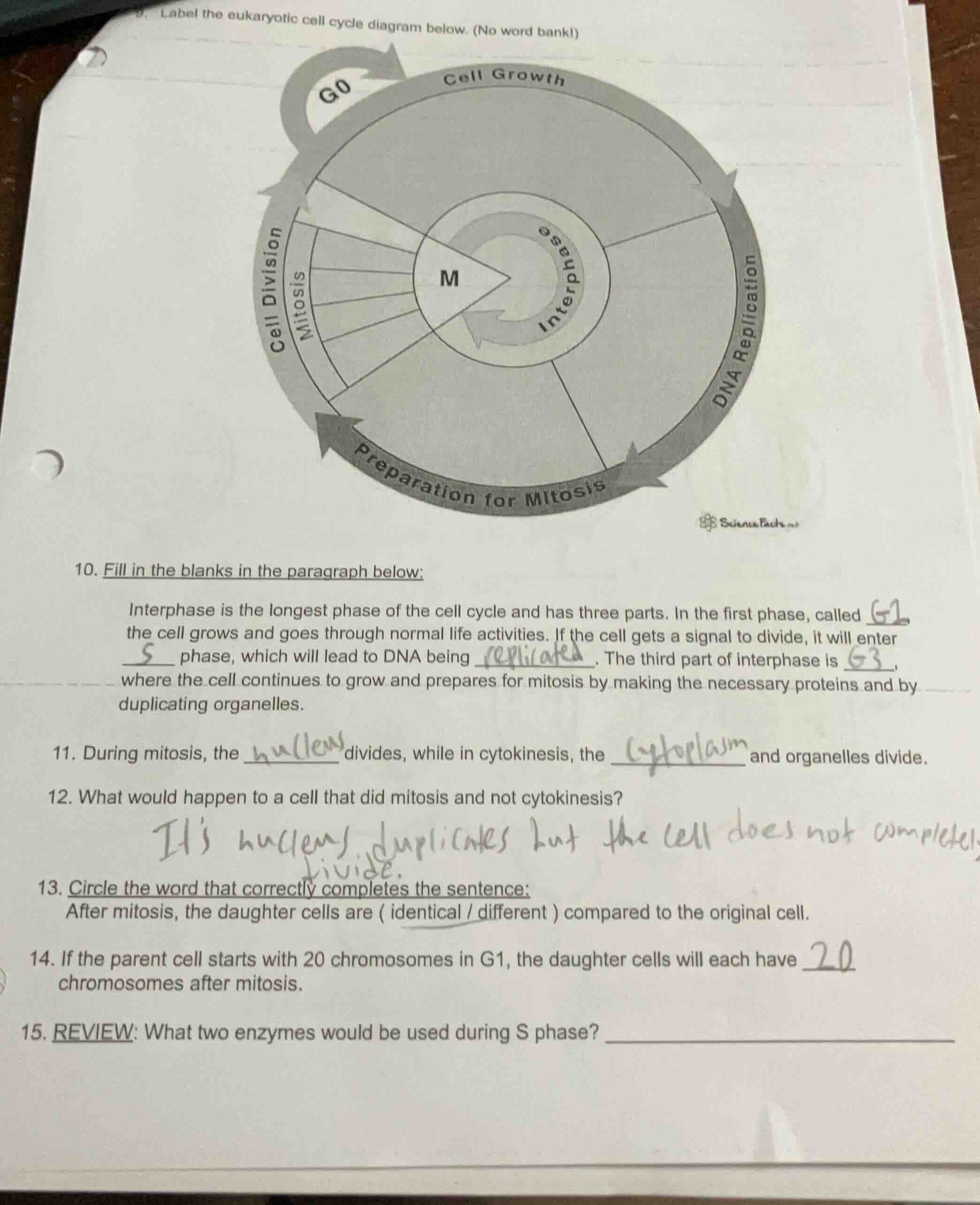
label the eukaryotic cell cycle diagram below. (no word bank!)10. fill in the blanks in the paragraph below:interphase is the longest phase of the cell cycle and has three parts. in the first phase, called __ the cell grows and goes through normal life activities. if the cell gets a signal to divide, it will enter phase, which will lead to dna being . the third part of interphase is , where the cell continues to grow and prepares for mitosis by making the necessary proteins and by duplicating organelles.11. during mitosis, the divides, while in cytokinesis, the and organelles divide.12. what would happen to a cell that did mitosis and not cytokinesis?13. circle the word that correctly completes the sentence:after mitosis, the daughter cells are ( identical / different ) compared to the original cell.14. if the parent cell starts with 20 chromosomes in g1, the daughter cells will each have chromosomes after mitosis.15. review: what two enzymes would be used during s phase? __
Question 15:
The S phase focuses on DNA replication. DNA helicase unwinds the double-stranded DNA molecule to expose the template strands, and DNA polymerase adds complementary nucleotides to build new DNA strands, which are the two key enzymes for this process.
Question 13:
Mitosis is a process of cell division that produces genetically identical daughter cells, as the DNA is replicated exactly and evenly distributed to the new cells.
Question 12:
Mitosis divides the nucleus and its genetic material, but cytokinesis splits the cytoplasm and cell membrane. Without cytokinesis, the nucleus duplicates but the cell does not split into two, resulting in a single cell with multiple nuclei.
Question 11:
Mitosis specifically involves the division of the cell's nucleus to separate chromosomes. Cytokinesis follows mitosis, dividing the cytoplasm (and its organelles) to form two distinct cells.
Question 10:
Interphase has three sequential stages: G1 (Gap 1) is for cell growth and normal function; S (Synthesis) is when DNA replication occurs; G2 (Gap 2) is the final growth and preparation stage for mitosis.

Snap & solve any problem in the app
Get step-by-step solutions on Sovi AI
Photo-based solutions with guided steps
Explore more problems and detailed explanations
- G1; S; replicated; G2
- nucleus; cytoplasm
- The cell will have multiple nuclei (one cell with two sets of genetic material, no full cell division into two separate cells)
- identical
- 20
- DNA helicase and DNA polymerase