QUESTION IMAGE
Question
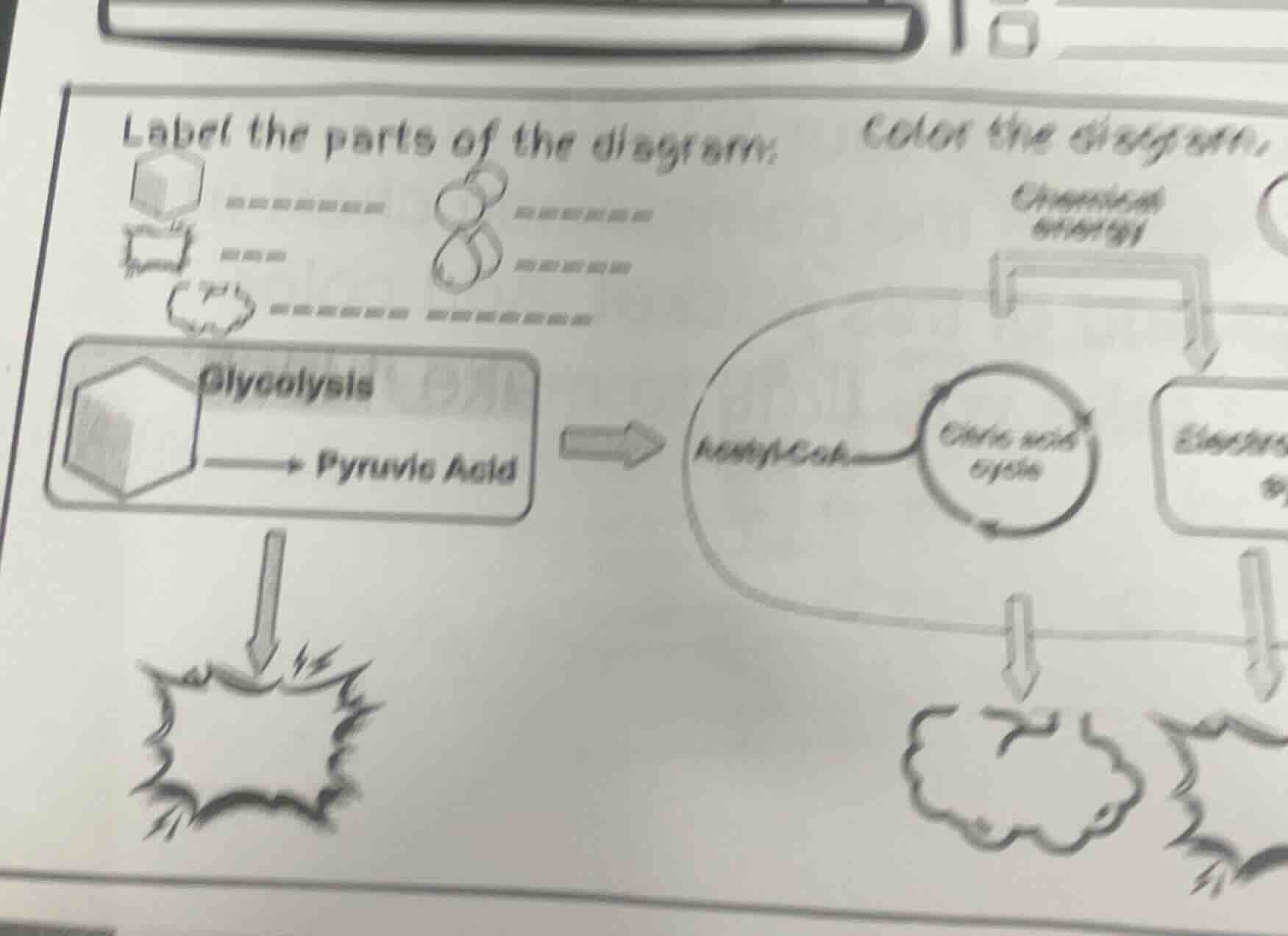
label the parts of the diagram. color the diagram. glycolysis pyruvic acid chemical energy citric acid cycle electro
Brief Explanations
The diagram is about cellular respiration, including glycolysis, pyruvic acid, acetyl - CoA, the citric acid cycle, and related energy - transfer processes. In cellular respiration:
- The hexagon - shaped molecule at the start of glycolysis is glucose ($C_6H_{12}O_6$). Glycolysis breaks down glucose into pyruvic acid.
- The "Pyruvic Acid" is the product of glycolysis.
- After glycolysis, pyruvic acid is converted to acetyl - CoA, which then enters the citric acid cycle (also known as the Krebs cycle).
- The "Citric acid cycle" is a key part of aerobic respiration, where acetyl - CoA is further broken down to release energy in the form of electron carriers (like $NADH$ and $FADH_2$) and some ATP.
- The "Electron..." (likely Electron Transport Chain) is where the electron carriers from the citric acid cycle donate electrons, and this process is used to generate a large amount of ATP, with oxygen as the final electron acceptor (in aerobic conditions).
- The "Chemical energy" is related to the energy stored in molecules like ATP, $NADH$, etc., which is transferred and transformed through these processes.
For labeling:
- The hexagon: Glucose (the starting substrate of glycolysis).
- "Pyruvic Acid": Product of glycolysis.
- "Acetyl - CoA": Intermediate between pyruvic acid and the citric acid cycle.
- "Citric acid cycle": Also called Krebs cycle, processes acetyl - CoA.
- "Electron..." (Electron Transport Chain): Uses electrons from previous steps to make ATP.
- "Chemical energy": Represents the energy in molecules like ATP, $NADH$ during respiration.
For coloring, typically:
- Glucose (hexagon) can be colored a distinct color (e.g., green) to represent the initial sugar.
- Pyruvic acid - related area can be orange.
- Acetyl - CoA and citric acid cycle area can be yellow.
- Electron transport chain area can be red to represent the high - energy electron transfer.
- Chemical energy - related parts can be blue to represent the energy - rich molecules.

Snap & solve any problem in the app
Get step-by-step solutions on Sovi AI
Photo-based solutions with guided steps
Explore more problems and detailed explanations
Labeling:
- Hexagon: Glucose
- "Pyruvic Acid": Product of glycolysis
- "Acetyl - CoA": Intermediate to citric acid cycle
- "Citric acid cycle": Krebs cycle, processes acetyl - CoA
- "Electron..." (likely Electron Transport Chain): Generates ATP from electrons
- "Chemical energy": Energy in ATP, $NADH$, etc.
Coloring (Suggestions):
- Glucose (hexagon): Green
- Pyruvic acid area: Orange
- Acetyl - CoA and citric acid cycle: Yellow
- Electron Transport Chain area: Red
- Chemical energy areas: Blue