QUESTION IMAGE
Question
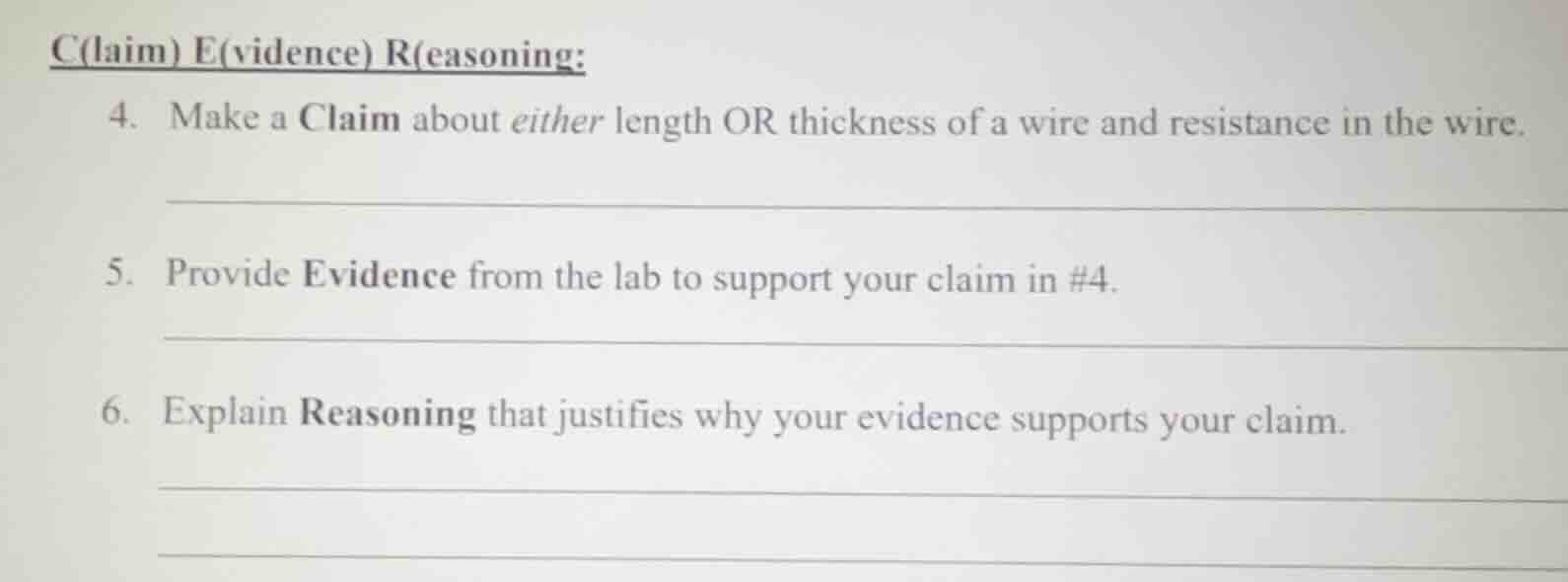
c(laim) e(vidence) r(easoning:
- make a claim about either length or thickness of a wire and resistance in the wire.
- provide evidence from the lab to support your claim in #4.
- explain reasoning that justifies why your evidence supports your claim.
Brief Explanations
For the claim, a standard relationship from electrical physics is selected. The evidence is a typical lab observation that aligns with this relationship, and the reasoning connects the evidence to the claim using the core principle of how wire properties affect electron flow and resistance.

Snap & solve any problem in the app
Get step-by-step solutions on Sovi AI
Photo-based solutions with guided steps
Explore more problems and detailed explanations
- Claim: The resistance of a wire increases as its length increases (when thickness and material are constant).
- Evidence: In the lab, we tested two copper wires of the same thickness: a 10 cm wire had a resistance of 0.2 Ω, while a 20 cm wire of the same type had a resistance of 0.4 Ω.
- Reasoning: Resistance depends on how easily electrons can flow through a wire. A longer wire means electrons have more atoms to collide with, increasing the opposition to their flow. The lab data shows doubling the length doubled the resistance, which matches this relationship, so the evidence supports the claim.