QUESTION IMAGE
Question
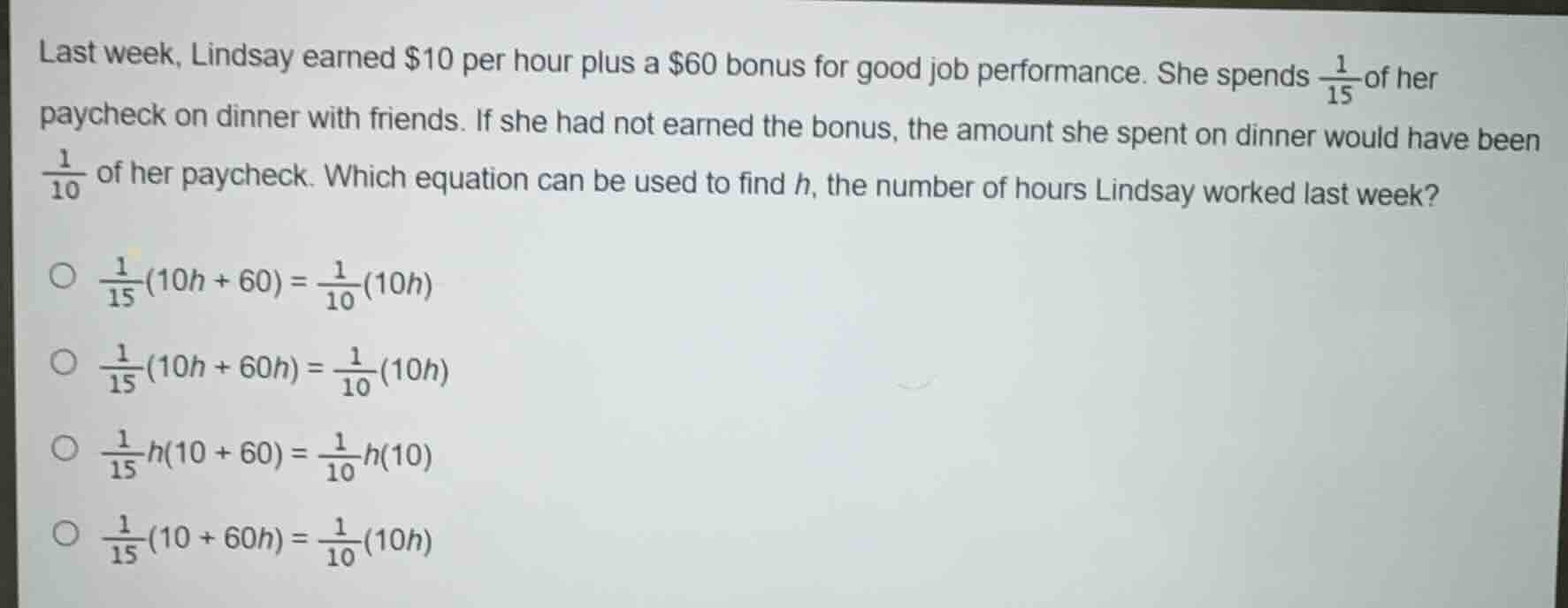
last week, lindsay earned $10 per hour plus a $60 bonus for good job performance. she spends \\(\frac{1}{15}\\) of her paycheck on dinner with friends. if she had not earned the bonus, the amount she spent on dinner would have been \\(\frac{1}{10}\\) of her paycheck. which equation can be used to find \\(h\\), the number of hours lindsay worked last week?\\(\bigcirc\\ \frac{1}{15}(10h + 60) = \frac{1}{10}(10h)\\)\\(\bigcirc\\ \frac{1}{15}(10h + 60h) = \frac{1}{10}(10h)\\)\\(\bigcirc\\ \frac{1}{15}h(10 + 60) = \frac{1}{10}h(10)\\)\\(\bigcirc\\ \frac{1}{15}(10 + 60h) = \frac{1}{10}(10h)\\)
Step1: Determine total earnings with bonus
Lindsay earns $10 per hour for LXI0 hours, so her hourly earnings are LXI1. She also gets a $60 bonus. So total earnings with bonus: \( 10h + 60 \). She spends \( \frac{1}{15} \) of this, so dinner cost: \( \frac{1}{15}(10h + 60) \).
Step2: Determine total earnings without bonus
Without the bonus, her earnings are just \( 10h \). She would spend \( \frac{1}{10} \) of this, so dinner cost: \( \frac{1}{10}(10h) \).
Step3: Set the two dinner costs equal
The amount spent on dinner is the same in both scenarios (the problem states "the amount she spent on dinner would have been" implying the dinner cost is equal in concept, so we set the two expressions equal: \( \frac{1}{15}(10h + 60) = \frac{1}{10}(10h) \).

Snap & solve any problem in the app
Get step-by-step solutions on Sovi AI
Photo-based solutions with guided steps
Explore more problems and detailed explanations
\(\boldsymbol{\frac{1}{15}(10h + 60) = \frac{1}{10}(10h)}\) (the first option)