QUESTION IMAGE
Question
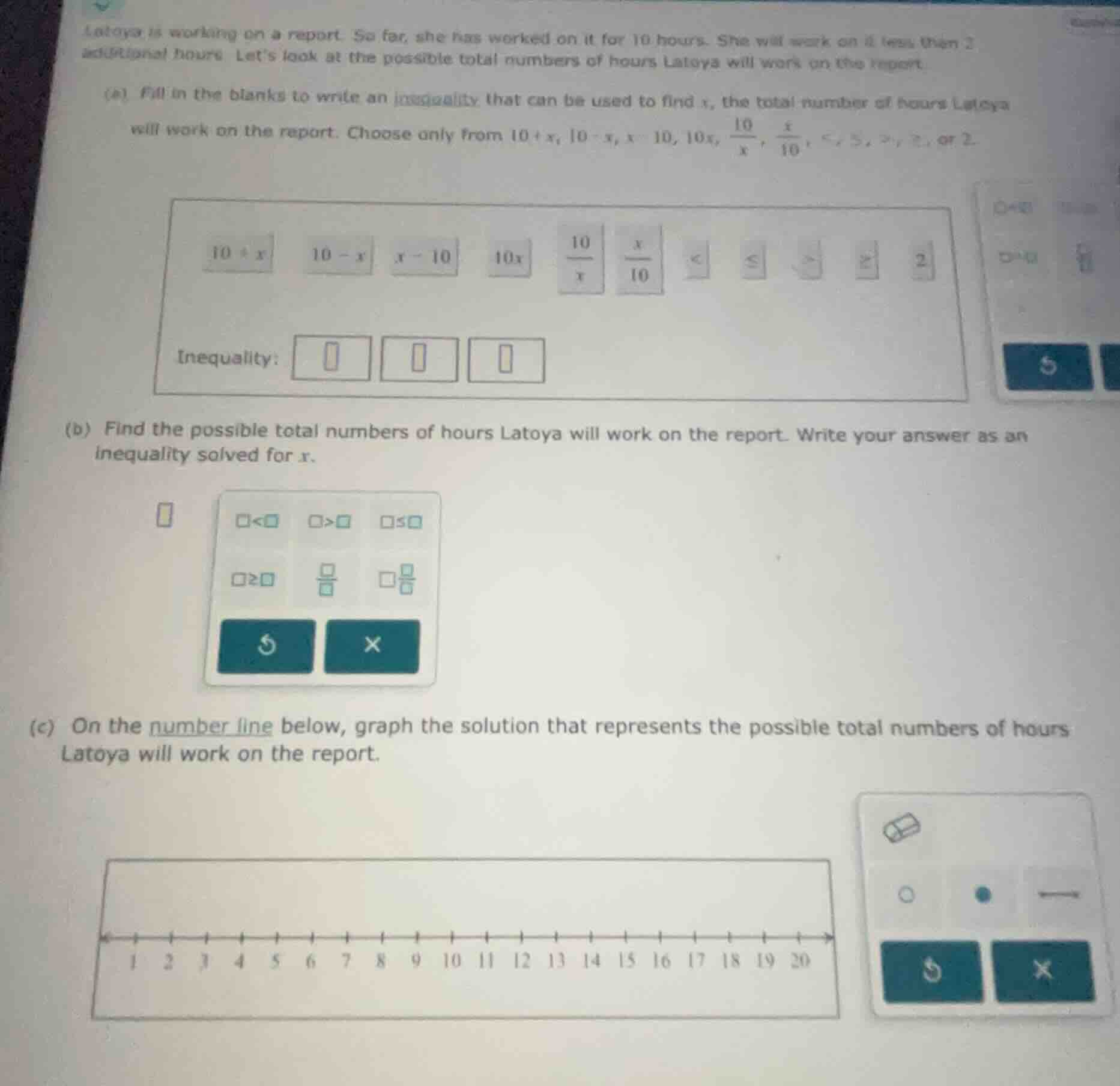
latoya is working on a report. so far, she has worked on it for 10 hours. she will work on it less than 2 additional hours. lets look at the possible total numbers of hours latoya will work on the report.
(a) fill in the blanks to write an inequality that can be used to find x, the total number of hours latoya will work on the report. choose only from (10 + x), (10 - x), (x - 10), (10x), (\frac{10}{x}), (\frac{x}{10}), (<), (>), (leq), (geq), or 2.
inequality: (square) (square) (square)
(b) find the possible total numbers of hours latoya will work on the report. write your answer as an inequality solved for (x).
(c) on the number line below, graph the solution that represents the possible total numbers of hours latoya will work on the report.
number line from 1 to 20 with tick marks
Step1: Define total hours relation
Let \(x\) = total hours, additional hours = \(x - 10\).
Step2: Set up inequality
Additional hours < 2, so \(x - 10 < 2\).
Step3: Solve for total hours
Add 10 to both sides:
\(x - 10 + 10 < 2 + 10\)
\(x < 12\)
Also, total hours > 10 (since she already worked 10 hours and will work more, just less than 2 extra). So \(10 < x < 12\).
Step4: Graph the solution
On the number line, draw an open circle at 10, an open circle at 12, and shade the region between them.

Snap & solve any problem in the app
Get step-by-step solutions on Sovi AI
Photo-based solutions with guided steps
Explore more problems and detailed explanations
(a) Inequality: \(x - 10 < 2\)
(b) \(10 < x < 12\)
(c) On the number line:
- Place an open circle at 10 and an open circle at 12.
- Shade the segment of the number line between 10 and 12.