QUESTION IMAGE
Question
lc algebra 1b - standard (15261)
exponential decay functions
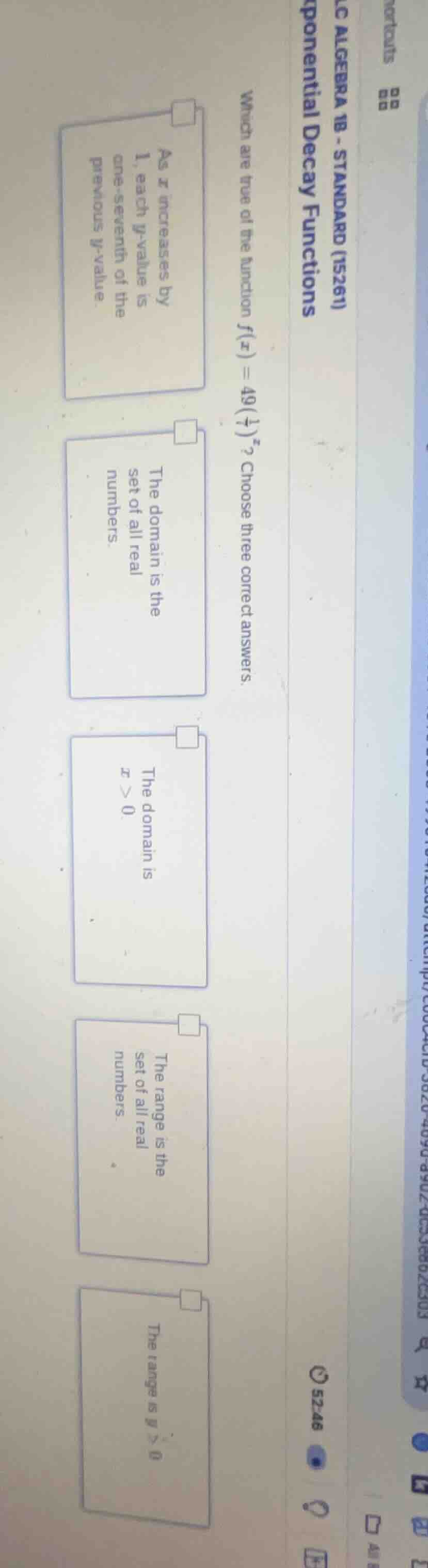
which are true of the function $f(x) = 49\left(\frac{1}{7}\
ight)^x$? choose three correct answers.
as $x$ increases by 1, each $y$-value is one-seventh of the previous $y$-value.
the domain is the set of all real numbers.
the domain is $x > 0$
the range is the set of all real numbers.
the range is $y > 0$
Step1: Analyze domain of $f(x)$
For exponential functions $a(b)^x$, $x$ can be any real number, so domain is all real numbers.
Step2: Analyze range of $f(x)$
$(\frac{1}{7})^x > 0$ for all real $x$, so $49(\frac{1}{7})^x > 0$. Range is $y>0$.
Step3: Analyze rate of change
When $x$ increases by 1:
$f(x+1)=49(\frac{1}{7})^{x+1}=49(\frac{1}{7})^x \cdot \frac{1}{7}=f(x) \cdot \frac{1}{7}$
So each $y$-value is 1/7 of the previous.

Snap & solve any problem in the app
Get step-by-step solutions on Sovi AI
Photo-based solutions with guided steps
Explore more problems and detailed explanations
- As $x$ increases by 1, each $y$-value is one-seventh of the previous $y$-value.
- The domain is the set of all real numbers.
- The range is $y > 0$