QUESTION IMAGE
Question
learning and the brain
when you learn something new, your brain actually changes! you might not be able to see it, but your brain is getting stronger as you work on the problems, just the way that your muscles get stronger when you exercise.
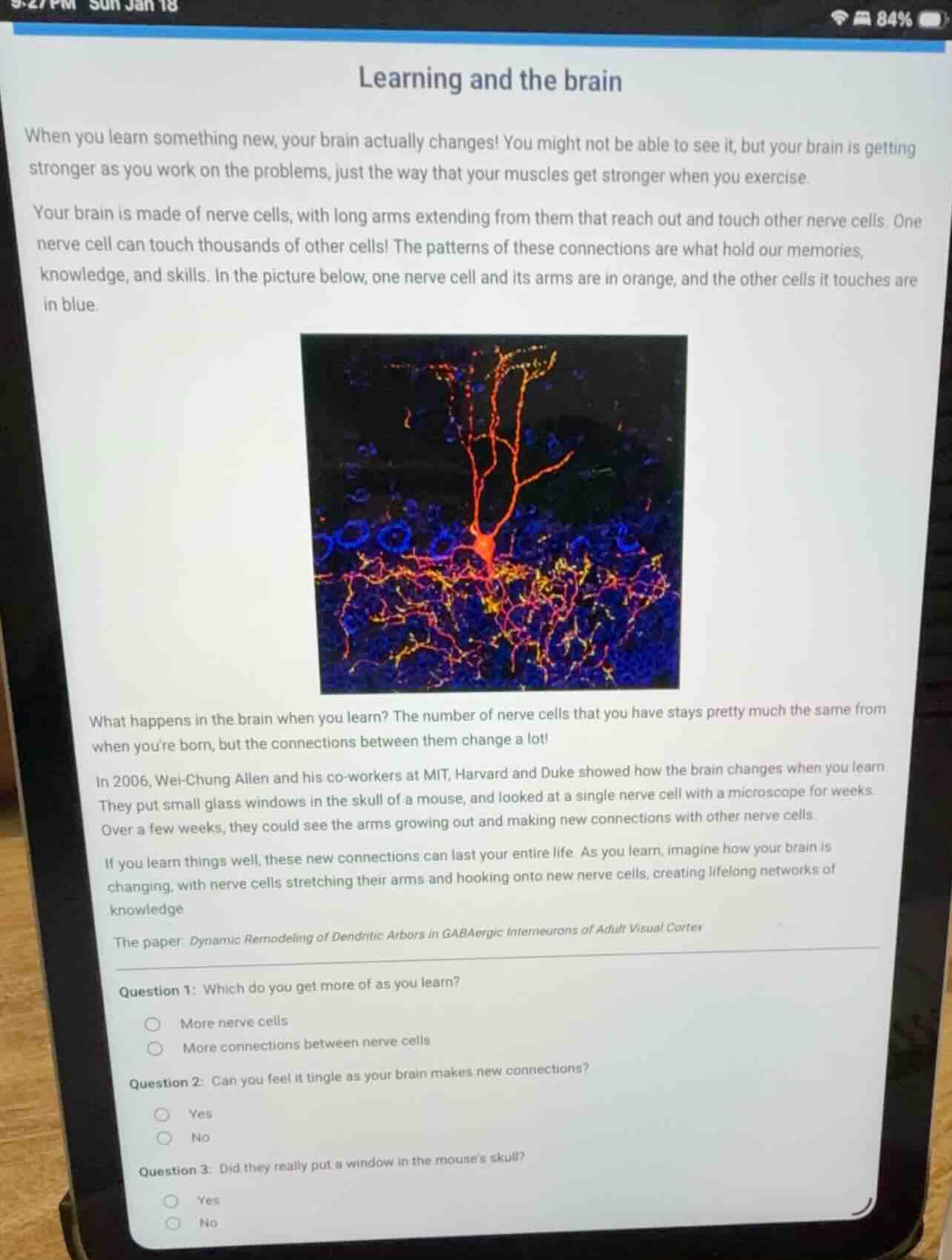
your brain is made of nerve cells, with long arms extending from them that reach out and touch other nerve cells. one nerve cell can touch thousands of other cells! the patterns of these connections are what hold our memories, knowledge, and skills. in the picture below, one nerve cell and its arms are in orange, and the other cells it touches are in blue.
image of nerve cells
what happens in the brain when you learn? the number of nerve cells that you have stays pretty much the same from when youre born, but the connections between them change a lot!
in 2006, wei - chung allen and his co - workers at mit, harvard and duke showed how the brain changes when you learn. they put small glass windows in the skull of a mouse, and looked at a single nerve cell with a microscope for weeks. over a few weeks, they could see the arms growing out and making new connections with other nerve cells.
if you learn things well, these new connections can last your entire life. as you learn, imagine how your brain is changing, with nerve cells stretching their arms and hooking onto new nerve cells, creating lifelong networks of knowledge
the paper: dynamic remodeling of dendritic arbors in gabaergic interneurons of adult visual cortex
question 1: which do you get more of as you learn?
○ more nerve cells
○ more connections between nerve cells
question 2: can you feel it tingle as your brain makes new connections?
○ yes
○ no
question 3: did they really put a window in the mouses skull?
○ yes
○ no
Question 1: The text states the number of nerve cells stays similar, but connections change a lot and grow new ones with learning.
Question 2: The text does not mention any physical tingling sensation from new brain connections, and this is not a documented sensory experience of learning-related brain changes.
Question 3: The text explicitly says researchers put small glass windows in mouse skulls for their study.

Snap & solve any problem in the app
Get step-by-step solutions on Sovi AI
Photo-based solutions with guided steps
Explore more problems and detailed explanations
- More connections between nerve cells
- No
- Yes