QUESTION IMAGE
Question
lesson 17 | session 1
complete problems 3–5.
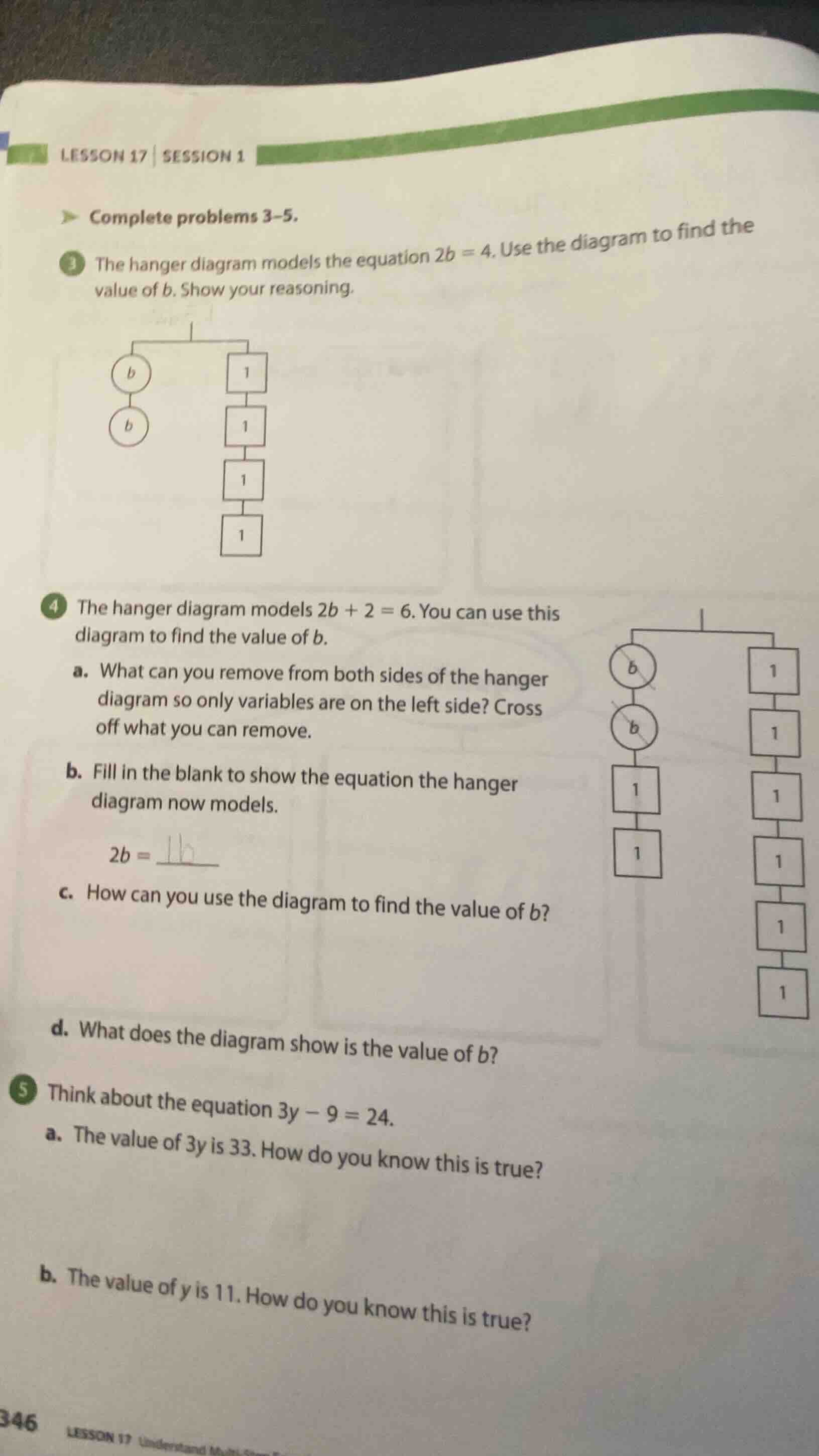
3 the hanger diagram models the equation $2b = 4$. use the diagram to find the value of $b$. show your reasoning.
hanger diagram with two $b$ circles on left and four 1 squares on right
4 the hanger diagram models $2b + 2 = 6$. you can use this diagram to find the value of $b$.
a. what can you remove from both sides of the hanger diagram so only variables are on the left side? cross off what you can remove.
b. fill in the blank to show the equation the hanger diagram now models.
$2b = \underline{\quad\quad}$
c. how can you use the diagram to find the value of $b$?
d. what does the diagram show is the value of $b$?
hanger diagram with two $b$ circles and two 1 squares on left, six 1 squares on right
5 think about the equation $3y - 9 = 24$.
a. the value of $3y$ is 33. how do you know this is true?
b. the value of $y$ is 11. how do you know this is true?
Problem 3
Step1: Analyze the hanger diagram
The hanger has 2 \( b \)-weights on the left and 4 \( 1 \)-weights on the right, modeling \( 2b = 4 \).
Step2: Solve for \( b \)
To find \( b \), we divide both sides of the equation \( 2b = 4 \) by 2.
\( b=\frac{4}{2} \)
Step3: Calculate the value
\( \frac{4}{2}=2 \)
In the hanger diagram for \( 2b + 2 = 6 \), there are 2 \( 1 \)-weights on the left (below the \( b \)-weights) and 2 \( 1 \)-weights on the right (the top two). To have only variables on the left, we can remove 2 \( 1 \)-weights from both sides (cross off the two \( 1 \)-weights from the left below the \( b \)-weights and the top two \( 1 \)-weights from the right).
Step1: Analyze the original equation
The original equation is \( 2b + 2=6 \). When we remove 2 (1 - unit) weights from both sides, we subtract 2 from both sides of the equation.
\( 2b+2 - 2=6 - 2 \)
Step2: Simplify the equation
Simplifying both sides, we get \( 2b=4 \)

Snap & solve any problem in the app
Get step-by-step solutions on Sovi AI
Photo-based solutions with guided steps
Explore more problems and detailed explanations
The value of \( b \) is 2.