QUESTION IMAGE
Question
lesson 19 | session 5
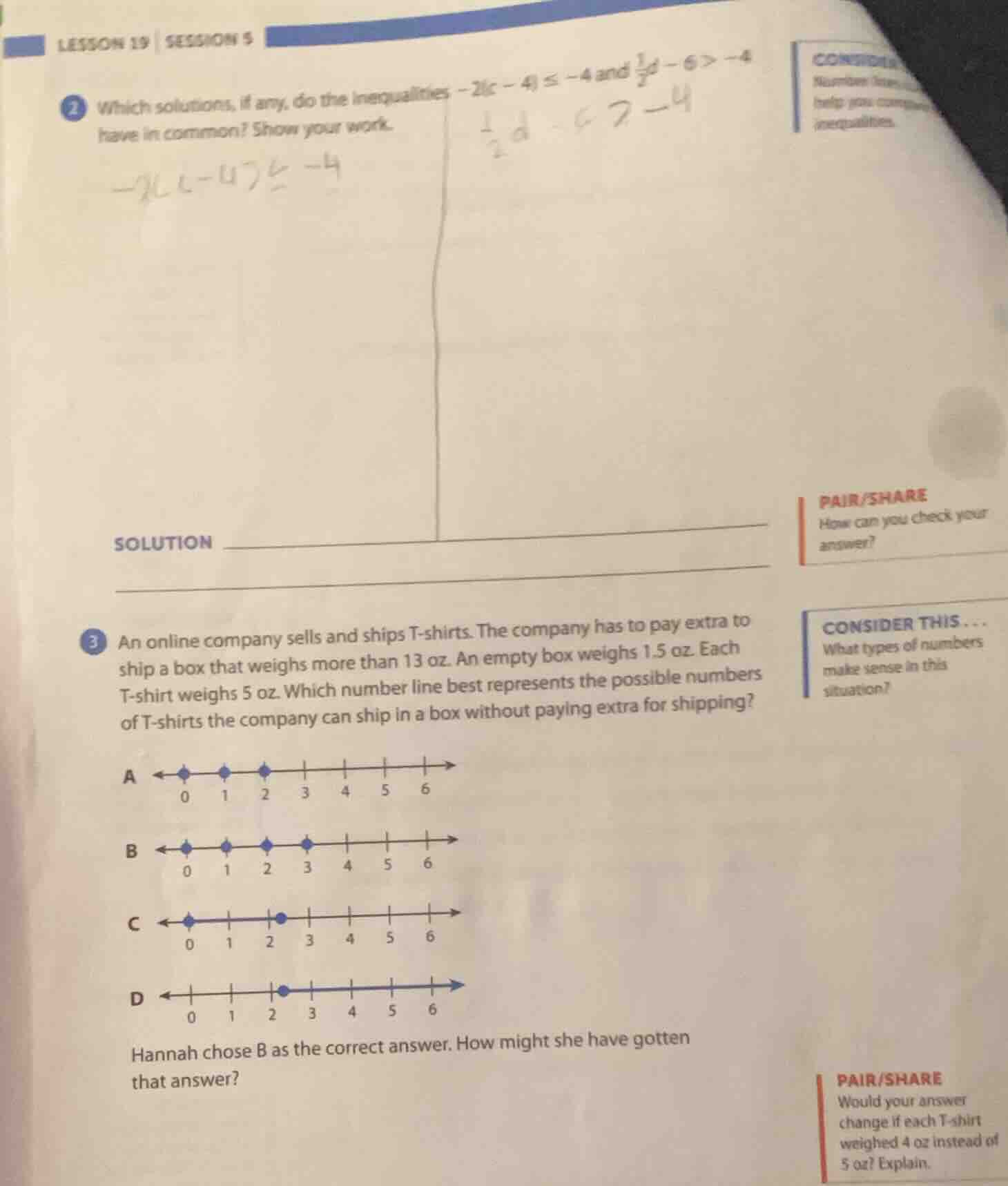
2 which solutions, if any, do the inequalities $-2(c - 4) \leq -4$ and $\frac{1}{2}d - 6 > -4$ have in common? show your work.
solution
3 an online company sells and ships t - shirts. the company has to pay extra to ship a box that weighs more than 13 oz. an empty box weighs 1.5 oz. each t - shirt weighs 5 oz. which number line best represents the possible numbers of t - shirts the company can ship in a box without paying extra for shipping?
a
<----•----•----•----|----|----|----|--->
0 1 2 3 4 5 6
b
<----•----•----•----•----|----|----|--->
0 1 2 3 4 5 6
c
<----•----|----|----•----|----|----|--->
0 1 2 3 4 5 6
d
<----|----|----|----•----|----|----|--->
0 1 2 3 4 5 6
hannah chose b as the correct answer. how might she have gotten that answer?
Problem 2 (Inequalities)
Step 1: Solve \(-2(c - 4) \leq -4\)
Divide both sides by \(-2\) (remember to reverse the inequality sign):
\(c - 4 \geq \frac{-4}{-2}\)
\(c - 4 \geq 2\)
Add 4 to both sides:
\(c \geq 2 + 4\)
\(c \geq 6\)
Step 2: Solve \(\frac{1}{2}d - 6 > -4\)
Add 6 to both sides:
\(\frac{1}{2}d > -4 + 6\)
\(\frac{1}{2}d > 2\)
Multiply both sides by 2:
\(d > 4\)
Step 3: Find common solutions
The solution to the first inequality is \(c \geq 6\) and the second is \(d > 4\). The common solutions would be values where \(x \geq 6\) (since \(c \geq 6\) is a subset of \(d > 4\) for \(x \geq 6\)). Wait, actually, the variables are different (\(c\) and \(d\)), but if we consider the number lines, the first inequality's solution is \(c \geq 6\) and the second is \(d > 4\). There's a mis - variable, but assuming it's a typo and same variable, say \(x\), then solving \(-2(x - 4) \leq -4\) gives \(x \geq 6\) and \(\frac{1}{2}x - 6 > -4\) gives \(x > 4\). The common solutions are \(x \geq 6\) (since \(x \geq 6\) satisfies \(x > 4\)). But if variables are different, there's no common solution in terms of variable values. But likely a typo, so for the same variable, the common solution is \(x \geq 6\).
Let \(n\) be the number of T - shirts. The weight of the box with T - shirts is \(1.5+5n\) ounces. The company does not pay extra if the weight is \(\leq13\) oz. So we solve the inequality \(1.5 + 5n\leq13\).
Subtract \(1.5\) from both sides: \(5n\leq13 - 1.5=11.5\)
Divide both sides by \(5\): \(n\leq\frac{11.5}{5}=2.3\)
Since the number of T - shirts \(n\) must be a non - negative integer (\(n = 0,1,2\)), the number line should have closed circles at 0, 1, 2 (since \(n\) can be 0, 1, or 2) and no circle at 3 (because \(n = 3\) would make the weight \(1.5+5\times3=16.5>13\)). Looking at the options, option A has closed circles at 0, 1, 2.
Hannah might have made a mistake in setting up the inequality. She might have set up \(1.5 + 5n<13\) (instead of \(\leq13\)) and solved \(5n<11.5\), \(n < 2.3\), but then incorrectly included \(n = 3\) (since \(1.5+5\times3 = 16.5>13\)), which is wrong. Or she might have miscalculated the inequality, for example, when solving \(1.5+5n\leq13\), she might have done \(5n\leq13 + 1.5\) (adding 1.5 instead of subtracting) leading to \(5n\leq14.5\), \(n\leq2.9\), and then included \(n = 3\) incorrectly.

Snap & solve any problem in the app
Get step-by-step solutions on Sovi AI
Photo-based solutions with guided steps
Explore more problems and detailed explanations
If we assume the same variable (correcting the typo), the common solutions are \(x \geq 6\). If variables are different (\(c\) and \(d\)), there is no common solution for the variable values.