QUESTION IMAGE
Question
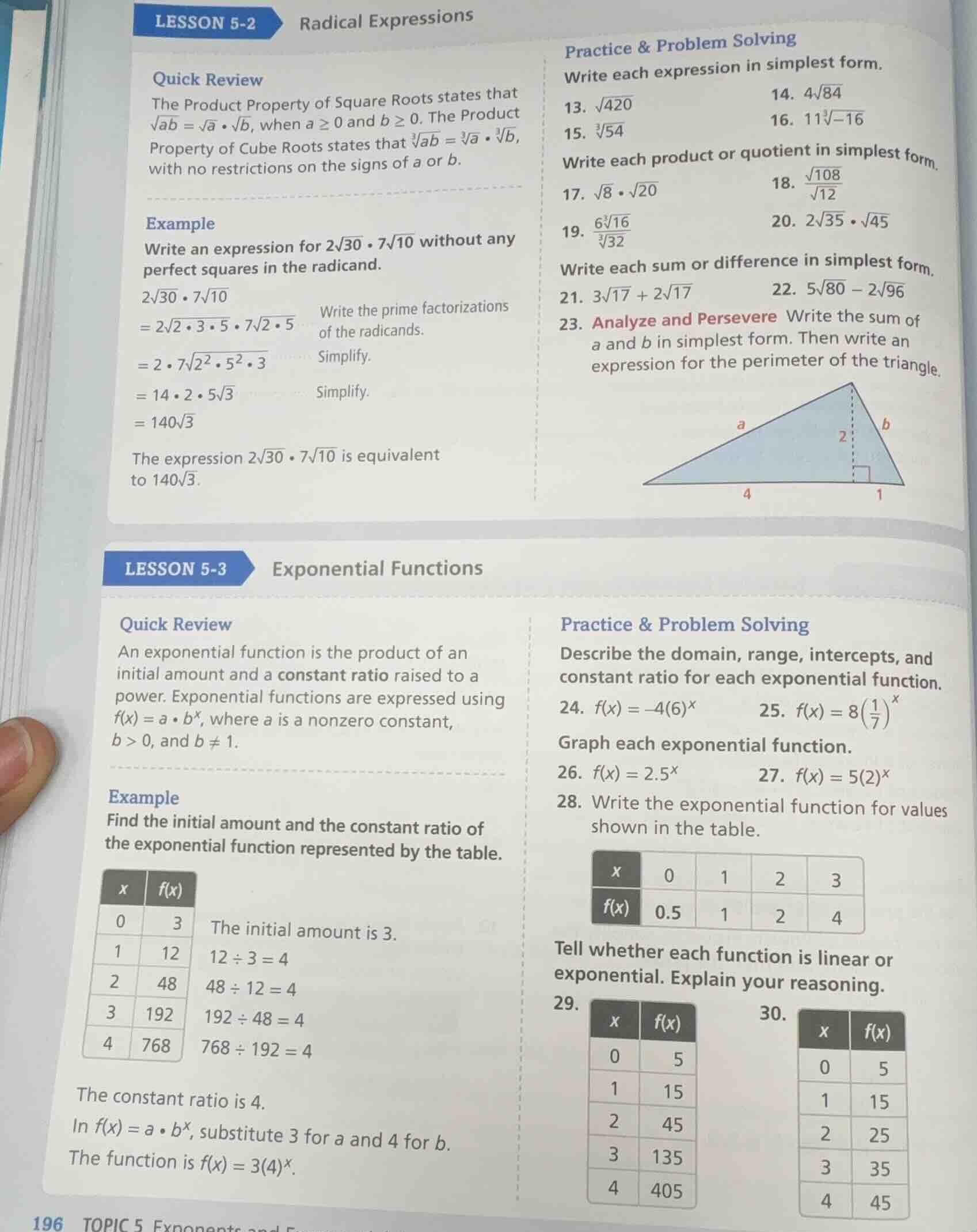
lesson 5-2 radical expressions
quick review
the product property of square roots states that (sqrt{ab} = sqrt{a} cdot sqrt{b}), when (a geq 0) and (b geq 0). the product property of cube roots states that (sqrt3{ab} = sqrt3{a} cdot sqrt3{b}), with no restrictions on the signs of (a) or (b).
example
write an expression for (2sqrt{30} cdot 7sqrt{10}) without any perfect squares in the radicand.
(2sqrt{30} cdot 7sqrt{10})
(= 2sqrt{2 cdot 3 cdot 5} cdot 7sqrt{2 cdot 5}) (write the prime factorizations of the radicands.)
(= 2 cdot 7sqrt{2^2 cdot 5^2 cdot 3}) (simplify.)
(= 14 cdot 2 cdot 5sqrt{3}) (simplify.)
(= 140sqrt{3})
the expression (2sqrt{30} cdot 7sqrt{10}) is equivalent to (140sqrt{3}).
practice & problem solving
write each expression in simplest form.
- (sqrt{420}) 14. (4sqrt{84})
- (sqrt3{54}) 16. (11sqrt3{-16})
write each product or quotient in simplest form.
- (sqrt{8} cdot sqrt{20}) 18. (\frac{sqrt{108}}{sqrt{12}})
- (\frac{6sqrt3{16}}{sqrt3{32}}) 20. (2sqrt{35} cdot sqrt{45})
write each sum or difference in simplest form.
- (3sqrt{17} + 2sqrt{17}) 22. (5sqrt{80} - 2sqrt{96})
- analyze and persevere write the sum of (a) and (b) in simplest form. then write an expression for the perimeter of the triangle.
(image of a triangle with base segments 4 and 1, height 2, sides (a) and (b))
lesson 5-3 exponential functions
quick review
an exponential function is the product of an initial amount and a constant ratio raised to a power. exponential functions are expressed using (f(x) = a cdot b^x), where (a) is a nonzero constant, (b > 0), and (b
eq 1).
example
find the initial amount and the constant ratio of the exponential function represented by the table.
| (x) | (f(x)) |
|---|---|
| 1 | 12 |
| 2 | 48 |
| 3 | 192 |
| 4 | 768 |
the initial amount is 3.
(12 div 3 = 4)
(48 div 12 = 4)
(192 div 48 = 4)
(768 div 192 = 4)
the constant ratio is 4.
in (f(x) = a cdot b^x), substitute 3 for (a) and 4 for (b).
the function is (f(x) = 3(4)^x).
practice & problem solving
describe the domain, range, intercepts, and constant ratio for each exponential function.
- (f(x) = -4(6)^x) 25. (f(x) = 8left(\frac{1}{7}
ight)^x)
graph each exponential function.
- (f(x) = 2.5^x) 27. (f(x) = 5(2)^x)
- write the exponential function for values shown in the table.
| (x) | 0 | 1 | 2 | 3 |
|---|
tell whether each function is linear or exponential. explain your reasoning.
- | (x) | (f(x)) |
| 0 | 5 |
| 1 | 15 |
| 2 | 45 |
| 3 | 135 |
| 4 | 405 |
- | (x) | (f(x)) |
| 0 | 5 |
| 1 | 15 |
| 2 | 25 |
| 3 | 35 |
| 4 | 45 |
196 topic 5 exponents...
To solve these problems, we'll address a few of them step by step. Let's start with simplifying radical expressions (Lesson 5-2) and then move to exponential functions (Lesson 5-3).
Problem 13: Simplify \(\boldsymbol{\sqrt{420}}\)
Step 1: Prime Factorize 420
Find the prime factors of 420: \( 420 = 2^2 \cdot 3 \cdot 5 \cdot 7 \).
Step 2: Apply the Product Property of Square Roots
Using \( \sqrt{ab} = \sqrt{a} \cdot \sqrt{b} \) (for \( a, b \geq 0 \)):
\( \sqrt{420} = \sqrt{2^2 \cdot 3 \cdot 5 \cdot 7} = \sqrt{2^2} \cdot \sqrt{3 \cdot 5 \cdot 7} \).
Step 3: Simplify the Perfect Square
\( \sqrt{2^2} = 2 \), so:
\( \sqrt{420} = 2\sqrt{105} \).
Problem 24: Analyze \(\boldsymbol{f(x) = -4(6)^x}\) (Exponential Function)
Step 1: Identify \( a \) and \( b \) in \( \boldsymbol{f(x) = a \cdot b^x} \)
For \( f(x) = -4(6)^x \), \( a = -4 \) (initial amount) and \( b = 6 \) (constant ratio).
Step 2: Domain
The domain of an exponential function \( f(x) = a \cdot b^x \) is all real numbers (\( \mathbb{R} \)), since \( x \) can be any real number.
Step 3: Range
Since \( 6^x > 0 \) for all \( x \), multiplying by \( -4 \) gives \( -4(6)^x < 0 \). Thus, the range is \( (-\infty, 0) \).
Step 4: Intercepts
- y-intercept: Set \( x = 0 \): \( f(0) = -4(6)^0 = -4(1) = -4 \). So the y-intercept is \( (0, -4) \).
- x-intercept: Set \( f(x) = 0 \): \( -4(6)^x = 0 \). But \( 6^x > 0 \), so \( -4(6)^x \) can never be 0. No x-intercept.
Step 5: Constant Ratio
The constant ratio \( b = 6 \) (since \( f(x) = a \cdot b^x \), \( b = 6 \)).
Problem 28: Find the Exponential Function for the Table
The table is:
| \( x \) | 0 | 1 | 2 | 3 |
| \( f(x) \) | 0.5 | 1 | 2 | 4 |
Step 1: Identify \( a \) (Initial Amount)
At \( x = 0 \), \( f(0) = 0.5 \), so \( a = 0.5 \).
Step 2: Find the Constant Ratio \( b \)
Divide consecutive \( f(x) \)-values:
- \( \frac{f(1)}{f(0)} = \frac{1}{0.5} = 2 \)
- \( \frac{f(2)}{f(1)} = \frac{2}{1} = 2 \)
- \( \frac{f(3)}{f(2)} = \frac{4}{2} = 2 \)
Thus, \( b = 2 \).
Step 3: Write the Exponential Function
Using \( f(x) = a \cdot b^x \):
\( f(x) = 0.5(2)^x \) (or \( f(x) = \frac{1}{2}(2)^x = 2^{x - 1} \)).
Problem 29: Is \(\boldsymbol{f(x)}\) Linear or Exponential?
The table is:
| \( x \) | 0 | 1 | 2 | 3 | 4 |
| \( f(x) \) | 5 | 15 | 45 | 135 | 405 |

Snap & solve any problem in the app
Get step-by-step solutions on Sovi AI
Photo-based solutions with guided steps
Explore more problems and detailed explanations
Step 1: Check for Constant Difference (Linear)
Calculate differences between consecutive \( f(x) \)-values:
- \( 15 - 5 = 10 \)
- \( 45 - 15 = 30 \)
- \( 135 - 45 = 90 \)
- \( 405 - 135 = 270 \)
Differences are not constant (10, 30, 90, 270), so not linear.
Step 2: Check for Constant Ratio (Exponential)
Calculate ratios between consecutive \( f(x) \)-values:
- \( \frac{15}{5} = 3 \)
- \( \frac{45}{15} = 3 \)
- \( \frac{135}{45} = 3 \)
- \( \frac{405}{135} = 3 \)
Ratios are constant (\( b = 3 \)), so the function is exponential.
Final Answers
- Problem 13: \( \boldsymbol{2\sqrt{105}} \)
- Problem 24:
- Domain: \( \boldsymbol{\mathbb{R}} \)
- Range: \( \boldsymbol{(-\infty, 0)} \)
- y-intercept: \( \boldsymbol{(0, -4)} \) (no x-intercept)
- Constant ratio: \( \boldsymbol{6} \)
- Problem 28: \( \boldsymbol{f(x) = 0.5(2)^x} \) (or \( \boldsymbol{f(x) = 2^{x - 1}} \))
- Problem 29: \( \boldsymbol{\text{Exponential (constant ratio of 3)}} \)