QUESTION IMAGE
Question
lesson 4.1.4 enlightenment democra
name
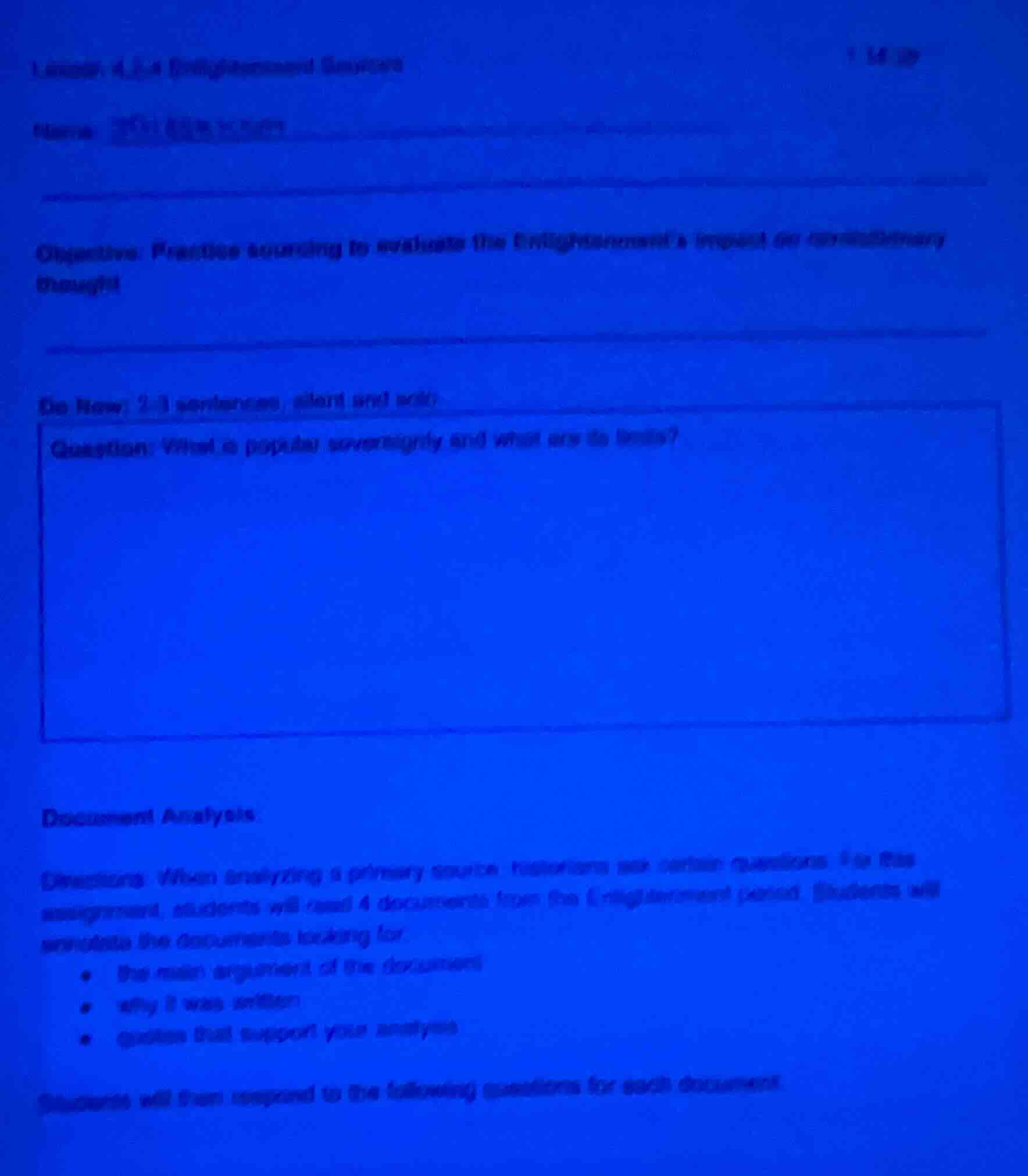
objective: practice sourcing to evaluate the enlightenment’s impact on revolutionary thought
do now: 2-3 sentences, short and sweet
question: what is popular sovereignty and what are its limits?
document analysis
directions: when analyzing a primary source, historians ask certain questions. for this assignment, students will read 4 documents from the enlightenment period. students will evaluate the documents looking for:
- the main argument of the document
- why it was written
- evidence that support your analysis
students will then respond to the following questions for each document:
Popular sovereignty is the principle that a state's authority and government are created and sustained by the consent of its people, who are the source of all political power. Its limits include:
- It cannot violate fundamental individual rights (like those in a bill of rights) to protect minority groups from tyranny of the majority.
- It is constrained by legal frameworks (constitutions, laws) that set rules for how popular will is expressed and implemented.
- Practical limits exist, such as the inability of the public to directly weigh in on every complex policy issue, requiring representative systems that may not perfectly mirror immediate popular sentiment.

Snap & solve any problem in the app
Get step-by-step solutions on Sovi AI
Photo-based solutions with guided steps
Explore more problems and detailed explanations
Popular Sovereignty Definition: A political principle where the legitimacy of a government and its authority derive from the consent and will of the people, who are the ultimate source of political power.
Limits of Popular Sovereignty:
- Protection of minority rights: It cannot be used to override the fundamental rights of marginalized or minority groups, preventing the "tyranny of the majority."
- Legal and constitutional constraints: It operates within the bounds of a constitution or legal system that establishes rules for how popular will is channeled (e.g., elections, checks and balances).
- Practical feasibility: The public cannot directly participate in every governance decision, so representative structures may moderate direct popular control, and complex technical issues may require expert input over direct popular vote.