QUESTION IMAGE
Question
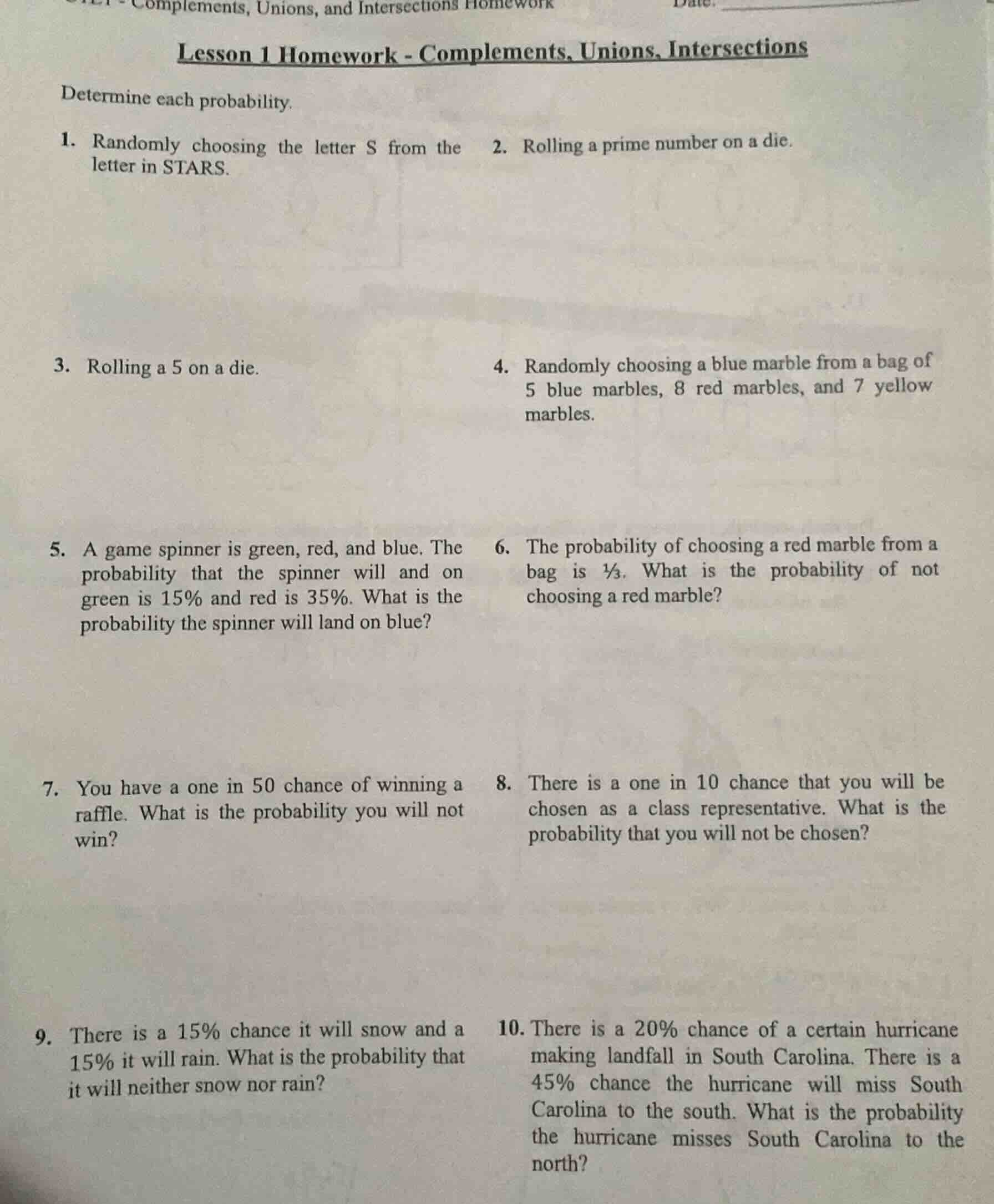
lesson 1 homework - complements, unions, intersections
determine each probability.
- randomly choosing the letter s from the letter in stars. 2. rolling a prime number on a die.
- rolling a 5 on a die. 4. randomly choosing a blue marble from a bag of 5 blue marbles, 8 red marbles, and 7 yellow marbles.
- a game spinner is green, red, and blue. the probability that the spinner will and on green is 15% and red is 35%. what is the probability the spinner will land on blue? 6. the probability of choosing a red marble from a bag is ⅓. what is the probability of not choosing a red marble?
- you have a one in 50 chance of winning a raffle. what is the probability you will not win? 8. there is a one in 10 chance that you will be chosen as a class representative. what is the probability that you will not be chosen?
- there is a 15% chance it will snow and a 15% it will rain. what is the probability that it will neither snow nor rain? 10. there is a 20% chance of a certain hurricane making landfall in south carolina. there is a 45% chance the hurricane will miss south carolina to the south. what is the probability the hurricane misses south carolina to the north?
Problem 1: Randomly choosing the letter S from the letters in STARS.
Step 1: Count total letters
The word "STARS" has 5 letters: S, T, A, R, S. So total number of letters \( n = 5 \).
Step 2: Count number of S
Number of S in "STARS" is 2. Let \( m = 2 \).
Step 3: Calculate probability
Probability \( P = \frac{m}{n} = \frac{2}{5} \).
Step 1: Identify prime numbers on die
A die has numbers 1, 2, 3, 4, 5, 6. Prime numbers are 2, 3, 5. So number of prime numbers \( m = 3 \).
Step 2: Total outcomes
Total outcomes when rolling a die \( n = 6 \).
Step 3: Calculate probability
Probability \( P = \frac{m}{n} = \frac{3}{6} = \frac{1}{2} \).
Step 1: Total outcomes
A die has 6 faces, so total outcomes \( n = 6 \).
Step 2: Favorable outcomes
Only 1 face has 5, so favorable outcomes \( m = 1 \).
Step 3: Calculate probability
Probability \( P = \frac{m}{n} = \frac{1}{6} \).

Snap & solve any problem in the app
Get step-by-step solutions on Sovi AI
Photo-based solutions with guided steps
Explore more problems and detailed explanations
\(\frac{2}{5}\)