QUESTION IMAGE
Question
lesson 3 homework 5•1
name brocky urauser date 4/8/26
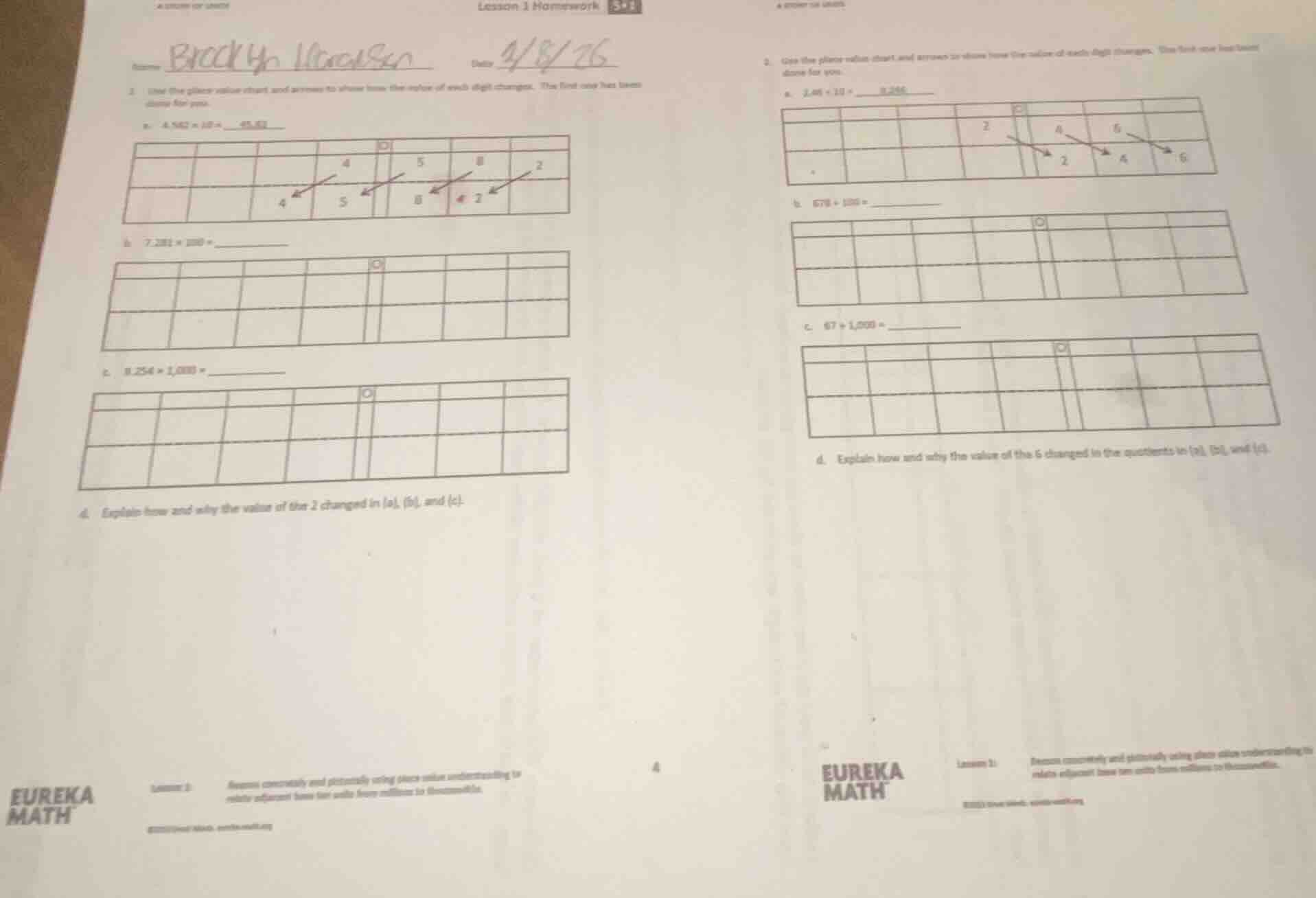
- use the place value chart and arrows to show how the value of each digit changes. the first one has been done for you.
a. 4.562 × 10 = 45.62
chart with digits 4,5,8,2 and arrows
b. 7.281 × 1000 =
empty place value chart
c. 8.254 × 1,000 =
empty place value chart
- explain how and why the value of the 2 changed in (a), (b), and (c).
- use the place value chart and arrows to show how the value of each digit changes. the first one has been done for you.
a. 3.48 ÷ 10 = 0.348
chart with digits 2,4,6 and arrows
b. 678 ÷ 100 =
empty place value chart
c. 87 ÷ 1,000 =
empty place value chart
- explain how and why the value of the 5 changed in the quotients in (a), (b), and (c).
eureka math
lesson 3: reason concretely and pictorially using place value understanding to relate adjacent base ten units from millions to thousandths.
Step1: Solve 7.281 × 100
When multiplying by 100, shift digits 2 places right.
$7.281 \times 100 = 728.1$
Step2: Solve 9.254 × 1,000
When multiplying by 1000, shift digits 3 places right.
$9.254 \times 1000 = 9254$
Step3: Explain digit 2's value change (Q4)
- In (a): 2 is hundredths place ($0.02$).
- In (b): 2 shifts to ones place ($2$), 100× larger.
- In (c): 2 shifts to hundreds place ($200$), 10,000× larger than (a).
Multiplication by 10/100/1000 increases place value.
Step4: Solve 678 ÷ 100
When dividing by 100, shift digits 2 places left.
$678 \div 100 = 6.78$
Step5: Solve 67 ÷ 1,000
When dividing by 1000, shift digits 3 places left.
$67 \div 1000 = 0.067$
Step6: Explain digit 6's value change (Q2d)
- In (a): 6 is hundredths place ($0.06$).
- In (b): 6 is ones place ($6$), 100× larger than (a).
- In (c): 6 is hundredths place ($0.06$), 100× smaller than (b).
Division by 10/100/1000 decreases place value.

Snap & solve any problem in the app
Get step-by-step solutions on Sovi AI
Photo-based solutions with guided steps
Explore more problems and detailed explanations
Question 1:
b. $728.1$
c. $9254$
Question 4:
In part (a), the 2 represents 0.02 (hundredths place). In part (b), multiplying by 100 shifts the 2 to the ones place, making it worth 2 (100 times larger than in (a)). In part (c), multiplying by 1000 shifts the 2 to the hundreds place, making it worth 200 (10,000 times larger than in (a)). Multiplying by powers of 10 moves digits to higher place values, increasing their worth.
Question 2:
b. $6.78$
c. $0.067$
d. In part (a), the 6 represents 0.06 (hundredths place). In part (b), dividing 678 by 100 shifts the 6 to the ones place, making it worth 6 (100 times larger than in (a)). In part (c), dividing 67 by 1000 shifts the 6 to the hundredths place, making it worth 0.06 (100 times smaller than in (b)). Dividing by powers of 10 moves digits to lower place values, decreasing their worth.
---
Place Value Charts (filled):
Question 1b:
| Hundreds | Tens | Ones | . | Tenths | Hundredths | Thousandths |
|---|
(Arrows shift 7.281 digits 2 places right)
Question 1c:
| Thousands | Hundreds | Tens | Ones | . | Tenths |
|---|
(Arrows shift 9.254 digits 3 places right)
Question 2b:
| Tens | Ones | . | Tenths | Hundredths |
|---|
(Arrows shift 678 digits 2 places left)
Question 2c:
| Ones | . | Tenths | Hundredths | Thousandths |
|---|
(Arrows shift 67 digits 3 places left)