QUESTION IMAGE
Question
lesson 7 homework 1•3
name
date
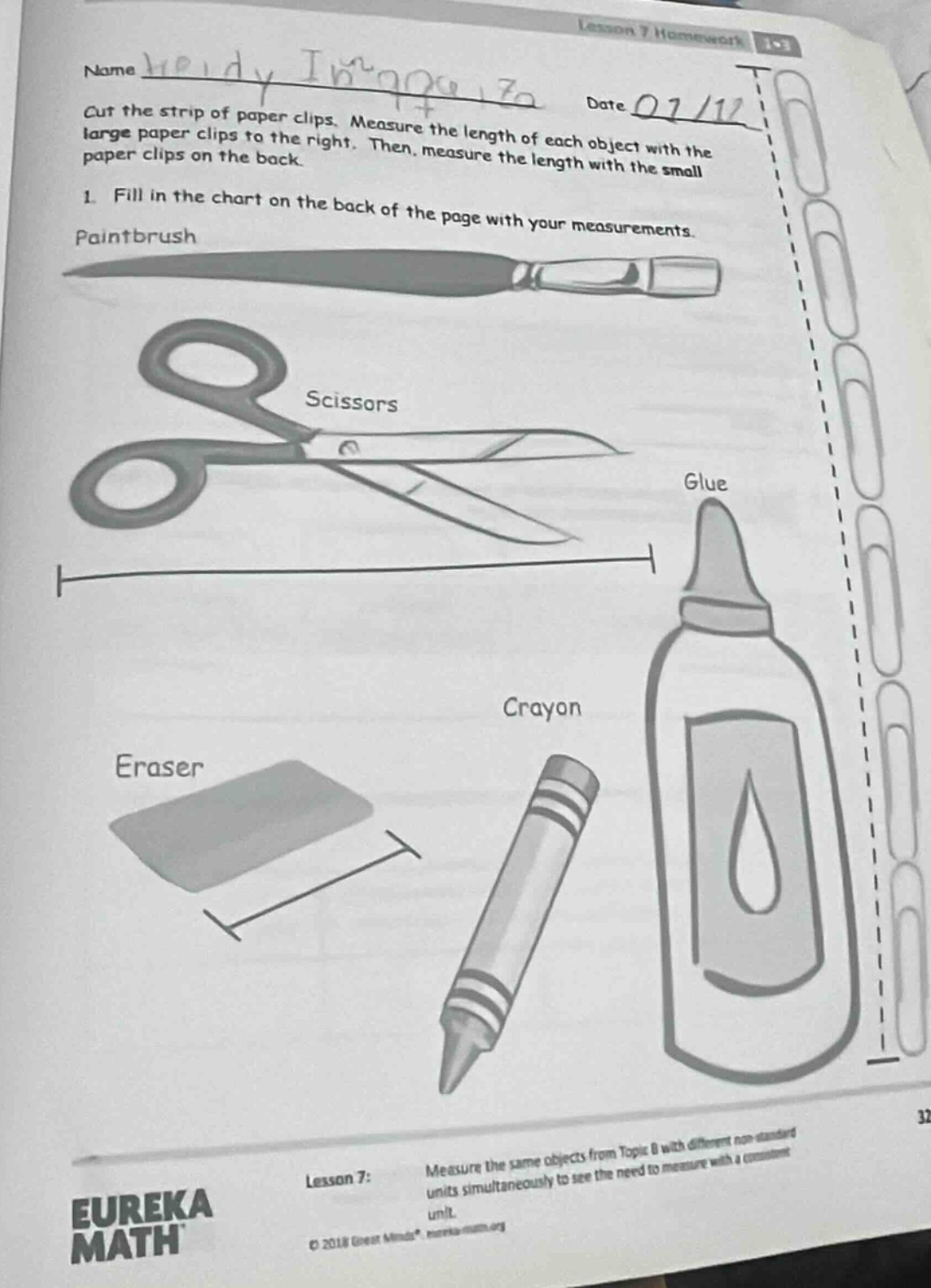
cut the strip of paper clips. measure the length of each object with the large paper clips to the right. then, measure the length with the small paper clips on the back.
- fill in the chart on the back of the page with your measurements.
paintbrush
scissors
glue
eraser
crayon
lesson 7: measure the same objects from topic b with different non - standard units simultaneously to see the need to measure with a common unit.
© 2018 great minds® eureka - math.org
To solve this problem, we need to measure the length of each object (Paintbrush, Scissors, Glue, Crayon, Eraser) using large and small paper clips. Here are the general steps:
Step 1: Prepare the paper clips
Cut the strip of large and small paper clips as instructed.
Step 2: Measure with large paper clips
- For each object, place the large paper clips end - to - end along the length of the object. Count the number of large paper clips that fit. For example, if we measure the paintbrush:
- Align the first large paper clip at one end of the paintbrush.
- Continue placing paper clips until we reach the other end. Let's say the paintbrush is 5 large paper clips long (this is a sample value, the actual value will depend on the size of the paper clip and the paintbrush in the given problem).
- Repeat this process for the scissors, glue, crayon, and eraser.
Step 3: Measure with small paper clips
- Similarly, place the small paper clips end - to - end along the length of each object. Count the number of small paper clips. For the same paintbrush, if a small paper clip is shorter, it might be 8 small paper clips long (again, a sample value).
- Do this for all the objects: scissors, glue, crayon, and eraser.
Step 4: Fill in the chart
- Create a chart (on the back as instructed) with columns for the object name, length in large paper clips, and length in small paper clips.
- Enter the measured values for each object into the corresponding cells of the chart.
Since this is a hands - on measurement activity, the actual answers (the number of paper clips for each object) will be obtained by physically performing the measurements.
For example, if after measuring:
- Paintbrush: 4 large paper clips, 6 small paper clips
- Scissors: 5 large paper clips, 7 small paper clips
- Glue: 3 large paper clips, 5 small paper clips
- Crayon: 2 large paper clips, 3 small paper clips
- Eraser: 1 large paper clip, 2 small paper clips
These values are just for illustration. You need to perform the actual measurement to get the correct number of paper clips for each object.

Snap & solve any problem in the app
Get step-by-step solutions on Sovi AI
Photo-based solutions with guided steps
Explore more problems and detailed explanations
To solve this problem, we need to measure the length of each object (Paintbrush, Scissors, Glue, Crayon, Eraser) using large and small paper clips. Here are the general steps:
Step 1: Prepare the paper clips
Cut the strip of large and small paper clips as instructed.
Step 2: Measure with large paper clips
- For each object, place the large paper clips end - to - end along the length of the object. Count the number of large paper clips that fit. For example, if we measure the paintbrush:
- Align the first large paper clip at one end of the paintbrush.
- Continue placing paper clips until we reach the other end. Let's say the paintbrush is 5 large paper clips long (this is a sample value, the actual value will depend on the size of the paper clip and the paintbrush in the given problem).
- Repeat this process for the scissors, glue, crayon, and eraser.
Step 3: Measure with small paper clips
- Similarly, place the small paper clips end - to - end along the length of each object. Count the number of small paper clips. For the same paintbrush, if a small paper clip is shorter, it might be 8 small paper clips long (again, a sample value).
- Do this for all the objects: scissors, glue, crayon, and eraser.
Step 4: Fill in the chart
- Create a chart (on the back as instructed) with columns for the object name, length in large paper clips, and length in small paper clips.
- Enter the measured values for each object into the corresponding cells of the chart.
Since this is a hands - on measurement activity, the actual answers (the number of paper clips for each object) will be obtained by physically performing the measurements.
For example, if after measuring:
- Paintbrush: 4 large paper clips, 6 small paper clips
- Scissors: 5 large paper clips, 7 small paper clips
- Glue: 3 large paper clips, 5 small paper clips
- Crayon: 2 large paper clips, 3 small paper clips
- Eraser: 1 large paper clip, 2 small paper clips
These values are just for illustration. You need to perform the actual measurement to get the correct number of paper clips for each object.