QUESTION IMAGE
Question
lesson 2: slicing solids
exit ticket: sketch it
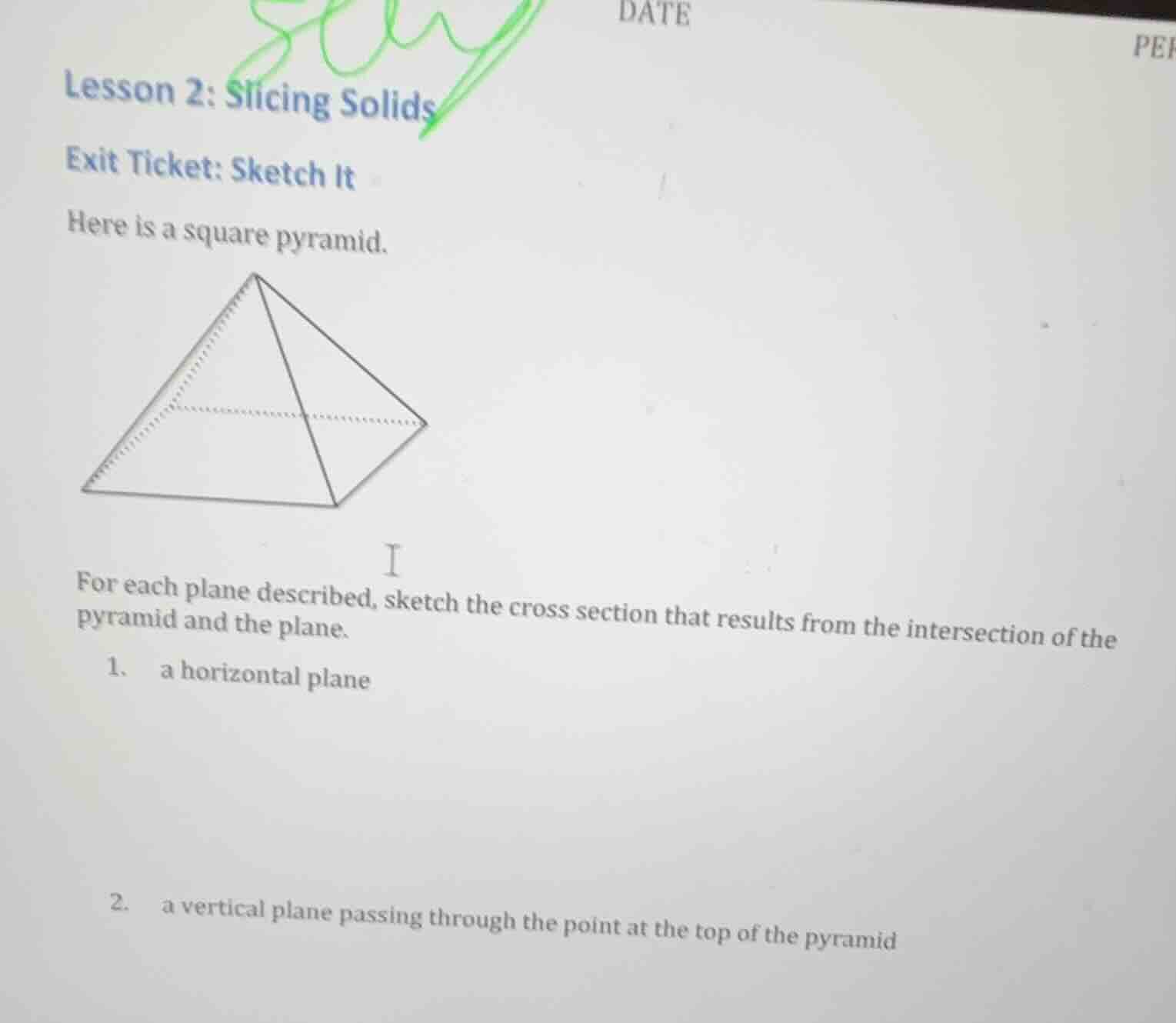
here is a square pyramid.
for each plane described, sketch the cross section that results from the intersection of the pyramid and the plane.
- a horizontal plane
- a vertical plane passing through the point at the top of the pyramid
1. Cross - section with a horizontal plane
Step 1: Recall the properties of a square pyramid
A square pyramid has a square base and four triangular faces that meet at a single vertex (the apex) at the top.
Step 2: Analyze the intersection with a horizontal plane
When a horizontal plane (a plane parallel to the base) intersects a square pyramid, the cross - section will be similar to the base of the pyramid. Since the base is a square, the cross - section formed by a horizontal plane cutting the square pyramid will be a square. This is because the horizontal plane will intersect each of the triangular faces of the pyramid at a line segment, and these line segments will form the sides of a square. The size of the square cross - section will be smaller than the base square as we move the horizontal plane up from the base towards the apex.
Step 1: Recall the structure of the square pyramid
The square pyramid has an apex (the top point) and a square base with four vertices. A vertical plane passing through the apex will also pass through two opposite vertices of the square base (in the case of a vertical plane that is along the plane of symmetry of the square pyramid) or through two adjacent vertices (depending on the orientation, but typically we consider the plane of symmetry).
Step 2: Analyze the intersection
When a vertical plane passes through the apex and the base of the square pyramid, it will intersect two of the triangular faces of the pyramid. The cross - section formed will be a triangle. The base of this triangle will be a side of the square base of the pyramid (if the plane passes through two adjacent vertices of the base) or a diagonal of the square base (if the plane passes through two opposite vertices of the base). The two equal sides of the triangle will be the edges of the triangular faces of the pyramid that the vertical plane intersects. In the case of a plane of symmetry (passing through the apex and the mid - points of opposite sides of the square base), the cross - section will be an isosceles triangle.

Snap & solve any problem in the app
Get step-by-step solutions on Sovi AI
Photo-based solutions with guided steps
Explore more problems and detailed explanations
The cross - section is a square (smaller than the base square of the pyramid, parallel to the base). To sketch it, draw a square inside the pyramid such that its sides are parallel to the sides of the base square of the pyramid.