QUESTION IMAGE
Question
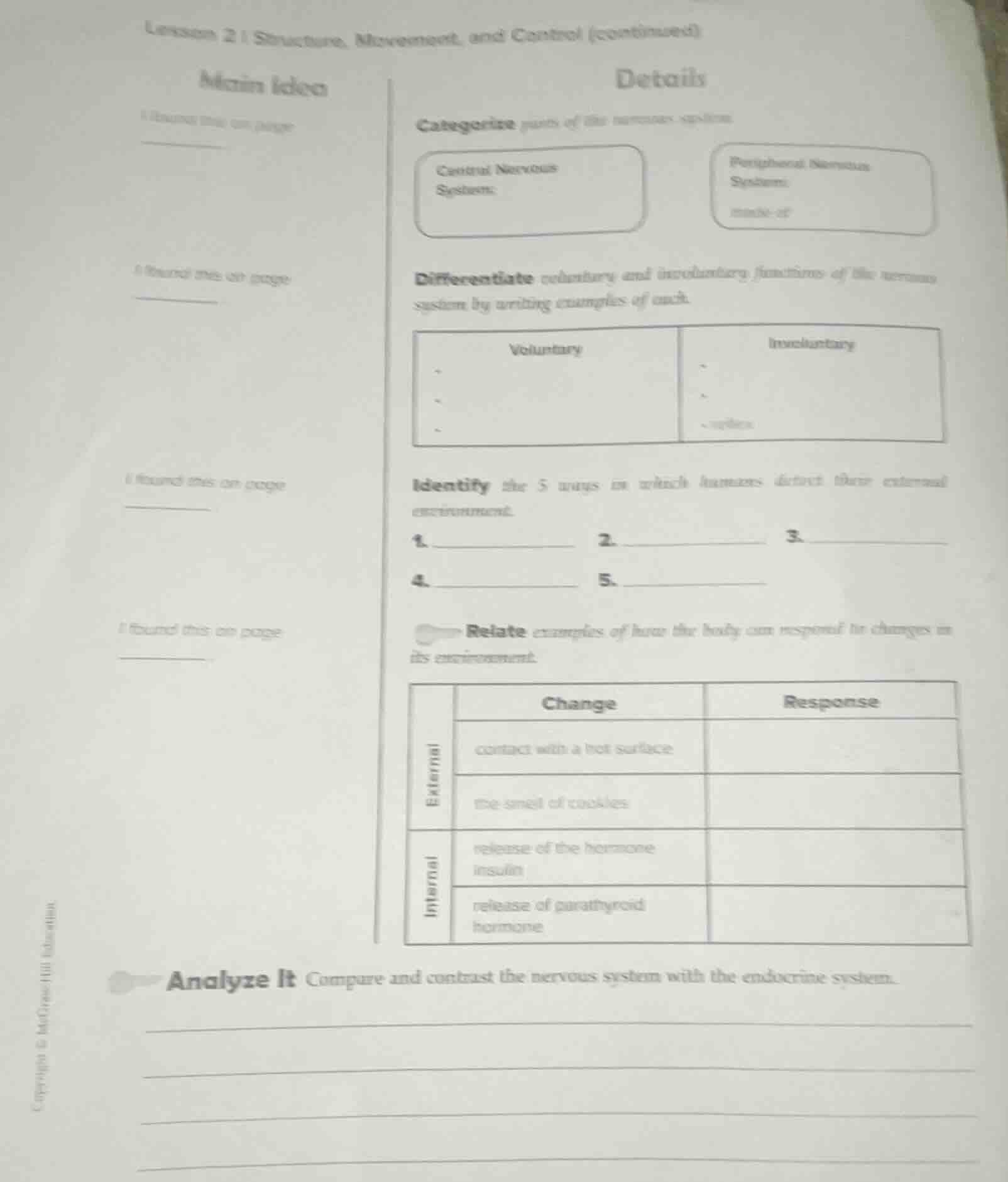
lesson 2 | structure, movement, and control (continued)main ideasi found this on pagei found this on pagei found this on pagei found this on pagedetailscategorize parts of the nervous systemcentral nervous system:peripheral nervous system:made ofdifferentiate voluntary and involuntary functions of the nervous system by writing examples of each.voluntaryinvoluntaryidentify the 5 ways in which humans detect their external environment.1. 2. 3.4. 5.relate examples of how the body can respond to changes in its environment.externalchange: contact with a hot surfaceresponse:change: the smell of cookiesresponse:internalchange: release of the hormone insulinresponse:change: release of parathyroid hormoneresponse:analyze it compare and contrast the nervous system with the endocrine system.
1. Nervous System Categorization
The central nervous system (CNS) is the core processing unit, while the peripheral nervous system (PNS) connects the CNS to the body.
2. Voluntary vs. Involuntary Functions
Voluntary actions are consciously controlled; involuntary actions happen automatically without conscious thought.
3. Human Senses
Humans detect the external environment through five primary sensory pathways.
4. Body Responses to Environmental Changes
External changes trigger physical reflexes or behavioral responses, while internal hormonal changes trigger regulatory responses to maintain balance.
5. Nervous vs. Endocrine Systems
Both regulate body functions, but use different signaling methods and act on different timelines.

Snap & solve any problem in the app
Get step-by-step solutions on Sovi AI
Photo-based solutions with guided steps
Explore more problems and detailed explanations
Categorize parts of the nervous system
- Central Nervous System: Brain, Spinal Cord
- Peripheral Nervous System: made of Cranial nerves, Spinal nerves, Ganglia
Differentiate voluntary and involuntary functions of the nervous system by writing examples of each
| Voluntary | Involuntary |
|---|---|
| Writing | Breathing (automatic) |
| Talking | Pupil dilation |
Identify the 5 ways in which humans detect their external environment
- Sight (vision)
- Sound (hearing)
- Touch (tactile sense)
- Smell (olfaction)
- Taste (gustation)
Relate examples of how the body can respond to changes in its environment
| Change | Response | |
|---|---|---|
| External | the smell of cookies | Moving toward the source, salivating |
| Internal | release of the hormone insulin | Cells absorb glucose, lowering blood sugar |
| Internal | release of parathyroid hormone | Bones release calcium, raising blood calcium levels |
Analyze It: Compare and contrast the nervous system with the endocrine system
- Similarity: Both systems regulate and coordinate body functions to maintain homeostasis.
- Differences:
- The nervous system uses electrical impulses (via neurons) and acts quickly, with short-lasting effects.
- The endocrine system uses chemical signals (hormones via the bloodstream) and acts slowly, with longer-lasting effects.
- Nervous system signals target specific cells/tissues; endocrine signals can target widespread cells throughout the body.