QUESTION IMAGE
Question
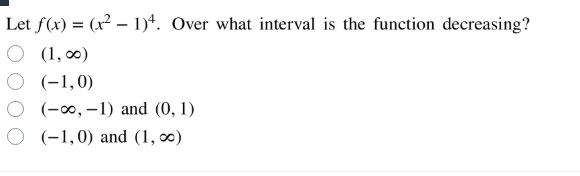
let ( f(x) = (x^2 - 1)^4 ). over what interval is the function decreasing?
\\( (1, infty) \\)
\\( (-1, 0) \\)
\\( (-infty, -1) \\) and ( (0, 1) \\)
\\( (-1, 0) \\) and ( (1, infty) \\)
Step1: Find the derivative of \( f(x) \)
Using the chain rule, if \( f(x) = (u)^4 \) where \( u = x^2 - 1 \), then \( f'(x)=4u^3\cdot u' \).
First, find \( u' \): \( u = x^2 - 1 \), so \( u' = 2x \).
Then, \( f'(x)=4(x^2 - 1)^3\cdot 2x = 8x(x^2 - 1)^3 \).
Step2: Factor the derivative
We can factor \( (x^2 - 1)^3 \) as \( (x - 1)^3(x + 1)^3 \), so \( f'(x)=8x(x - 1)^3(x + 1)^3 \).
Step3: Find critical points
Set \( f'(x) = 0 \):
\( 8x(x - 1)^3(x + 1)^3 = 0 \)
This gives \( x = 0 \), \( x = 1 \), and \( x = - 1 \) as critical points. These points divide the real number line into intervals: \( (-\infty, - 1) \), \( (-1, 0) \), \( (0, 1) \), and \( (1, \infty) \).
Step4: Test intervals for sign of \( f'(x) \)
- For \( (-\infty, - 1) \): Let's pick \( x=-2 \). Then \( f'(-2)=8(-2)(-2 - 1)^3(-2 + 1)^3=8(-2)(-27)(-1)= - 432<0 \)? Wait, no: \( 8(-2)(-3)^3(-1)^3=8(-2)(-27)(-1)=8\times(-2)\times27=-432 \)? Wait, no, \( (-3)^3=-27 \), \( (-1)^3=-1 \), so \( (-27)\times(-1) = 27 \), then \( 8\times(-2)\times27=-432 \)? Wait, no, \( 8x(x - 1)^3(x + 1)^3 \), when \( x=-2 \), \( x=-2 \), \( (x - 1)=-3 \), \( (x + 1)=-1 \). So \( 8\times(-2)\times(-3)^3\times(-1)^3=8\times(-2)\times(-27)\times(-1)=8\times(-2)\times27=-432 \). Wait, but actually, let's simplify the sign analysis. The factors: \( x \), \( (x - 1)^3 \), \( (x + 1)^3 \).
- For \( (-\infty, - 1) \): \( x<0 \), \( (x - 1)^3<0 \) (since \( x - 1<-2<0 \)), \( (x + 1)^3<0 \) (since \( x + 1<0 \)). So the product \( x(x - 1)^3(x + 1)^3 \): negative \(\times\) negative \(\times\) negative = negative. Then \( 8\times\) negative is negative. Wait, but let's check \( (-1, 0) \): \( x\in(-1,0) \), so \( x<0 \), \( (x - 1)^3<0 \) (since \( x - 1<0 \)), \( (x + 1)^3>0 \) (since \( x + 1>0 \)). So \( x(x - 1)^3(x + 1)^3 \): negative \(\times\) negative \(\times\) positive = positive. Then \( 8\times\) positive is positive. Wait, no, wait: \( (x - 1)^3 \) when \( x\in(-1,0) \), \( x - 1\in(-2, - 1) \), so \( (x - 1)^3<0 \), \( (x + 1)\in(0,1) \), so \( (x + 1)^3>0 \), \( x\in(-1,0) \) so \( x<0 \). So \( x(x - 1)^3(x + 1)^3=(negative)\times(negative)\times(positive)=positive \). So \( f'(x)=8\times(positive)>0 \) in \( (-1,0) \)? Wait, no, I think I made a mistake earlier. Wait, let's redo the sign analysis:
Let's make a sign chart:
| Interval | \( x \) | \( (x - 1)^3 \) | \( (x + 1)^3 \) | \( f'(x)=8x(x - 1)^3(x + 1)^3 \) |
|---|---|---|---|---|
| \( (-1, 0) \) | - | - | + | \( 8\times(-)\times(-)\times(+)=8\times(+)= + \) |
| \( (0, 1) \) | + | - | + | \( 8\times(+)\times(-)\times(+)=8\times(-)= - \) |
| \( (1, \infty) \) | + | + | + | \( 8\times(+)\times(+)\times(+)=8\times(+)= + \) |
Wait, so the derivative is negative when \( f'(x)<0 \), which is in \( (-\infty, - 1) \) and \( (0, 1) \), and positive when \( f'(x)>0 \) in \( (-1, 0) \) and \( (1, \infty) \). Wait, but the function is decreasing when \( f'(x)<0 \). Wait, but let's check the original function \( f(x)=(x^2 - 1)^4 \). Let's take a point in \( (-\infty, - 1) \), say \( x = - 2 \), \( f(-2)=((-2)^2 - 1)^4=(4 - 1)^4 = 81 \). \( x=-1.5 \), \( f(-1.5)=((-1.5)^2 - 1)^4=(2.25 - 1)^4=(1.25)^4 = 2.44140625 \). Wait, as \( x \) increases from \( - \infty \) to \( - 1 \), \( x^2 - 1 \) decreases from \( \infty \) to \( 0 \), so \( (x^2 - 1)^4 \) decreases? Wait, no, when \( x \) increases from \( - \infty \) to \( - 1 \), \( x^2 \) decreases from \( \infty \) to \( 1 \), so \( x^2 - 1 \) decreases from \( \infty \) to \( 0 \), s…

Snap & solve any problem in the app
Get step-by-step solutions on Sovi AI
Photo-based solutions with guided steps
Explore more problems and detailed explanations
\( (-\infty, - 1) \) and \( (0, 1) \) (corresponding to the option: \( (-\infty, -1) \) and \( (0, 1) \))