QUESTION IMAGE
Question
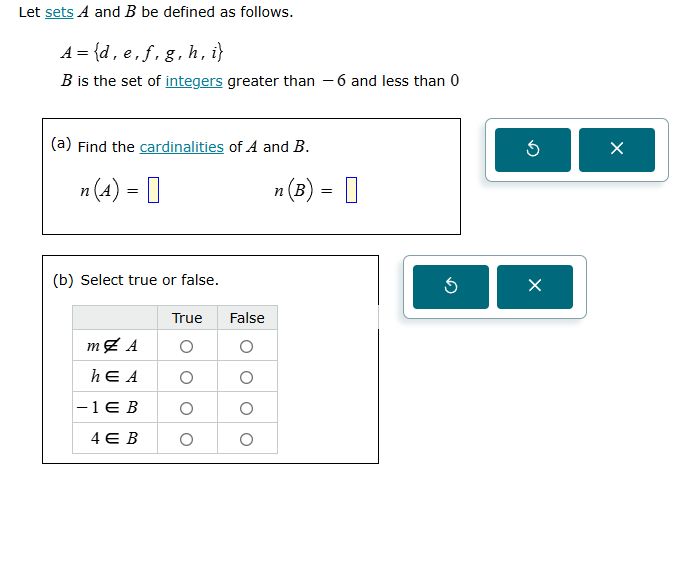
let sets a and b be defined as follows.
a = {d, e, f, g, h, i}
b is the set of integers greater than −6 and less than 0
(a) find the cardinalities of a and b.
n(a) =
n(b) =
(b) select true or false.
| true | false |
m ∉ a | ○ | ○
h ∈ a | ○ | ○
−1 ∈ b | ○ | ○
4 ∈ b | ○ | ○
Step1: Count elements in set A
Count distinct elements: $A=\{d,e,f,g,h,i\}$, so $n(A)=6$.
Step2: Define set B
Integers between -6 and 0: $B=\{-5,-4,-3,-2,-1\}$, so $n(B)=5$.
Step3: Verify $m
otin A$
$m$ is not in $A$, so this is true.
Step4: Verify $h \in A$
$h$ is an element of $A$, so this is true.
Step5: Verify $-1 \in B$
$-1$ is in $B$, so this is true.
Step6: Verify $4 \in B$
$4$ is not in $B$, so this is false.

Snap & solve any problem in the app
Get step-by-step solutions on Sovi AI
Photo-based solutions with guided steps
Explore more problems and detailed explanations
Part (a)
$n(A) = 6$, $n(B) = 5$
Part (b)
| Statement | True | False |
|---|
| $m
otin A$ | $\bigcirc$ | |
| $h \in A$ | $\bigcirc$ | |
| $-1 \in B$ | $\bigcirc$ | |
| $4 \in B$ | $\bigcirc$ |