QUESTION IMAGE
Question
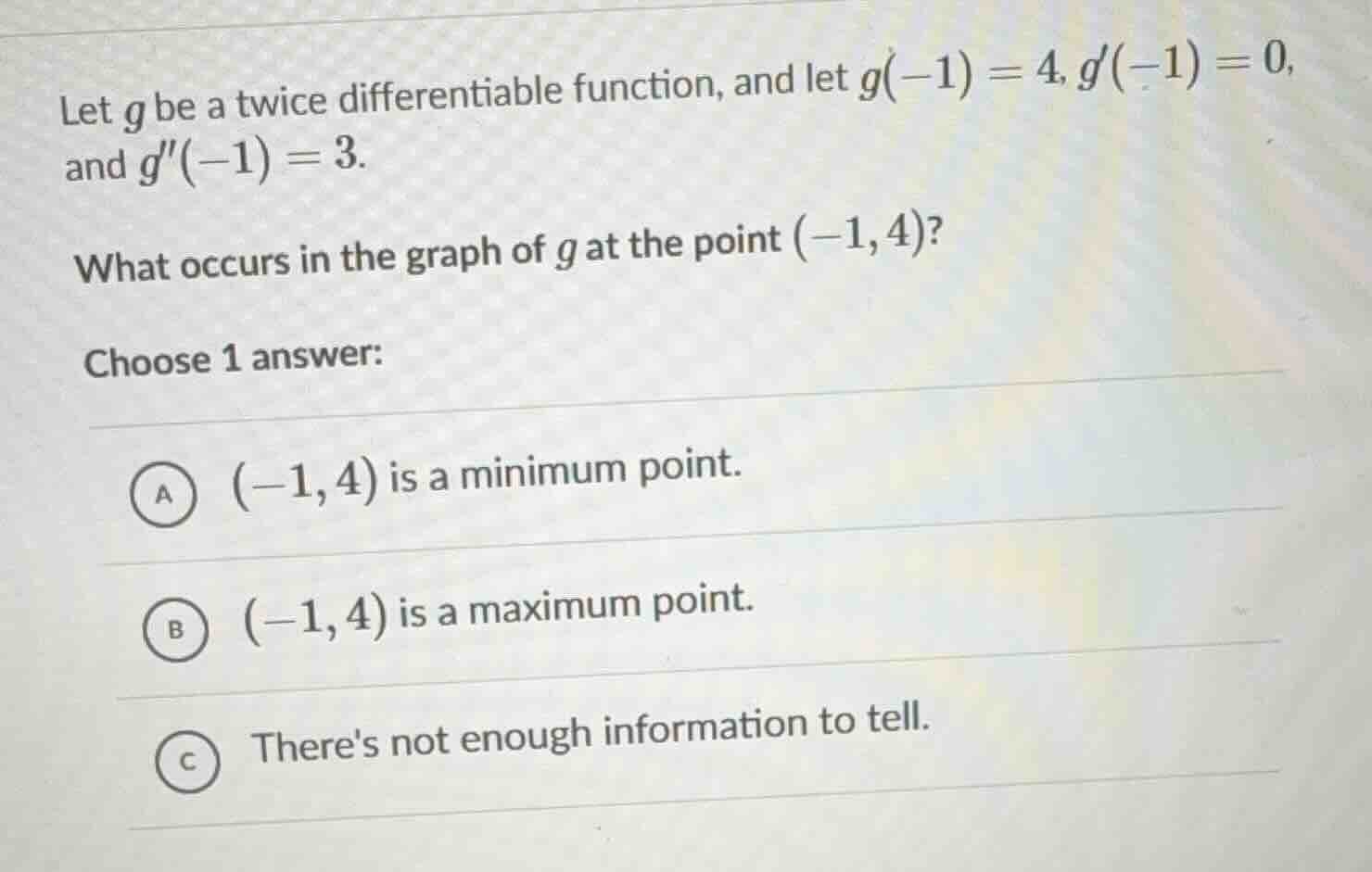
let g be a twice differentiable function, and let $g(-1) = 4$, $g(-1) = 0$, and $g(-1) = 3$. what occurs in the graph of g at the point $(-1, 4)$? choose 1 answer: a $(-1, 4)$ is a minimum point. b $(-1, 4)$ is a maximum point. c theres not enough information to tell.
Step1: Recall the Second Derivative Test
The Second Derivative Test states that for a function \( y = g(x) \) that is twice - differentiable at a critical point \( x = a \) (where \( g^{\prime}(a)=0 \)):
- If \( g^{\prime\prime}(a)>0 \), then the function \( g(x) \) has a local minimum at \( x = a \).
- If \( g^{\prime\prime}(a)<0 \), then the function \( g(x) \) has a local maximum at \( x = a \).
- If \( g^{\prime\prime}(a) = 0 \), the test is inconclusive.
Step2: Analyze the given values
We are given that \( g(- 1)=4 \), \( g^{\prime}(-1)=0 \) (so \( x=-1 \) is a critical point) and \( g^{\prime\prime}(-1)=3 \).
Since \( g^{\prime\prime}(-1)=3>0 \), by the Second Derivative Test, the function \( g(x) \) has a local minimum at \( x = - 1 \). And since \( g(-1) = 4 \), the point \( (-1,4) \) is a minimum point on the graph of \( g(x) \).

Snap & solve any problem in the app
Get step-by-step solutions on Sovi AI
Photo-based solutions with guided steps
Explore more problems and detailed explanations
A. \((-1, 4)\) is a minimum point.