QUESTION IMAGE
Question
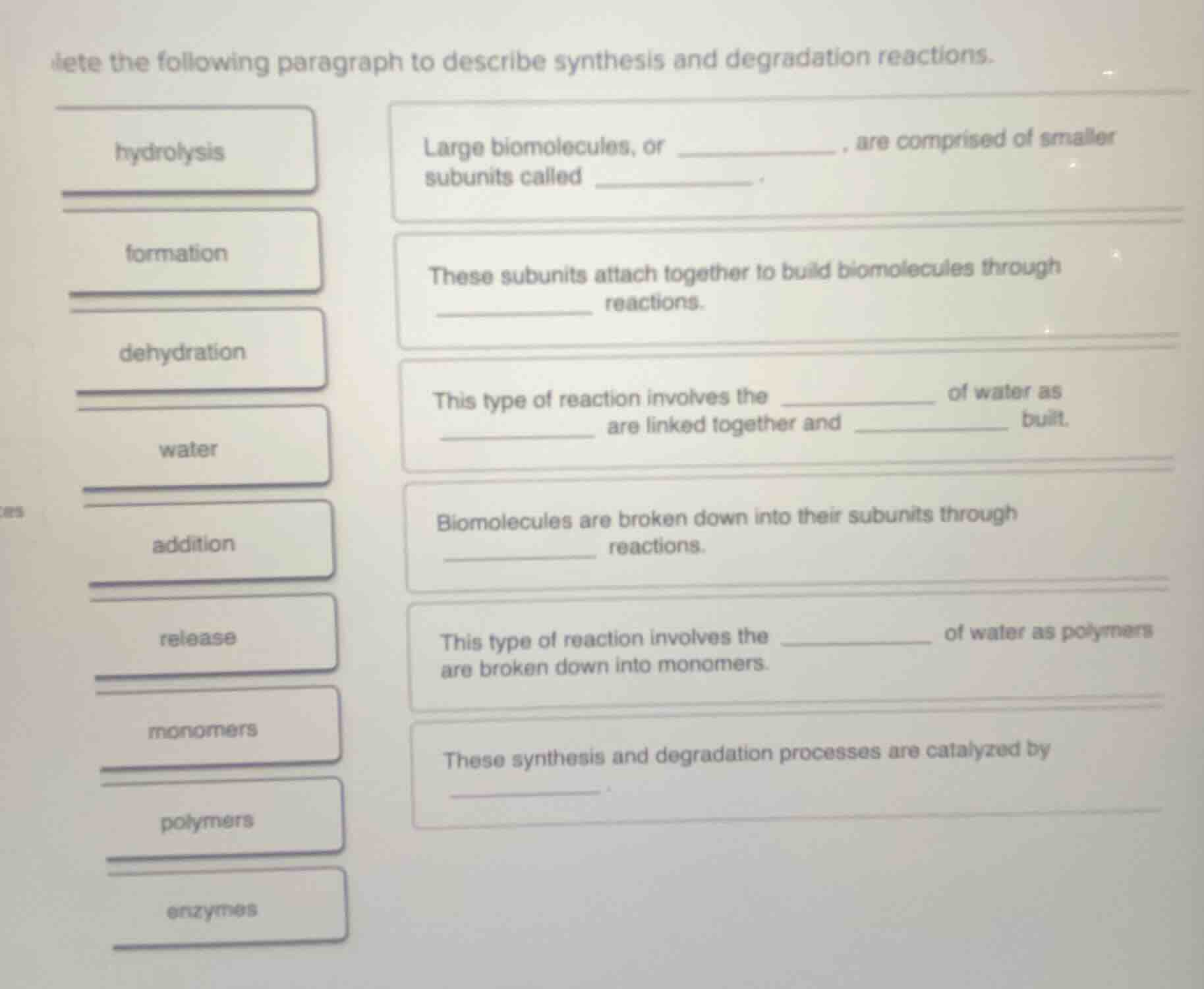
lete the following paragraph to describe synthesis and degradation reactions.
hydrolysis
formation
dehydration
water
addition
release
monomers
polymers
enzymes
large biomolecules, or ______ , are comprised of smaller subunits called ______ .
these subunits attach together to build biomolecules through ________ reactions.
this type of reaction involves the ______ of water as ____ are linked together and ______ built.
biomolecules are broken down into their subunits through ________ reactions.
this type of reaction involves the ________ of water as polymers are broken down into monomers.
these synthesis and degradation processes are catalyzed by ________ .
1st blank (Large biomolecules...):
Large biomolecules are called polymers (since polymers are large molecules made of repeating subunits). The smaller subunits are monomers (monomers are the building blocks of polymers).
2nd blank (These subunits attach...):
Subunits (monomers) join to form polymers through dehydration reactions (dehydration synthesis removes a water molecule to link monomers).
3rd blank (This type of reaction...):
Dehydration reactions involve the release of water. As monomers are linked, polymers are built.
4th blank (Biomolecules are broken down...):
Breaking down polymers into monomers is done via hydrolysis reactions (hydrolysis adds water to break bonds between monomers).
5th blank (This type of reaction...):
Hydrolysis involves the addition of water (to break the polymer into monomers).
6th blank (These synthesis and degradation...):
Enzymes catalyze these biochemical reactions (synthesis and degradation of biomolecules are enzyme - catalyzed).
Filled Paragraph:
- Large biomolecules, or $\boldsymbol{\text{polymers}}$, are comprised of smaller subunits called $\boldsymbol{\text{monomers}}$.
- These subunits attach together to build biomolecules through $\boldsymbol{\text{dehydration}}$ reactions.
- This type of reaction involves the $\boldsymbol{\text{release}}$ of water as $\boldsymbol{\text{monomers}}$ are linked together and $\boldsymbol{\text{polymers}}$ built.
- Biomolecules are broken down into their subunits through $\boldsymbol{\text{hydrolysis}}$ reactions.
- This type of reaction involves the $\boldsymbol{\text{addition}}$ of water as polymers are broken down into monomers.
- These synthesis and degradation processes are catalyzed by $\boldsymbol{\text{enzymes}}$.

Snap & solve any problem in the app
Get step-by-step solutions on Sovi AI
Photo-based solutions with guided steps
Explore more problems and detailed explanations
1st blank (Large biomolecules...):
Large biomolecules are called polymers (since polymers are large molecules made of repeating subunits). The smaller subunits are monomers (monomers are the building blocks of polymers).
2nd blank (These subunits attach...):
Subunits (monomers) join to form polymers through dehydration reactions (dehydration synthesis removes a water molecule to link monomers).
3rd blank (This type of reaction...):
Dehydration reactions involve the release of water. As monomers are linked, polymers are built.
4th blank (Biomolecules are broken down...):
Breaking down polymers into monomers is done via hydrolysis reactions (hydrolysis adds water to break bonds between monomers).
5th blank (This type of reaction...):
Hydrolysis involves the addition of water (to break the polymer into monomers).
6th blank (These synthesis and degradation...):
Enzymes catalyze these biochemical reactions (synthesis and degradation of biomolecules are enzyme - catalyzed).
Filled Paragraph:
- Large biomolecules, or $\boldsymbol{\text{polymers}}$, are comprised of smaller subunits called $\boldsymbol{\text{monomers}}$.
- These subunits attach together to build biomolecules through $\boldsymbol{\text{dehydration}}$ reactions.
- This type of reaction involves the $\boldsymbol{\text{release}}$ of water as $\boldsymbol{\text{monomers}}$ are linked together and $\boldsymbol{\text{polymers}}$ built.
- Biomolecules are broken down into their subunits through $\boldsymbol{\text{hydrolysis}}$ reactions.
- This type of reaction involves the $\boldsymbol{\text{addition}}$ of water as polymers are broken down into monomers.
- These synthesis and degradation processes are catalyzed by $\boldsymbol{\text{enzymes}}$.