QUESTION IMAGE
Question
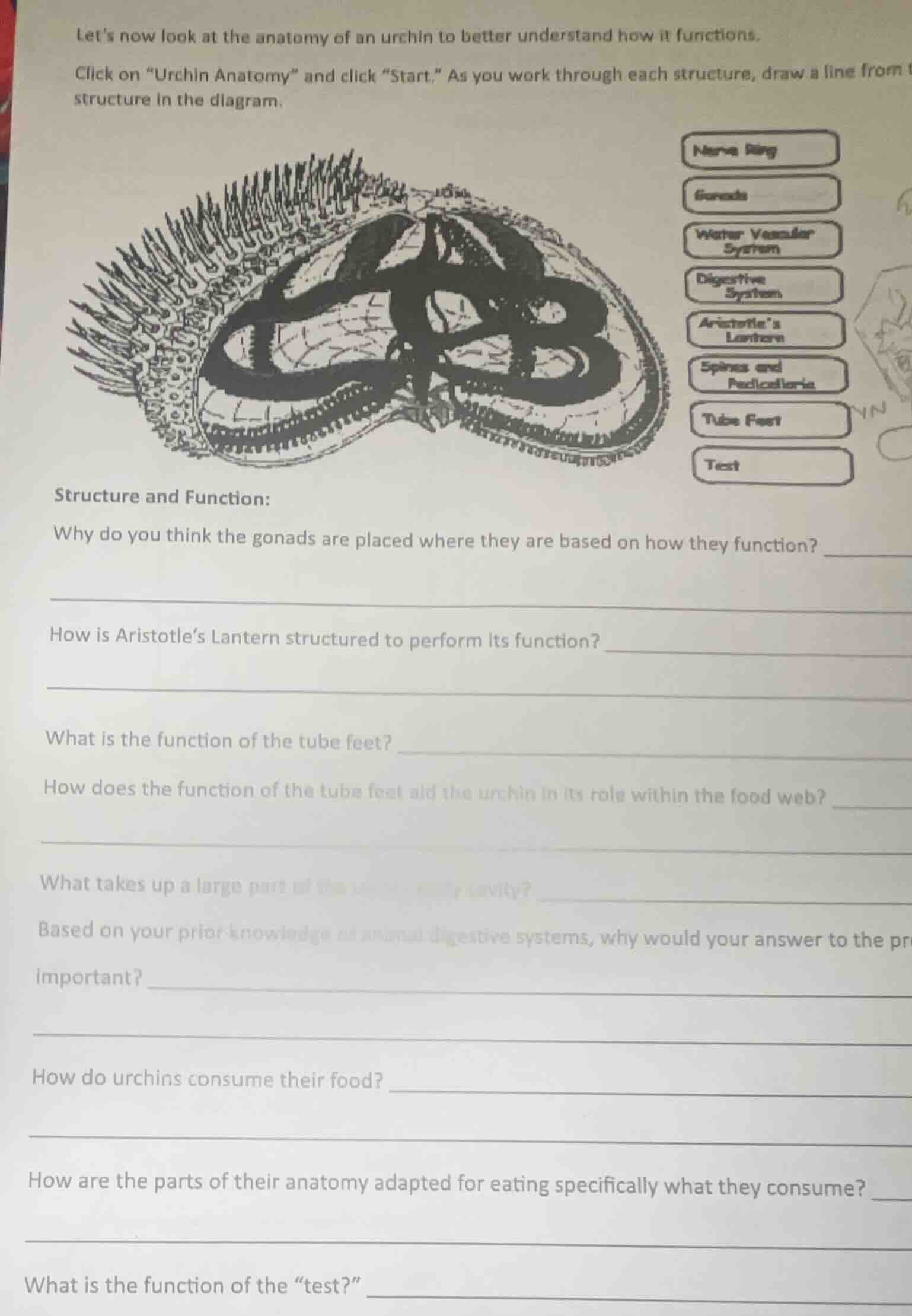
lets now look at the anatomy of an urchin to better understand how it functions.
click on \urchin anatomy\ and click \start.\ as you work through each structure, draw a line from t structure in the diagram.
structure and function:
why do you think the gonads are placed where they are based on how they function?
how is aristotle’s lantern structured to perform its function?
what is the function of the tube feet?
how does the function of the tube feet aid the urchin in its role within the food web?
what takes up a large part of
based on your prior knowledge of animal digestive systems, why would your answer to the pr important?
how do urchins consume their food?
how are the parts of their anatomy adapted for eating specifically what they consume?
what is the function of the \test?\
- For gonad placement: Gonads produce gametes; their central, protected position inside the test (hard shell) shields reproductive cells from damage, and their proximity to water flow helps release gametes into the ocean for fertilization.
- For Aristotle's Lantern structure: It is a complex, jaw-like structure made of 5 calcium carbonate teeth and supporting muscles, which can extend and retract to scrape/grind food.
- For tube feet function: Tube feet (powered by the water vascular system) are used for locomotion, attaching to surfaces, and capturing/handling food.
- For tube feet and food web: By clinging to rocks and scraping algae (their main food), urchins control algal growth, which supports the food web by keeping algae available for smaller grazers and preventing overgrowth that would harm coral/other organisms.
- For large coelom structure: The digestive system (a long, coiled gut) takes up most of the urchin's internal cavity.
- For digestive system importance: A large, coiled gut allows efficient breakdown and absorption of nutrient-poor algal material, which is critical for the urchin's energy needs since its food has low nutritional density.
- For urchin feeding: Urchins use Aristotle's Lantern to scrape, tear, and grind algae, kelp, and small organic matter from rocks and surfaces.
- For feeding adaptations: Aristotle's Lantern's hard, sharp teeth are adapted to scrape tough algal growth and kelp; tube feet help hold onto food and position the urchin on feeding surfaces; spines clear debris from the mouth area.
- For test function: The test (a rigid, calcium carbonate shell) provides structural support, protects internal organs from predators and physical damage, and anchors spines, tube feet, and muscles.

Snap & solve any problem in the app
Get step-by-step solutions on Sovi AI
Photo-based solutions with guided steps
Explore more problems and detailed explanations
- Their central, protected position shields gametes and aids in releasing them for fertilization.
- It has 5 hard teeth and muscles to scrape/grind food.
- Locomotion, surface attachment, and food handling.
- They let urchins scrape and control algal growth, supporting the food web by maintaining algal resources for other organisms.
- The long, coiled digestive system.
- It efficiently breaks down nutrient-poor algae to meet energy needs.
- Using Aristotle's Lantern to scrape/grind algae/kelp from surfaces.
- Sharp teeth of Aristotle's Lantern scrape tough algae; tube feet position the urchin; spines clear mouth debris.
- It protects internal organs, provides structure, and anchors spines/tube feet.