QUESTION IMAGE
Question
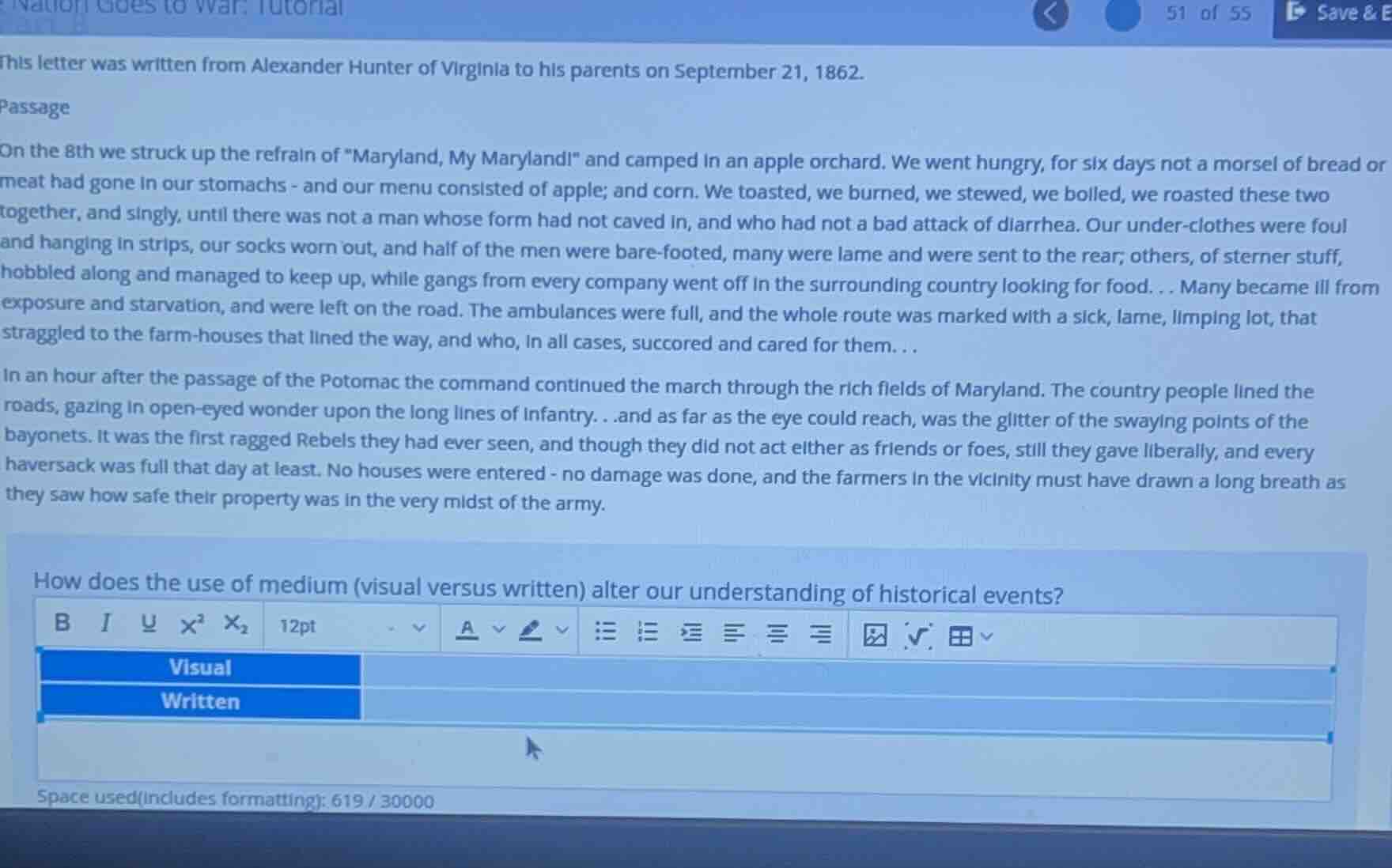
this letter was written from alexander hunter of virginia to his parents on september 21, 1862.
passage
on the 8th we struck up the refrain of \maryland, my maryland!\ and camped in an apple orchard. we went hungry, for six days not a morsel of bread or meat had gone in our stomachs - and our menu consisted of apple; and corn. we toasted, we burned, we stewed, we boiled, we roasted these two together, and singly, until there was not a man whose form had not caved in, and who had not a bad attack of diarrhea. our under - clothes were foul and hanging in strips, our socks worn out, and half of the men were bare - footed, many were lame and were sent to the rear; others, of sterner stuff, hobbled along and managed to keep up, while gangs from every company went off in the surrounding country looking for food... many became ill from exposure and starvation, and were left on the road. the ambulances were full, and the whole route was marked with a sick, lame, limping lot, that straggled to the farm - houses that lined the way, and who, in all cases, succored and cared for them...
in an hour after the passage of the potomac the command continued the march through the rich fields of maryland. the country people lined the roads, gazing in open - eyed wonder upon the long lines of infantry...and as far as the eye could reach, was the glitter of the swaying points of the bayonets. it was the first ragged rebels they had ever seen, and though they did not act either as friends or foes, still they gave liberally, and every haversack was full that day at least. no houses were entered - no damage was done, and the farmers in the vicinity must have drawn a long breath as they saw how safe their property was in the very midst of the army.
how does the use of medium (visual versus written) alter our understanding of historical events?
Visual Medium:
Visual mediums (like paintings, photographs, or documentaries) of this Civil War event can show the soldiers' ragged appearance, the landscape, and the scale of the army. They provide immediate, sensory details—like the glitter of bayonets or the haggard faces of starving soldiers—allowing viewers to "see" the scene, which can feel more visceral. However, visuals might lack the depth of personal experience or internal thoughts that written accounts offer. For example, a painting of the apple orchard camp could show the setting and soldiers’ condition but not the six - day hunger or the specific ailments (like diarrhea) as vividly as words.
Written Medium:
The written letter (like Alexander Hunter’s) gives a first - hand, narrative account of experiences. It details the soldiers’ diet (apples and corn, no bread/meat for six days), the state of their clothes (foul under - clothes, worn - out socks, bare feet), and the consequences (illness from exposure/starvation, ambulances full). Written accounts can include personal perspectives, emotions, and specific events (like gangs looking for food, farm - houses succoring the ill) that visuals may struggle to convey. They allow readers to imagine the scene through descriptive language and gain insight into the soldiers’ thoughts and the context of the time (e.g., the “ragged Rebels” perception by Marylanders).

Snap & solve any problem in the app
Get step-by-step solutions on Sovi AI
Photo-based solutions with guided steps
Explore more problems and detailed explanations
- Visual: Can offer immediate, sensory depictions of the event's setting, people, and scale (e.g., the long lines of infantry, bayonets' glitter, soldiers' ragged look). But it may lack the depth of personal experiences, specific details (like six - day hunger, diarrhea), and internal thoughts that written accounts provide.
- Written: Provides a detailed, narrative, first - hand perspective with specific events (e.g., six - day starvation, soldiers' ailments, farm - houses' aid) and personal insights (e.g., soldiers' struggles, Marylanders' reactions). It allows readers to imagine the scene through descriptive language and understand the context and emotions more deeply than a visual might, as it can include nuanced details and personal accounts.