QUESTION IMAGE
Question
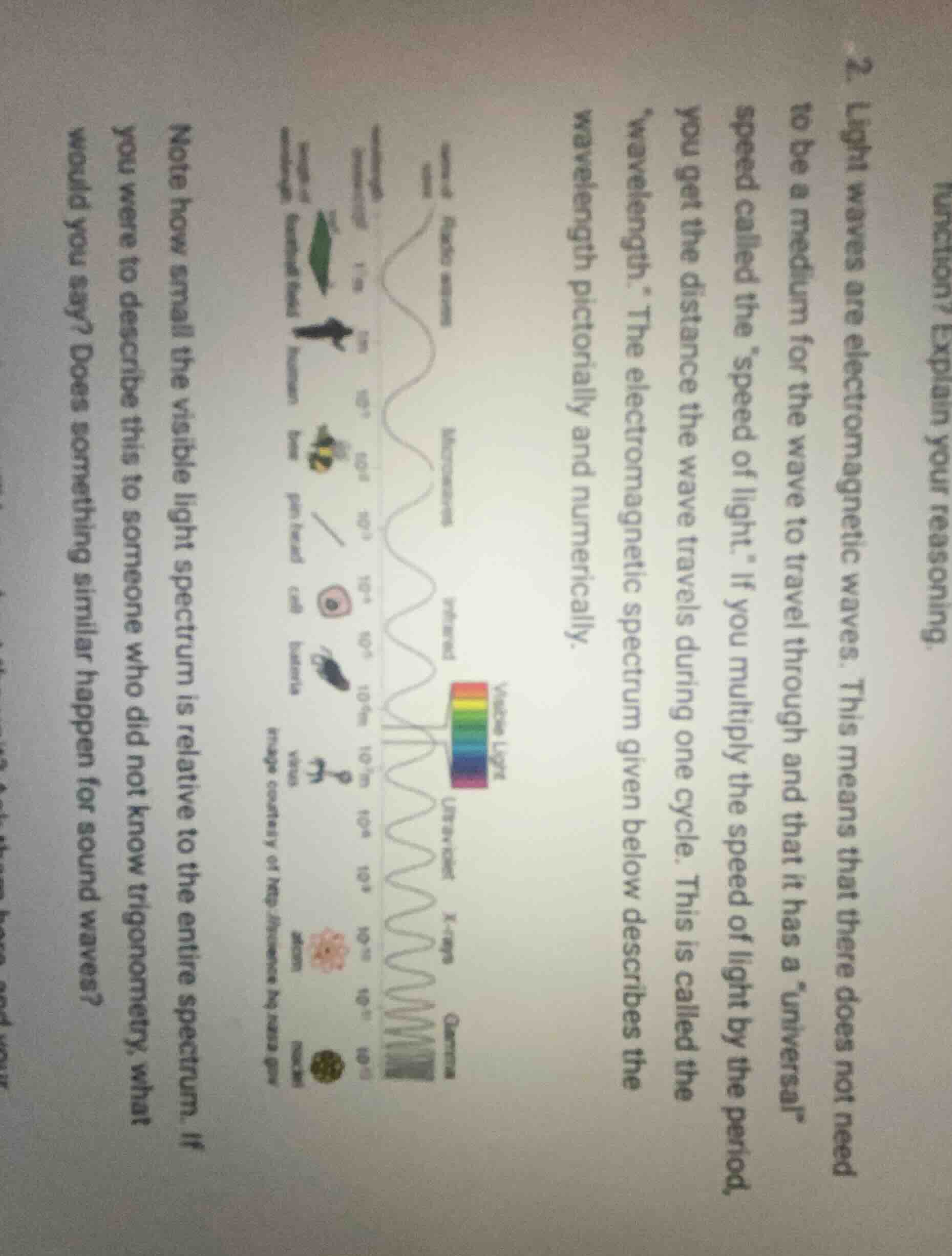
- light waves are electromagnetic waves. this means that there does not need to be a medium for the wave to travel through and that it has a universal speed called the speed of light. if you multiply the speed of light by the period, you get the distance the wave travels during one cycle. this is called the wavelength. the electromagnetic spectrum given below describes the wavelength pictorially and numerically.
note how small the visible light spectrum is relative to the entire spectrum. if you were to describe this to someone who did not know trigonometry, what would you say? does something similar happen for sound waves?

Snap & solve any problem in the app
Get step-by-step solutions on Sovi AI
Photo-based solutions with guided steps
Explore more problems and detailed explanations
The visible light spectrum is an extremely narrow portion of the full electromagnetic spectrum, with wavelengths roughly between $4\times10^{-7}$ m and $7\times10^{-7}$ m, far smaller than radio waves and larger than X-rays/gamma rays. To explain without trigonometry: it's like a tiny slice of a huge pie that covers all electromagnetic waves.
Yes, sound waves also have a narrow range of wavelengths/frequencies that humans can perceive, compared to the full possible range of sound waves.