QUESTION IMAGE
Question
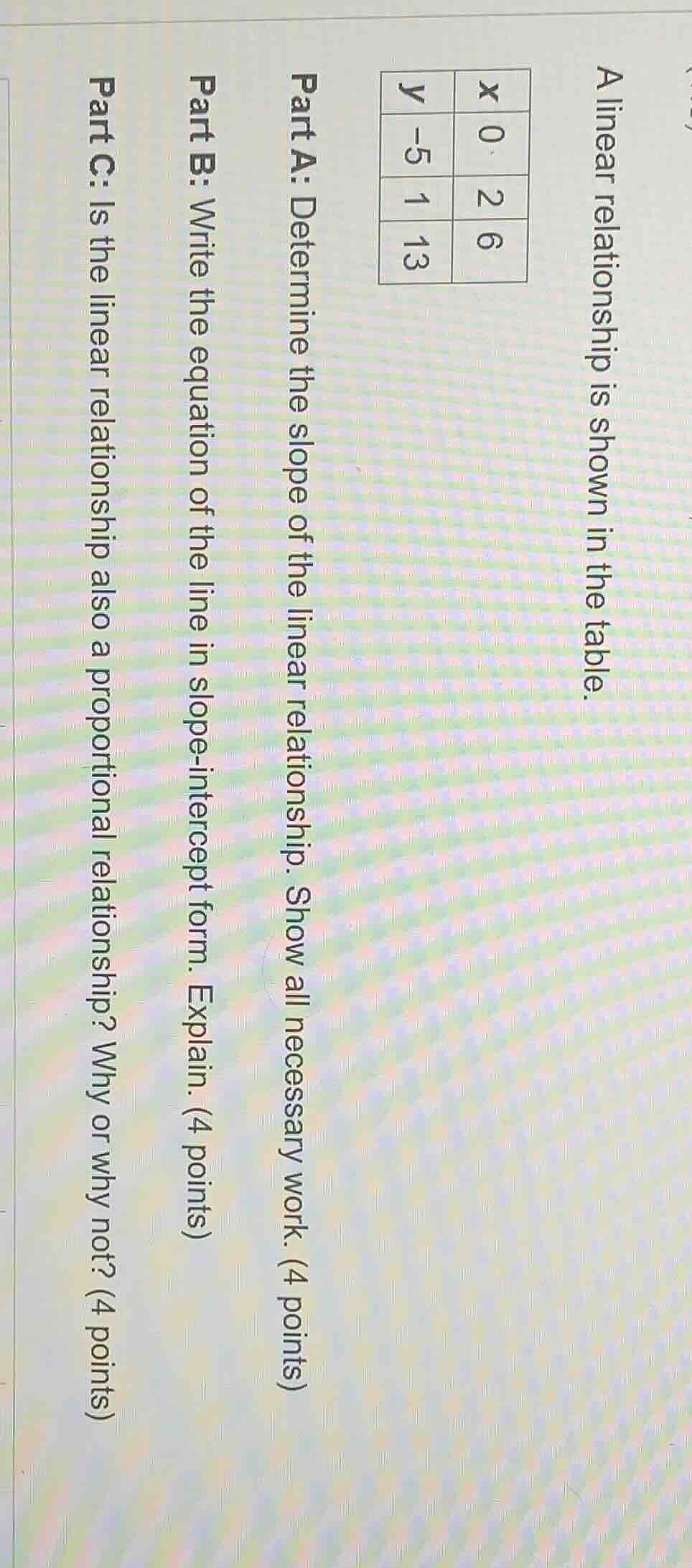
a linear relationship is shown in the table.
| x | 0 | 2 | 6 |
| y | -5 | 1 | 13 |
part a: determine the slope of the linear relationship. show all necessary work. (4 points)
part b: write the equation of the line in slope-intercept form. explain. (4 points)
part c: is the linear relationship also a proportional relationship? why or why not? (4 points)
Part A:
Step1: Identify coordinate pairs
Use points $(0, -5)$, $(2, 1)$, $(6, 13)$
Step2: Apply slope formula
Slope $m = \frac{y_2 - y_1}{x_2 - x_1}$. Use $(0, -5)$ and $(2, 1)$:
$m = \frac{1 - (-5)}{2 - 0} = \frac{6}{2} = 3$
Verify with $(2, 1)$ and $(6, 13)$:
$m = \frac{13 - 1}{6 - 2} = \frac{12}{4} = 3$
Part B:
Step1: Find y-intercept
From $(0, -5)$, $b = -5$
Step2: Write slope-intercept form
Slope-intercept form is $y = mx + b$. Substitute $m=3$, $b=-5$:
$y = 3x - 5$
Part C:
Step1: Recall proportionality rule
Proportional lines pass through $(0,0)$ (y-intercept $b=0$)
Step2: Compare to our line
Our line has $b = -5
eq 0$, so it is not proportional.

Snap & solve any problem in the app
Get step-by-step solutions on Sovi AI
Photo-based solutions with guided steps
Explore more problems and detailed explanations
Part A: The slope is $3$
Part B: The equation is $y = 3x - 5$; the slope is 3, and the y-intercept (from $x=0$) is $-5$, which fits the slope-intercept form $y=mx+b$.
Part C: No, it is not proportional. A proportional linear relationship must pass through the origin $(0,0)$, but this line has a y-intercept of $-5$, so it does not pass through the origin.