QUESTION IMAGE
Question
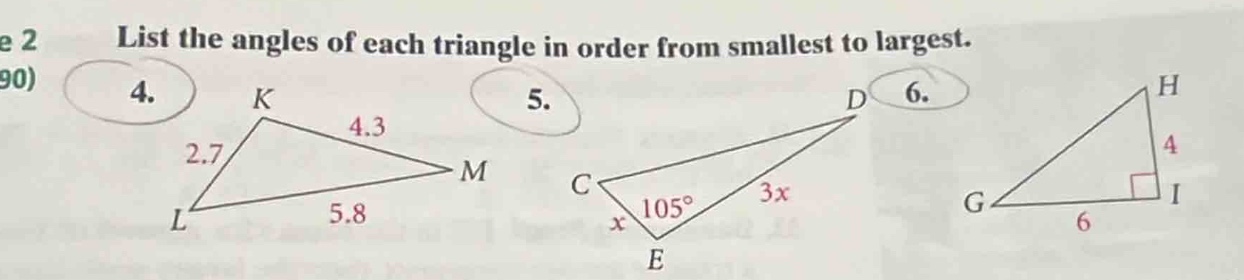
e 2 list the angles of each triangle in order from smallest to largest. 90) 4. 5. 6.
Problem 4: Triangle \( \triangle KLM \) with sides \( KL = 2.7 \), \( KM = 4.3 \), \( LM = 5.8 \)
Step 1: Recall the relationship between side lengths and angles in a triangle
In a triangle, the larger the side length, the larger the angle opposite to it. So we first identify the sides and their opposite angles.
- Side \( KL = 2.7 \) is opposite angle \( \angle M \)
- Side \( KM = 4.3 \) is opposite angle \( \angle L \)
- Side \( LM = 5.8 \) is opposite angle \( \angle K \)
Step 2: Order the sides from shortest to longest
The side lengths are \( 2.7 < 4.3 < 5.8 \), so \( KL < KM < LM \)
Step 3: Order the angles opposite these sides
Since the side opposite \( \angle M \) is \( KL = 2.7 \) (shortest), \( \angle M \) is the smallest. The side opposite \( \angle L \) is \( KM = 4.3 \), so \( \angle L \) is next. The side opposite \( \angle K \) is \( LM = 5.8 \) (longest), so \( \angle K \) is the largest.
So the order of angles from smallest to largest is \( \angle M < \angle L < \angle K \)
Step 1: Recall the angle - sum property of a triangle
The sum of angles in a triangle is \( 180^\circ \). Let \( \angle C=x \), \( \angle D = 3x \) and \( \angle E=105^\circ \)
So \( x + 3x+105^\circ=180^\circ \)
Step 2: Solve for \( x \)
Combine like terms: \( 4x+105^\circ = 180^\circ \)
Subtract \( 105^\circ \) from both sides: \( 4x=180^\circ - 105^\circ=75^\circ \)
Divide both sides by 4: \( x=\frac{75^\circ}{4} = 18.75^\circ \)
Then \( 3x=3\times18.75^\circ = 56.25^\circ \)
Step 3: Order the angles
We have \( \angle C=x = 18.75^\circ \), \( \angle D = 3x=56.25^\circ \), \( \angle E = 105^\circ \)
So the order from smallest to largest is \( \angle C<\angle D<\angle E \)
Step 1: Recall the Pythagorean theorem to find the third side (optional, but we can use side - angle relationship)
First, find the length of \( GH \) using Pythagorean theorem: \( GH=\sqrt{GI^{2}+HI^{2}}=\sqrt{6^{2} + 4^{2}}=\sqrt{36 + 16}=\sqrt{52}\approx7.21 \)
Now, identify the sides and their opposite angles:
- Side \( HI = 4 \) is opposite \( \angle G \)
- Side \( GI = 6 \) is opposite \( \angle H \)
- Side \( GH\approx7.21 \) is opposite \( \angle I = 90^\circ \)
Step 2: Order the sides from shortest to longest
\( 4<6 < 7.21 \), so \( HI The side opposite \( \angle G \) is \( HI = 4 \) (shortest), so \( \angle G \) is the smallest. The side opposite \( \angle H \) is \( GI = 6 \), so \( \angle H \) is next. The side opposite \( \angle I \) is \( GH\approx7.21 \) (longest) and \( \angle I = 90^\circ \) is the largest.Step 3: Order the angles opposite these sides
So the order of angles from smallest to largest is \( \angle G<\angle H<\angle I \)

Snap & solve any problem in the app
Get step-by-step solutions on Sovi AI
Photo-based solutions with guided steps
Explore more problems and detailed explanations
\( \angle M, \angle L, \angle K \)