QUESTION IMAGE
Question
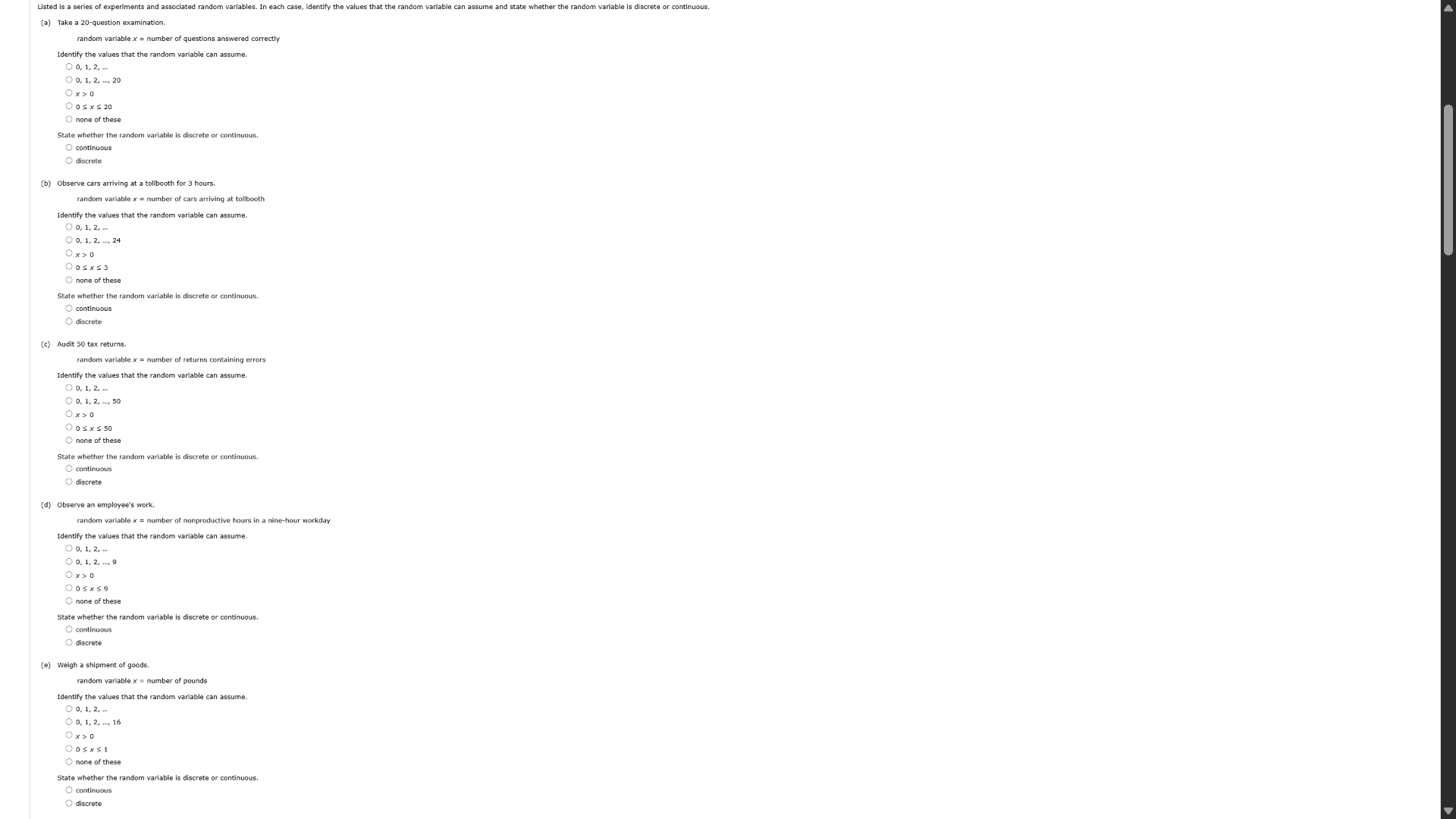
listed is a series of experiments and associated random variables. in each case, identify the values that the random variable can assume and state whether the random variable is discrete or continuous.
(a) take a 20 - question examination.
random variable ( x = ) number of questions answered correctly
identify the values that the random variable can assume.
( \bigcirc ) 0, 1, 2, ...
( \bigcirc ) 0, 1, 2, ..., 20
( \bigcirc ) ( x > 0 )
( \bigcirc ) ( 0 leq x leq 20 )
( \bigcirc ) none of these
state whether the random variable is discrete or continuous.
( \bigcirc ) continuous
( \bigcirc ) discrete
(b) observe cars arriving at a tollbooth for 3 hours.
random variable ( x = ) number of cars arriving at tollbooth
identify the values that the random variable can assume.
( \bigcirc ) 0, 1, 2, ...
( \bigcirc ) 0, 1, 2, ..., 24
( \bigcirc ) ( x > 0 )
( \bigcirc ) ( 0 leq x leq 3 )
( \bigcirc ) none of these
state whether the random variable is discrete or continuous.
( \bigcirc ) continuous
( \bigcirc ) discrete
(c) audit 50 tax returns.
random variable ( x = ) number of returns containing errors
identify the values that the random variable can assume.
( \bigcirc ) 0, 1, 2, ...
( \bigcirc ) 0, 1, 2, ..., 50
( \bigcirc ) ( x > 0 )
( \bigcirc ) ( 0 leq x leq 50 )
( \bigcirc ) none of these
state whether the random variable is discrete or continuous.
( \bigcirc ) continuous
( \bigcirc ) discrete
(d) observe an employees work.
random variable ( x = ) number of nonproductive hours in a nine - hour workday
identify the values that the random variable can assume.
( \bigcirc ) 0, 1, 2, ...
( \bigcirc ) 0, 1, 2, ..., 9
( \bigcirc ) ( x > 0 )
( \bigcirc ) ( 0 leq x leq 9 )
( \bigcirc ) none of these
state whether the random variable is discrete or continuous.
( \bigcirc ) continuous
( \bigcirc ) discrete
(e) weigh a shipment of goods.
random variable ( x = ) number of pounds
identify the values that the random variable can assume.
( \bigcirc ) 0, 1, 2, ...
( \bigcirc ) 0, 1, 2, ..., 16
( \bigcirc ) ( x > 0 )
( \bigcirc ) ( 0 leq x leq 1 )
( \bigcirc ) none of these
state whether the random variable is discrete or continuous.
( \bigcirc ) continuous
( \bigcirc ) discrete
Part (a)
Identify the values:
The exam has 20 questions, so the number of correct answers \( x \) can be 0, 1, 2, ..., up to 20. So the correct option is "0, 1, 2, ..., 20".
Discrete or Continuous:
The number of questions answered correctly is a count (whole numbers), so it's discrete.
Part (b)
Identify the values:
The number of cars arriving can be 0, 1, 2, ... (there's no upper limit in theory for the number of cars in 3 hours), so the correct option is "0, 1, 2, ...".
Discrete or Continuous:
The number of cars is a count (whole numbers), so it's discrete.
Part (c)
Identify the values:
We are auditing 50 tax returns, so the number of returns with errors \( x \) can be 0, 1, 2, ..., up to 50. So the correct option is "0, 1, 2, ..., 50".
Discrete or Continuous:
The number of returns with errors is a count (whole numbers), so it's discrete.
Part (d)
Identify the values:
The number of nonproductive hours in a 9 - hour workday can be any real number between 0 and 9 (e.g., 2.5 hours), so the correct option is " \( 0\leq x\leq9 \)".
Discrete or Continuous:
Since the number of hours can be a non - whole number (continuous measurement), it's continuous.
Part (e)
Identify the values:
The weight of a shipment in pounds can be any positive real number (e.g., 2.3 pounds, 5.7 pounds), so the correct option is " \( x > 0 \)".
Discrete or Continuous:
Weight is a continuous measurement (can take any value in an interval), so it's continuous.

Snap & solve any problem in the app
Get step-by-step solutions on Sovi AI
Photo-based solutions with guided steps
Explore more problems and detailed explanations
s:
(a) Values: 0, 1, 2, ..., 20; Type: discrete
(b) Values: 0, 1, 2, ...; Type: discrete
(c) Values: 0, 1, 2, ..., 50; Type: discrete
(d) Values: \( 0\leq x\leq9 \); Type: continuous
(e) Values: \( x > 0 \); Type: continuous