QUESTION IMAGE
Question
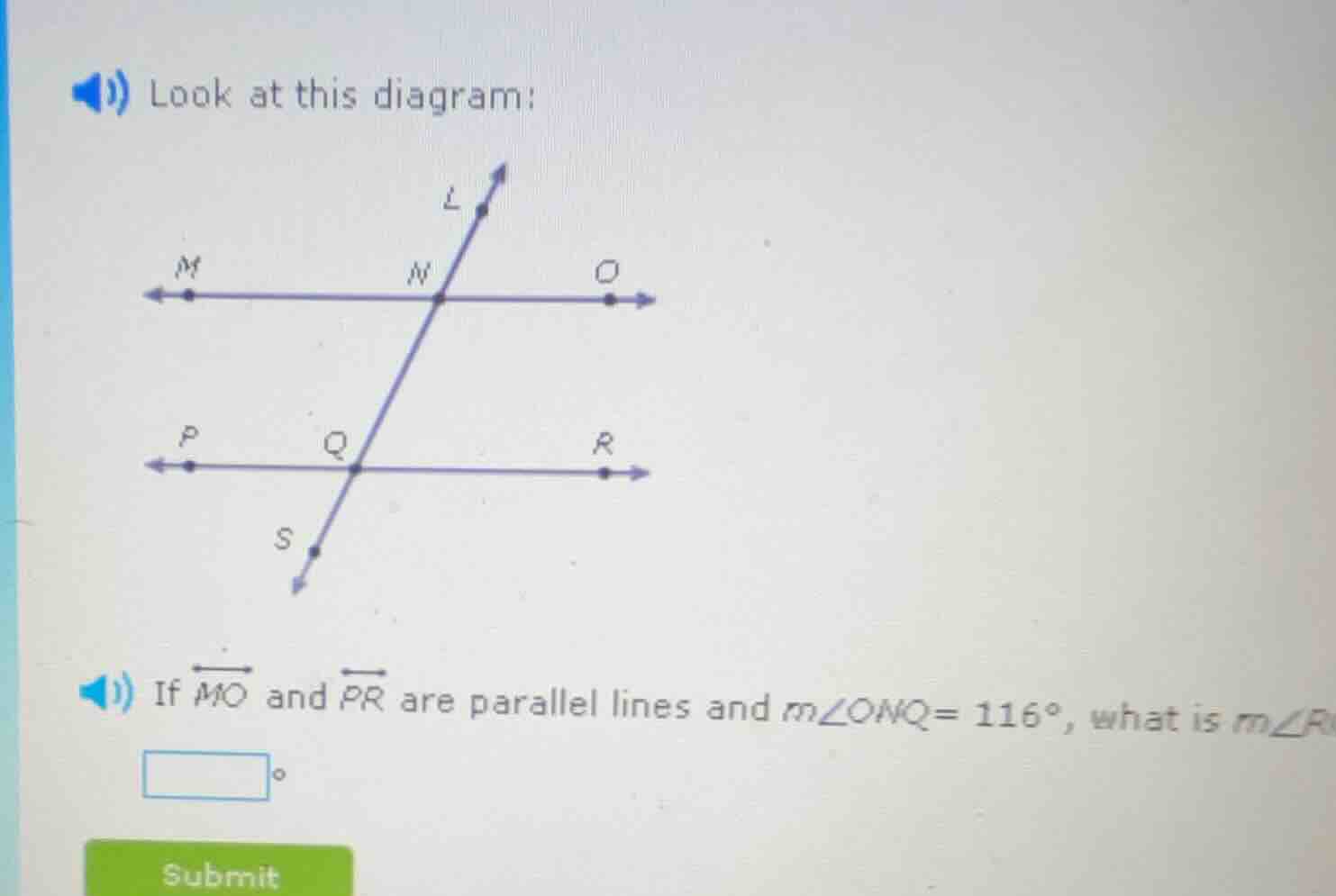
look at this diagram: if \\(\overleftrightarrow{mo}\\) and \\(\overleftrightarrow{pr}\\) are parallel lines and \\(m\angle onq = 116^\circ\\), what is \\(m\angle r\\) \\(\square^\circ\\)
Step1: Identify the relationship between angles
Since \( \overleftrightarrow{MO} \) and \( \overleftrightarrow{PR} \) are parallel lines, and \( \angle ONQ \) and \( \angle RQS \) (or the corresponding angle to \( \angle R \)'s adjacent angle) are same - side interior angles? Wait, actually, \( \angle ONQ \) and \( \angle RQS \) are same - side interior angles? No, wait, \( \angle ONQ \) and \( \angle RQS \) are same - side interior angles? Wait, no, \( \angle ONQ \) and \( \angle RQS \) are same - side interior angles? Wait, actually, \( \angle ONQ \) and \( \angle RQS \) are same - side interior angles? Wait, no, let's correct. Since \( MO\parallel PR \) and the transversal is \( LS \), \( \angle ONQ \) and \( \angle RQS \) are same - side interior angles? Wait, no, \( \angle ONQ \) and \( \angle RQS \) are same - side interior angles? Wait, actually, \( \angle ONQ \) and \( \angle RQS \) are same - side interior angles? Wait, no, the sum of same - side interior angles is \( 180^{\circ} \). Wait, but maybe \( \angle ONQ \) and \( \angle RQS \) are same - side interior angles. Wait, let's see, \( MO\parallel PR \), transversal \( LS \). So \( \angle ONQ \) and \( \angle RQS \) are same - side interior angles, so \( m\angle ONQ + m\angle RQS=180^{\circ} \)? Wait, no, maybe \( \angle ONQ \) and \( \angle RQS \) are same - side interior angles. Wait, but the question is about \( m\angle R \)? Wait, maybe there is a typo, and the angle is \( \angle RQS \) or \( \angle RQN \)? Wait, the original question says "what is \( m\angle R \)"? Wait, maybe it's \( m\angle RQS \) or \( m\angle RQN \). Wait, assuming that the angle we need to find is supplementary to \( \angle ONQ \) because they are same - side interior angles. Since \( MO\parallel PR \), and the transversal is \( LS \), \( \angle ONQ \) and \( \angle RQS \) (or the angle at \( Q \) on the line \( PR \)) are same - side interior angles. So \( m\angle ONQ + m\angle RQS = 180^{\circ} \).
Step2: Calculate the measure of the angle
Given \( m\angle ONQ = 116^{\circ} \), then \( m\angle RQS=180^{\circ}- 116^{\circ}=64^{\circ} \). Wait, maybe the angle we need to find is \( \angle RQS \) (assuming the question has a typo and the angle is \( \angle RQS \) instead of \( \angle R \)). So we use the property of parallel lines: same - side interior angles are supplementary.
So \( m\angle\text{required angle}=180^{\circ}-116^{\circ} = 64^{\circ} \)

Snap & solve any problem in the app
Get step-by-step solutions on Sovi AI
Photo-based solutions with guided steps
Explore more problems and detailed explanations
\( 64 \)