QUESTION IMAGE
Question
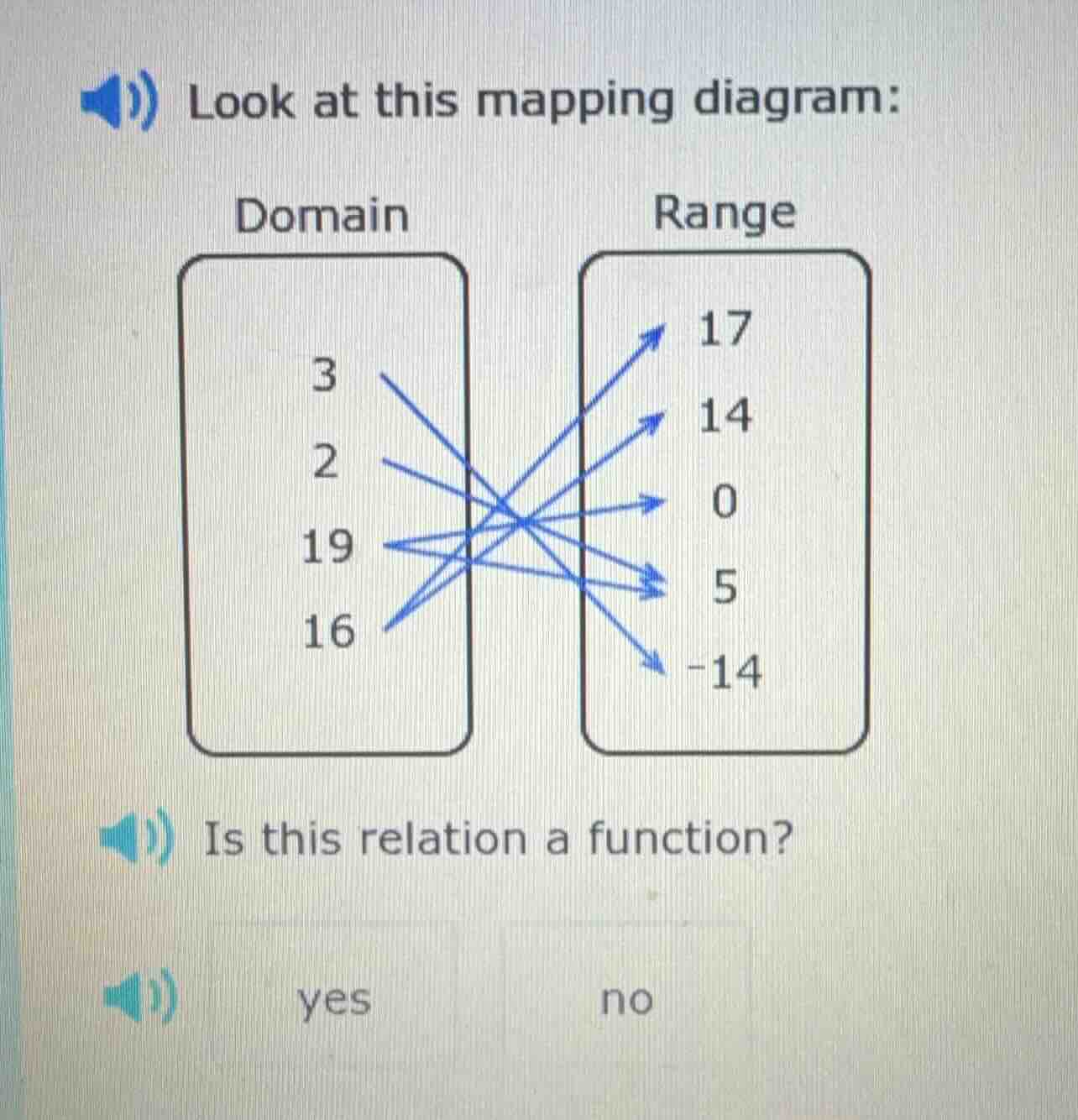
look at this mapping diagram:
domain elements: 3, 2, 19, 16; range elements: 17, 14, 0, 5, -14
is this relation a function?
options: yes, no
Step1: Recall the definition of a function
A function is a relation where each element in the domain is paired with exactly one element in the range.
Step2: Check each domain element
- For domain element 3: Check its mappings. If it maps to only one range element, proceed.
- For domain element 2: Check its mappings. If it maps to only one range element, proceed.
- For domain element 19: Check its mappings. If it maps to only one range element, proceed.
- For domain element 16: Check its mappings. If it maps to only one range element, proceed. Wait, but looking at the diagram, each domain element (3, 2, 19, 16) is connected to multiple range elements? Wait no, wait the definition: Wait, no, in a function, each domain element must have exactly one range element. Wait, let's check again. Wait the domain has 3, 2, 19, 16. Let's see: Does 3 map to more than one? Let's check the arrows. If 3 is connected to multiple range values, then it's not a function. Wait, the problem is: in the mapping diagram, if any domain element has more than one arrow (i.e., maps to more than one range element), then it's not a function. Looking at the diagram, each domain element (3, 2, 19, 16) has multiple arrows? Wait no, wait maybe I misread. Wait, no, let's think again. Wait the domain elements are 3, 2, 19, 16. Let's check each:
- 3: How many arrows? If it has more than one, then not a function.
- 2: How many arrows?
- 19: How many arrows?
- 16: How many arrows?
Wait, the key is: A function requires that each input (domain element) has exactly one output (range element). So if any domain element is mapped to more than one range element, then it's not a function. Looking at the diagram, it seems that each domain element is connected to multiple range elements? Wait, no, maybe the diagram is such that each domain element has only one arrow? Wait, no, the user's diagram: let's parse the mapping. Wait the domain is {3,2,19,16}, range is {17,14,0,5,-14}. Now, if, for example, 3 is connected to more than one range value, then it's not a function. So let's check:
Wait, the problem is to determine if the relation is a function. The definition of a function is that every element in the domain has exactly one corresponding element in the range (i.e., each x in domain has exactly one y in range). So if any x in domain has more than one y, then it's not a function.
Looking at the mapping diagram, let's see:
- Domain element 3: How many arrows? Let's see the blue arrows. If 3 is connected to multiple range values (like 17, 14, etc.? No, wait maybe I misinterpret. Wait, maybe the diagram is such that each domain element has only one arrow? Wait, no, the way the arrows are drawn, it looks like each domain element is connected to multiple range elements. Wait, but maybe I'm wrong. Wait, no, let's think again. Wait, the domain has 4 elements: 3, 2, 19, 16. The range has 5 elements: 17,14,0,5,-14. Now, if, for example, 3 is mapped to more than one range element, then it's not a function. So let's check:
Wait, the answer is no, because a function requires each domain element to have exactly one range element. Since in the mapping diagram, at least one domain element (maybe 3, 2, 19, or 16) is connected to more than one range element, so the relation is not a function.

Snap & solve any problem in the app
Get step-by-step solutions on Sovi AI
Photo-based solutions with guided steps
Explore more problems and detailed explanations
no