QUESTION IMAGE
Question
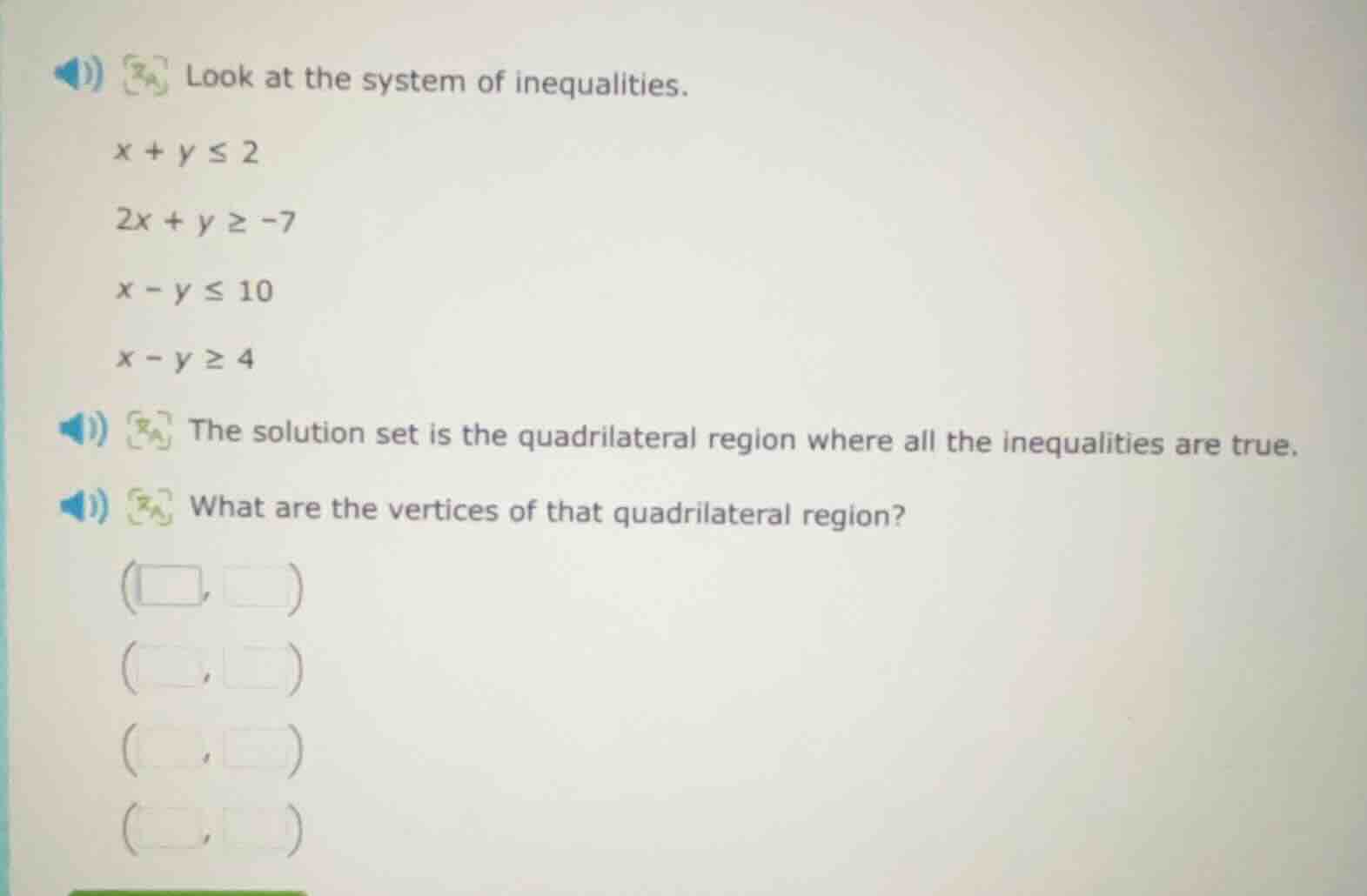
look at the system of inequalities.
$x + y \leq 2$
$2x + y \geq -7$
$x - y \leq 10$
$x - y \geq 4$
the solution set is the quadrilateral region where all the inequalities are true.
what are the vertices of that quadrilateral region?
$(\square, \square)$
$(\square, \square)$
$(\square, \square)$
$(\square, \square)$
To find the vertices of the quadrilateral region defined by the system of inequalities, we need to find the intersection points of the boundary lines of each pair of inequalities. The boundary lines are:
- \( x + y = 2 \)
- \( 2x + y = -7 \)
- \( x - y = 10 \)
- \( x - y = 4 \)
We will solve the following systems of equations to find the intersection points:
Step 1: Intersection of \( x + y = 2 \) and \( x - y = 4 \)
Add the two equations:
\[
\]
Substitute \( x = 3 \) into \( x + y = 2 \):
\[
3 + y = 2 \implies y = -1
\]
So, the intersection point is \( (3, -1) \).
Step 2: Intersection of \( x + y = 2 \) and \( x - y = 10 \)
Add the two equations:
\[
\]
Substitute \( x = 6 \) into \( x + y = 2 \):
\[
6 + y = 2 \implies y = -4
\]
So, the intersection point is \( (6, -4) \).
Step 3: Intersection of \( 2x + y = -7 \) and \( x - y = 10 \)
Add the two equations:
\[
\]
Substitute \( x = 1 \) into \( x - y = 10 \):
\[
1 - y = 10 \implies y = -9
\]
So, the intersection point is \( (1, -9) \).
Step 4: Intersection of \( 2x + y = -7 \) and \( x - y = 4 \)
Add the two equations:
\[
\]
Substitute \( x = -1 \) into \( x - y = 4 \):
\[
-1 - y = 4 \implies y = -5
\]
So, the intersection point is \( (-1, -5) \).

Snap & solve any problem in the app
Get step-by-step solutions on Sovi AI
Photo-based solutions with guided steps
Explore more problems and detailed explanations
The vertices of the quadrilateral region are:
\( (3, -1) \)
\( (6, -4) \)
\( (1, -9) \)
\( (-1, -5) \)