QUESTION IMAGE
Question
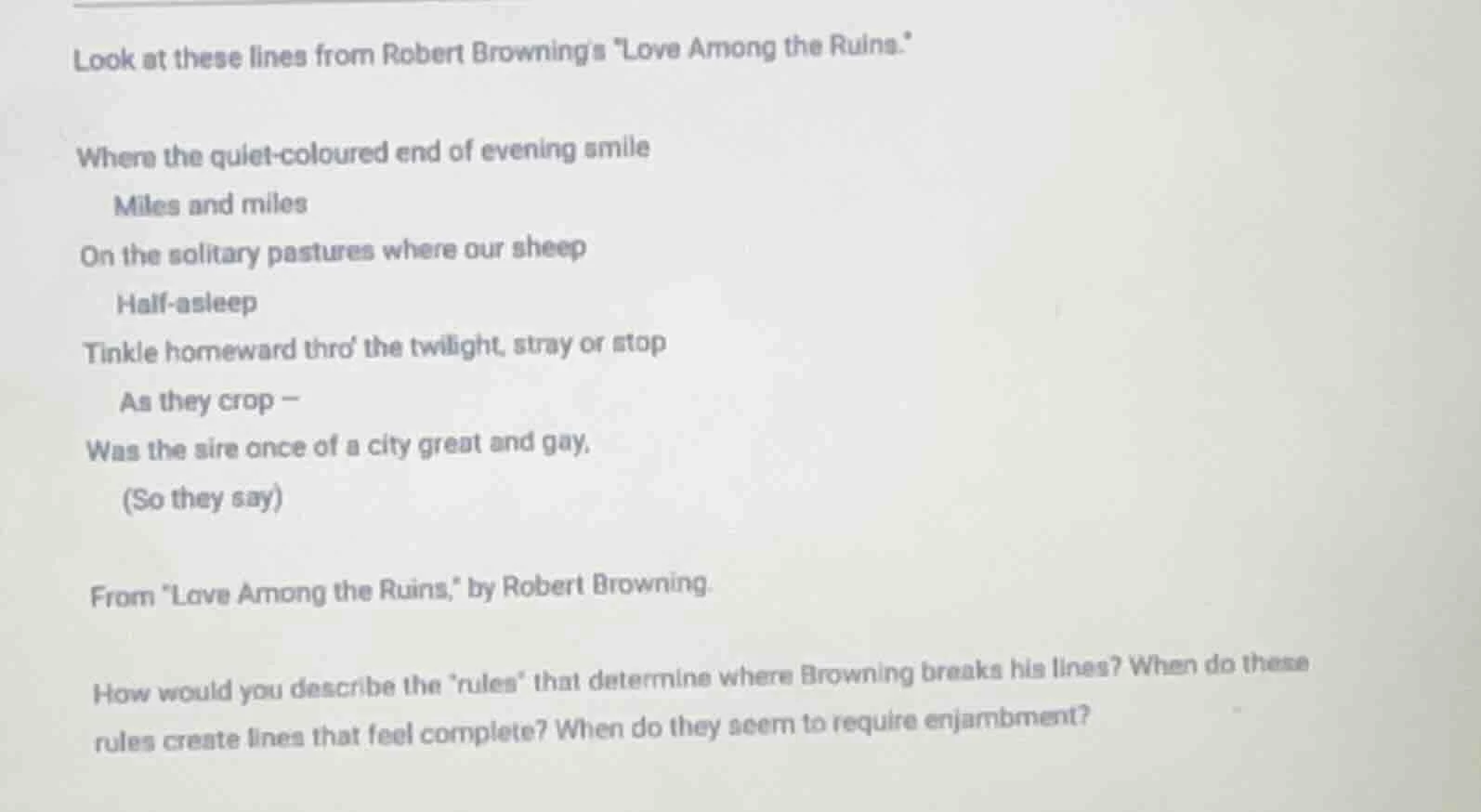
look at these lines from robert browning’s “love among the ruins.”
where the quiet - coloured end of evening smile
miles and miles
on the solitary pastures where our sheep
half - asleep
tinkle homeward thro’ the twilight, stray or stop
as they crop -
was the sire once of a city great and gay,
(so they say)
from “love among the ruins,” by robert browning.
how would you describe the “rules” that determine where browning breaks his lines? when do these rules create lines that feel complete? when do they seem to require enjambment?
Brief Explanations
- The line breaks prioritize rhythmic cadence and the pacing of the pastoral scene, aligning with the poem's gentle, meandering tone.
- Complete lines are short, self-sustaining phrases that deliver a full, small sensory or conceptual detail, creating a sense of pause and emphasis.
- Enjambment is used for continuous, flowing actions or clauses that require the next line to finish the logical or descriptive thought, maintaining the forward momentum of the scene's narrative.

Snap & solve any problem in the app
Get step-by-step solutions on Sovi AI
Photo-based solutions with guided steps
Explore more problems and detailed explanations
- Browning's line breaks follow rhythmic and syntactic "rules": he splits lines to emphasize breath, rhythm, and fragmented imagery, often breaking after short phrases or single words to mirror the quiet, meandering pace of the pastoral scene.
- Lines feel complete when they form a self-contained phrase or convey a full small idea: e.g., "Miles and miles" or "Half-asleep" stand alone as complete, evocative units that capture a distinct detail or pause.
- Enjambment occurs when a sentence or logical phrase spills across line breaks: e.g., "Where the quiet-coloured end of evening smile / Miles and miles" and "Tinkle homeward thro' the twilight, stray or stop / As they crop –" use enjambment to maintain the flow of the descriptive action, forcing the reader to carry the thought to the next line to grasp the full meaning.