QUESTION IMAGE
Question
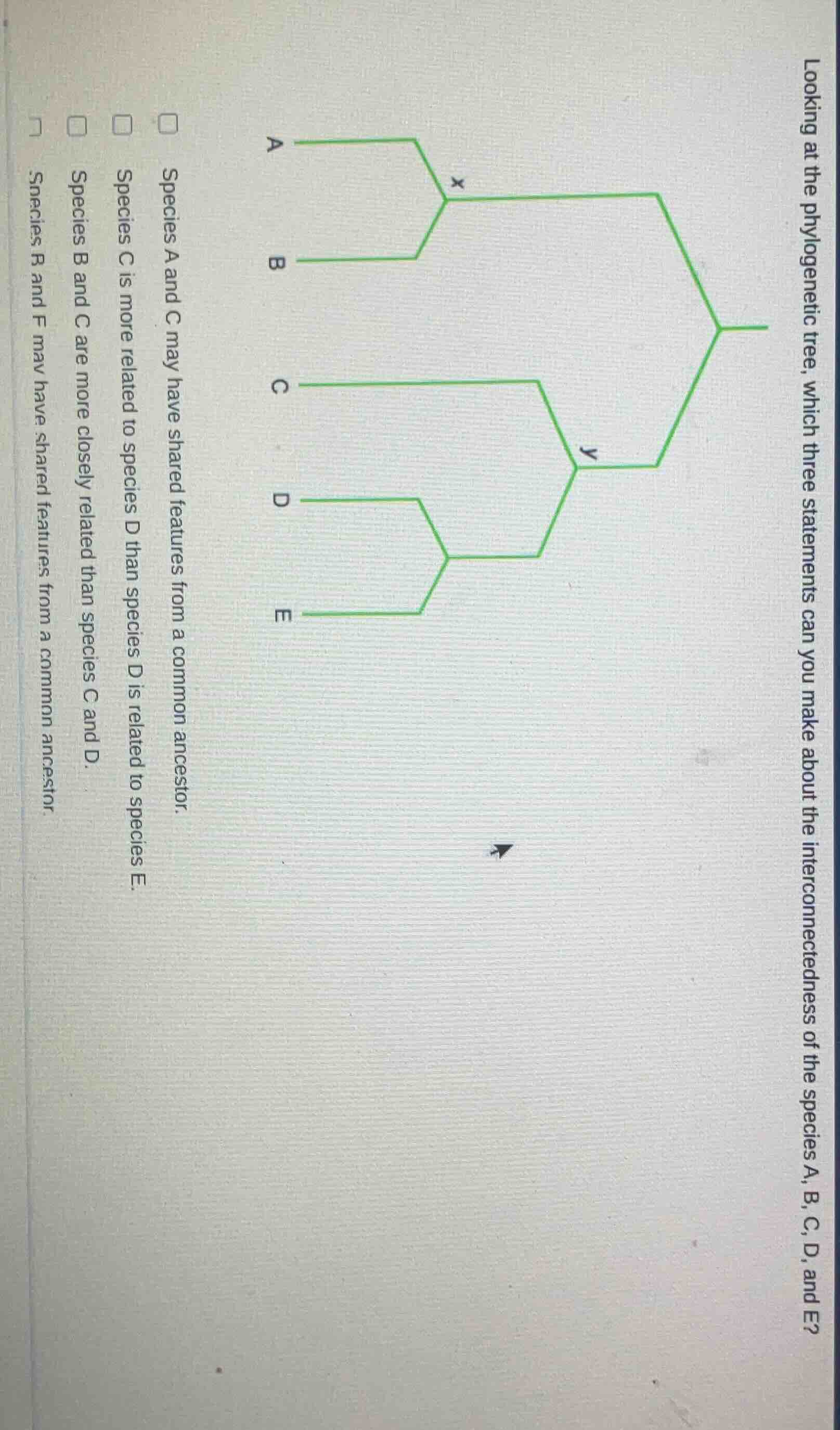
looking at the phylogenetic tree, which three statements can you make about the interconnectedness of the species a, b, c, d, and e?
species a and c may have shared features from a common ancestor.
species c is more related to species d than species d is related to species e.
species b and c are more closely related than species c and d.
species b and f may have shared features from a common ancestor.
- For "Species A and C may have shared features from a common ancestor":
- In a phylogenetic tree, species that share a more recent common ancestor (or a common ancestor further back in the tree) can inherit shared features. Species A and C, while not in the same immediate branch, still share the overall root ancestor of the tree, so they may have shared features from a common ancestor.
- For "Species B and C are more closely related than species C and D":
- Looking at the tree, species B is in branch x, and species C is in a different branch (y) that is more distantly related to x than the relationship between C and D (D is in the same larger branch as C, under y). So the distance between B and C (across x and y) is greater than between C and D (under y), so this statement is false.
- For "Species C is more related to species D than species D is related to species E":
- Species D and E are in the same immediate branch (they share a very recent common ancestor), while C is in a branch that connects to D's branch at a higher node (y). So D and E are more closely related than C and D, so this statement is false.
- For "Species B and F may have shared features from a common ancestor":
- Since F is not shown in the tree, we can't be sure, but if we assume F is part of the larger tree, all species share the ultimate common ancestor of the tree, so they may have shared features from a common ancestor. But among the given, the first statement about A and C is more directly supported by the tree's structure (shared common ancestor at the root or higher nodes).

Snap & solve any problem in the app
Get step-by-step solutions on Sovi AI
Photo-based solutions with guided steps
Explore more problems and detailed explanations
The valid statement is: "Species A and C may have shared features from a common ancestor" (along with an analysis of why the others are invalid as above, but the key valid one is this first statement about A and C sharing features from a common ancestor). If we consider the options (assuming the checkboxes are for these statements), the correct one is the first: "Species A and C may have shared features from a common ancestor".