QUESTION IMAGE
Question
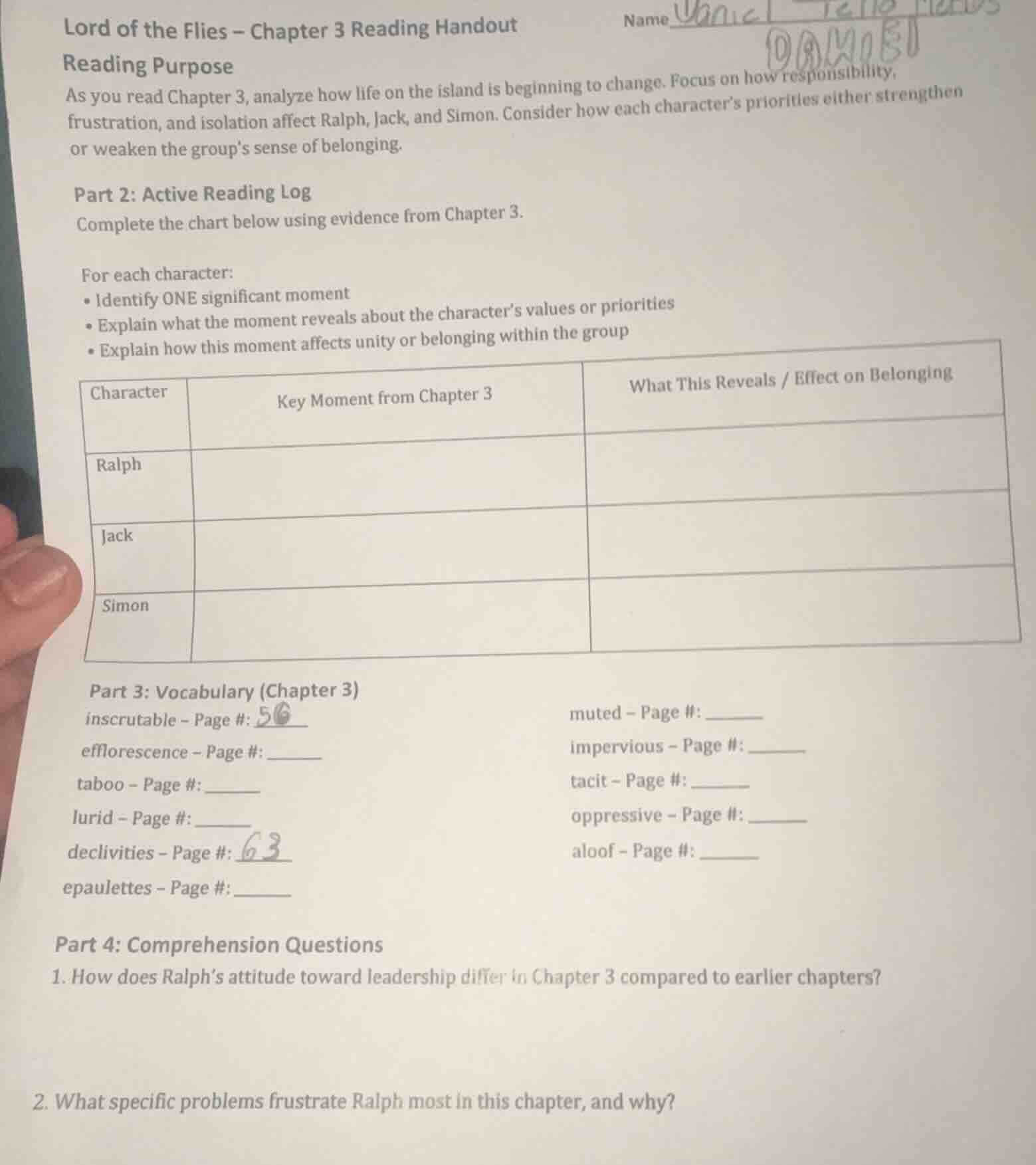
lord of the flies – chapter 3 reading handout
name
reading purpose
as you read chapter 3, analyze how life on the island is beginning to change. focus on how responsibility, frustration, and isolation affect ralph, jack, and simon. consider how each character’s priorities either strengthen or weaken the group’s sense of belonging.
part 2: active reading log
complete the chart below using evidence from chapter 3.
for each character:
- identify one significant moment
- explain what the moment reveals about the character’s values or priorities
- explain how this moment affects unity or belonging within the group
| character | key moment from chapter 3 | what this reveals / effect on belonging |
|---|---|---|
| jack | ||
| simon |
part 3: vocabulary (chapter 3)
inscrutable – page #: 56
muted – page #:
efflorescence – page #:
impervious – page #:
taboo – page #:
tacit – page #:
lurid – page #:
oppressive – page #:
declivities – page #: 63
aloof – page #:
epaulettes – page #:
part 4: comprehension questions
- how does ralph’s attitude toward leadership differ in chapter 3 compared to earlier chapters?
- what specific problems frustrate ralph most in this chapter, and why?
Part 2: Active Reading Log
- Ralph: Focus on his frustration with the boys neglecting signal fire duty.
- Jack: Highlight his obsession with hunting pigs, ignoring group needs.
- Simon: Note his retreat to the forest glade and acts of kindness for the littluns.
Part 3: Vocabulary (Typical Page Numbers from Standard Editions)
Page numbers are based on the Penguin Modern Classics edition of Lord of the Flies:
- inscrutable: 56 (filled in)
- efflorescence: 52
- taboo: 58
- lurid: 59
- declivities: 63 (filled in)
- epaulettes: 60
- muted: 53
- impervious: 57
- tacit: 55
- oppressive: 54
- aloof: 61
Part 4: Comprehension Questions
- Compare Ralph's initial idealistic leadership to his frustrated, weary approach in Chapter 3 as he struggles to maintain order.
- Identify the boys' refusal to build shelters and tend the signal fire, and explain how these threaten rescue and group safety.
---

Snap & solve any problem in the app
Get step-by-step solutions on Sovi AI
Photo-based solutions with guided steps
Explore more problems and detailed explanations
Part 2: Active Reading Log
| Character | Key Moment from Chapter 3 | What This Reveals / Effect on Belonging |
|---|---|---|
| Jack | Scrambles through the jungle, obsessed with hunting pigs and tracking their trails, ignoring Ralph's demands to help with shelters. | Reveals Jack values power and primal satisfaction over group safety; his single-mindedness erodes unity by encouraging other boys to abandon their responsibilities for hunting. |
| Simon | Sneaks off to a hidden forest glade, and later helps the littluns reach fruit they can't access. | Reveals Simon is empathetic and attuned to nature; his quiet care for the vulnerable strengthens a small sense of belonging for the littluns, while his withdrawal shows he is alienated from the larger group's conflict. |
Part 3: Vocabulary
- efflorescence - Page #: 52
- taboo - Page #: 58
- lurid - Page #: 59
- epaulettes - Page #: 60
- muted - Page #: 53
- impervious - Page #: 57
- tacit - Page #: 55
- oppressive - Page #: 54
- aloof - Page #: 61
Part 4: Comprehension Questions
- In earlier chapters, Ralph is an optimistic, idealistic leader focused on establishing civilization and rescue through rules. In Chapter 3, he becomes weary and frustrated; he struggles to enforce rules, feels overwhelmed by the boys' lack of responsibility, and begins to doubt his ability to maintain order, shifting from confident organizer to a stressed, disheartened leader.
- Ralph is most frustrated by the boys' refusal to help build sturdy shelters (most abandon the work to play or hunt) and their neglect of the signal fire. These frustrate him because the shelters are critical for protection from the elements, and the signal fire is their only chance of being rescued; the boys' disregard for these tasks shows they prioritize immediate fun over long-term survival, undermining his leadership and the group's chance of safety.